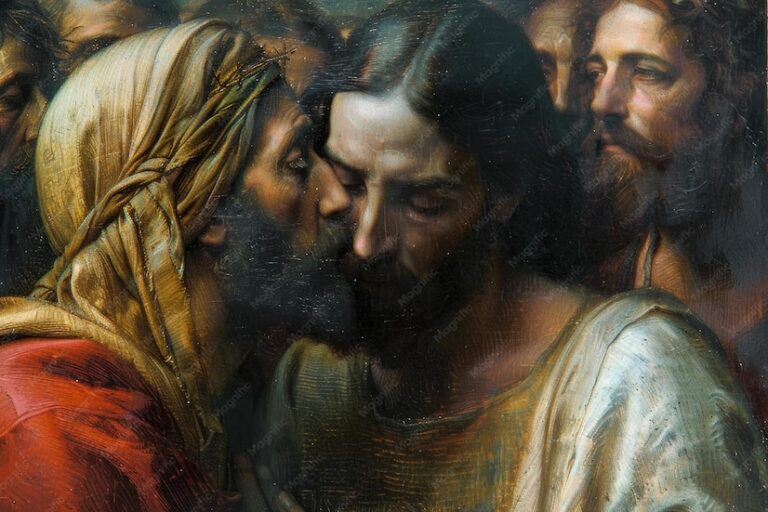
Mark 14 brings us to the moment when Jesus knows His earthly ministry is coming to its appointed hour. Betrayal is approaching, religious leaders Were Scheming To Arrest, and His disciples struggle to understand what is about to happen. Yet Jesus remains obedient to the Father. At the Passover table, He speaks of a new covenant through His blood. In Gethsemane, He prays, “Not what I will, but what you will.” Even through betrayal, suffering, denial, and judgment, God’s Redemption Plan is moving forward through Jesus Christ.
Obedience, God’s Covenant, Mercy, Salvation, Judgment, Betrayal, Teacher, It Is Written, Redemption Plan, Jesus Christ
📖 Mark 14:1-4 (NIV)
“14 Now the Passover and the Festival of Unleavened Bread were only two days away, and the chief priests and the teachers of the law were scheming to arrest Jesus secretly and kill him. 2 “But not during the festival,” they said, “or the people may riot.”
“3 While he was in Bethany, reclining at the table in the home of Simon the Leper, a woman came with an alabaster jar of very expensive perfume, made of pure nard. She broke the jar and poured the perfume on his head.”
“4 Some of those present were saying indignantly to one another, “Why this waste of perfume?”
The story of Mark 14 is not simply about the arrest of Jesus.
It is about obedience in the face of suffering.
Judas chose betrayal.
The disciples promised they would never abandon Him, yet Jesus knew they would scatter.
Peter believed he was strong enough to remain faithful, but before the night was over, he would deny knowing Jesus three times.
Still, Jesus continued forward.
At the Passover meal, Jesus took the bread and cup and connected them to what was coming.
His body would be given, and His blood would be poured out for many.
This points directly toward God’s Covenant and the Redemption Plan.
In Gethsemane, Jesus faced the suffering before Him and prayed to His Father. He did not hide His sorrow.
He did not pretend the coming cross would be easy. Yet He surrendered His will to the Father.
Even when betrayed, falsely accused, beaten, and abandoned, Jesus remained obedient.
And through that obedience, salvation was coming.
📖 Mark 14:5-11 (NIV)
:“5 It could have been sold for more than a year’s wages[a] and the money given to the poor.” And they rebuked her harshly.”
:6 “Leave her alone,” said Jesus. “Why are you bothering her? She has done a beautiful thing to me. 7 The poor you will always have with you,[b] and you can help them any time you want. But you will not always have me. 8 She did what she could. She poured perfume on my body beforehand to prepare for my burial. 9 Truly I tell you, wherever the gospel is preached throughout the world, what she has done will also be told, in memory of her.””
“10 Then Judas Iscariot, one of the Twelve, went to the chief priests to betray Jesus to them. 11 They were delighted to hear this and promised to give him money. So he watched for an opportunity to hand him over.”
Jesus knew what was waiting for Him.
His disciples would scatter. He knew Peter would deny Him.
Knew the religious leaders were seeking His death.
Yet Jesus did not run from God’s purpose.
In Gethsemane He prayed:
“Yet not what I will, but what you will.”
This is obedience at its deepest level.
Jesus was not saying that He wanted the suffering.
He was surrendering Himself completely to the Father.
There are times when obedience to God does not mean choosing the easiest road.
Sometimes obedience means continuing forward when we know the road will be difficult.
Jesus shows us that obedience is not based on comfort.
It is based on trust.
📖 Mark 14:12-18 (NIV)
“12 On the first day of the Festival of Unleavened Bread, when it was customary to sacrifice the Passover lamb, Jesus’ disciples asked him, “Where do you want us to go and make preparations for you to eat the Passover?”
“13 So he sent two of his disciples, telling them, “Go into the city, and a man carrying a jar of water will meet you. Follow him. 14 Say to the owner of the house he enters, ‘The Teacher asks: Where is my guest room, where I may eat the Passover with my disciples?’ 15 He will show you a large room upstairs, furnished and ready. Make preparations for us there.”
“16 The disciples left, went into the city and found things just as Jesus had told them. So they prepared the Passover.”
“17 When evening came, Jesus arrived with the Twelve. 18 While they were reclining at the table eating, he said, “Truly I tell you, one of you will betray me—one who is eating with me.”
He took the bread and said it represented His body.
Then He took the cup and said:
“This is my blood of the covenant, which is poured out for many.”
The Covenant was moving toward fulfillment through Jesus.
The Passover itself carried the memory of God’s deliverance. Israel remembered how God had brought His people out of slavery.
Now Jesus was pointing toward something greater.
The Redemption Plan would provide deliverance from sin.
Jesus would become the sacrifice.
His blood would be poured out.
The cross was not an accident.
It was part of God’s plan.
📖 Mark 14:19-26 (NIV)
“19 They were saddened, and one by one they said to him, “Surely you don’t mean me?”
“20 “It is one of the Twelve,” he replied, “one who dips bread into the bowl with me. 21 The Son of Man will go just as it is written about him. But woe to that man who betrays the Son of Man! It would be better for him if he had not been born.”
“22 While they were eating, Jesus took bread, and when he had given thanks, he broke it and gave it to his disciples, saying, “Take it; this is my body.”
“23 Then he took a cup, and when he had given thanks, he gave it to them, and they all drank from it.”
“24 “This is my blood of the[c] covenant, which is poured out for many,” he said to them. 25 “Truly I tell you, I will not drink again from the fruit of the vine until that day when I drink it new in the kingdom of God.”
“26 When they had sung a hymn, they went out to the Mount of Olives.”
Some people considered it wasteful.
Jesus did not.
He recognized the meaning behind her actions.
She had given something valuable to honor Him.
Jesus said she had done a beautiful thing and connected her act with His coming burial.
This woman teaches us something important about mercy and devotion.
God does not measure our giving the same way people do.
People often look at the amount.
God looks at the heart.
She gave what she could.
Her act of humility became part of the Gospel story.
Jesus said what she had done would be remembered wherever the Gospel was preached.
📖 Mark 14:27-33 (NIV)
“27 “You will all fall away,” Jesus told them, “for it is written:
“‘I will strike the shepherd,
and the sheep will be scattered.’[d]
“28 But after I have risen, I will go ahead of you into Galilee.”
“29 Peter declared, “Even if all fall away, I will not.”
“30 “Truly I tell you,” Jesus answered, “today—yes, tonight—before the rooster crows twice[e] you yourself will disown me three times.”
“31 But Peter insisted emphatically, “Even if I have to die with you, I will never disown you.” And all the others said the same.”
“32 They went to a place called Gethsemane, and Jesus said to his disciples, “Sit here while I pray.” 33 He took Peter, James and John along with him, and he began to be deeply distressed and troubled. “
Judas was one of the Twelve.
He had heard His teaching.
Judas had witnessed His miracles.
Yet Judas went to the chief priests and offered to betray Jesus.
This is a difficult lesson because being physically close to Jesus does not automatically mean the heart belongs to Him.
Each person must make a choice.
Judas chose betrayal.
Peter would later choose denial.
The religious leaders chose opposition.
The crowd would eventually be influenced against Jesus.
But Jesus continued toward the cross.
Mark reminds us that human choices are real, and those choices carry consequences.
📖 Mark 14:34-40 (NIV)
“34 “My soul is overwhelmed with sorrow to the point of death,” he said to them. “Stay here and keep watch.”
“35 Going a little farther, he fell to the ground and prayed that if possible the hour might pass from him. 36 “Abba,[f] Father,” he said, “everything is possible for you. Take this cup from me. Yet not what I will, but what you will.”
“37 Then he returned to his disciples and found them sleeping. “Simon,” he said to Peter, “are you asleep? Couldn’t you keep watch for one hour? 38 Watch and pray so that you will not fall into temptation. The spirit is willing, but the flesh is weak.”
“39 Once more he went away and prayed the same thing. 40 When he came back, he again found them sleeping, because their eyes were heavy. They did not know what to say to him.”
He told His disciples:
“The Son of Man will go just as it is written about him.”
Later, when He was arrested, Jesus again explained that what was happening was connected to the Scriptures.
The arrest was not proof that God’s plan had failed.
It was evidence that the plan was moving forward.
The disciples saw an arrest.
Jesus saw fulfillment.
The religious leaders believed they were controlling events.
But God was accomplishing something much greater.
This is one of the great lessons of Scripture:
God’s purposes cannot be defeated by human plans.
📖 Mark 14:41-48 (NIV)
“41 Returning the third time, he said to them, “Are you still sleeping and resting? Enough! The hour has come. Look, the Son of Man is delivered into the hands of sinners. 42 Rise! Let us go! Here comes my betrayer!”
“43 Just as he was speaking, Judas, one of the Twelve, appeared. With him was a crowd armed with swords and clubs, sent from the chief priests, the teachers of the law, and the elders.”
“44 Now the betrayer had arranged a signal with them: “The one I kiss is the man; arrest him and lead him away under guard.” 45 Going at once to Jesus, Judas said, “Rabbi!” and kissed him. 46 The men seized Jesus and arrested him. 47 Then one of those standing near drew his sword and struck the servant of the high priest, cutting off his ear.”
“48 “Am I leading a rebellion,” said Jesus, “that you have come out with swords and clubs to capture me? “
Jesus was deeply distressed and troubled.
He fell to the ground and prayed.
He asked the Father if the cup could be taken from Him.
Then came the surrender:
“Yet not what I will, but what you will.”
Faith can exist in the middle of tremendous difficulty.
Jesus brought His pain to the Father.
Prayed.
Trusted.
He obeyed.
Meanwhile, the disciples struggled to stay awake.
Jesus told them:
“Watch and pray so that you will not fall into temptation.”
The spirit may be willing, but human weakness is real.
Jesus understood that.
📖 Mark 14:49-56 (NIV)
“49 Every day I was with you, teaching in the temple courts, and you did not arrest me. But the Scriptures must be fulfilled.” 50 Then everyone deserted him and fled.
“51 A young man, wearing nothing but a linen garment, was following Jesus. When they seized him, 52 he fled naked, leaving his garment behind.”
“53 They took Jesus to the high priest, and all the chief priests, the elders and the teachers of the law came together. 54 Peter followed him at a distance, right into the courtyard of the high priest. There he sat with the guards and warmed himself at the fire.”
“55 The chief priests and the whole Sanhedrin were looking for evidence against Jesus so that they could put him to death, but they did not find any. 56 Many testified falsely against him, but their statements did not agree.”
But Jesus already knew what would happen.
Three times Peter was asked whether he knew Jesus.
Three times he denied Him.
Then the rooster crowed.
Peter remembered the words Jesus had spoken.
And he broke down and wept.
This moment teaches us about human weakness, but it also prepares us to understand mercy.
Peter’s failure did not surprise Jesus.
Jesus knew Peter would fail before Peter failed.
Yet Peter’s story did not end in that courtyard.
Failure does not have to be the final chapter.
Peter would eventually be restored and continue serving Christ.
His tears remind us that repentance begins when we recognize the truth about ourselves.
We cannot save ourselves through perfection.
We need Jesus.
📖 Mark 14:57-72 (NIV)
“57 Then some stood up and gave this false testimony against him: 58 “We heard him say, ‘I will destroy this temple made with human hands and in three days will build another, not made with hands.’” 59 Yet even then their testimony did not agree.”
“60 Then the high priest stood up before them and asked Jesus, “Are you not going to answer? What is this testimony that these men are bringing against you?” 61 But Jesus remained silent and gave no answer.
Again the high priest asked him, “Are you the Messiah, the Son of the Blessed One?”
“62 “I am,” said Jesus. “And you will see the Son of Man sitting at the right hand of the Mighty One and coming on the clouds of heaven.”
“63 The high priest tore his clothes. “Why do we need any more witnesses?” he asked. 64 “You have heard the blasphemy. What do you think?”
They all condemned him as worthy of death. 65 Then some began to spit at him; they blindfolded him, struck him with their fists, and said, “Prophesy!” And the guards took him and beat him.”
“66 While Peter was below in the courtyard, one of the servant girls of the high priest came by. 67 When she saw Peter warming himself, she looked closely at him.
“You also were with that Nazarene, Jesus,” she said.
“68 But he denied it. “I don’t know or understand what you’re talking about,” he said, and went out into the entryway.[g]”
“69 When the servant girl saw him there, she said again to those standing around, “This fellow is one of them.” 70 Again he denied it.
After a little while, those standing near said to Peter, “Surely you are one of them, for you are a Galilean.”
“71 He began to call down curses, and he swore to them, “I don’t know this man you’re talking about.”
“72 Immediately the rooster crowed the second time.[h] Then Peter remembered the word Jesus had spoken to him: “Before the rooster crows twice[i] you will disown me three times.” And he broke down and wept.”
His disciples scattered.
Peter denied Him.
False witnesses testified against Him.
The religious leaders condemned Him.
People spit on Him and beat Him.
Yet Jesus remained faithful.
When the high priest asked Him whether He was the Messiah, Jesus answered plainly.
Jesus did not deny who He was.
He did not attempt to escape God’s purpose.
Jesus stood firm.
This is where Mark’s message becomes central to the Redemption Plan.
Humanity failed.
Jesus did not.
The disciples failed.
Jesus did not.
Peter failed.
Jesus remained faithful.
The religious leaders rejected Him.
Jesus continued toward the cross.
The perfect obedience of Jesus would become the path toward salvation for imperfect people.
Everything happening in Mark 14 may appear chaotic from a human perspective.
Betrayal.
Fear.
False testimony.
Volence.
Denial.
Abandonment.
But God’s Covenant has not failed.
Jesus knows exactly what is happening.
The Passover meal points toward the sacrifice.
Gethsemane points toward obedience.
The arrest points toward the cross.
The cross points toward resurrection.
And the resurrection will point toward salvation.
God’s Covenant does not depend upon humanity always getting everything right.
It depends upon God being faithful.
Peter failed.
Judas betrayed.
The disciples fled.
But God’s plan continued.
The Covenant stands because God stands.
Mark 14 teaches us that faith is more than words.
Peter said he would never deny Jesus.
The other disciples made similar promises.
But when pressure came, they discovered how weak they really were.
Jesus showed something different.
He prayed when He was suffering.
Jesus trusted the Father when He was afraid.
Jesus remained obedient when obedience became painful.
He forgave through mercy.
Jesus continued forward when everyone else was falling away.
This teaches us to examine our own hearts.
Are we following Jesus only when life is easy?
Do we trust Him when circumstances become difficult?
Are we willing to obey when we do not understand everything?
And when we fail, will we turn back to Him?
Peter’s tears show us that recognizing our failure can become the beginning of restoration.
Jesus does not call us because we are perfect.
He calls us because we need Him.
Mark 14 brings the Redemption Plan into sharp focus.
The Passover.
God’s covenant.
The bread.
The cup.
Judas betrayal.
Gethsemane.
Jesus arrest.
They’re false accusations.
Peter’s denial.
All of these events move toward one central person:
Jesus Christ.
Jesus is the faithful One when humanity is unfaithful.
He is obedient when others run away.
Jesus is truthful when others give false testimony.
Jesus remains committed to God’s Covenant when others abandon Him.
And He willingly moves toward the cross.
The woman poured out her valuable perfume.
Judas poured out betrayal.
Peter poured out tears.
But Jesus would pour out His blood.
That is the heart of the Redemption Plan.
Jesus Christ came to do what we could never do for ourselves.
He came to fulfill God’s Covenant.
Jesus came to give His life.
Jesus came to bring salvation.
And even when the world appeared to be taking His life away, God was using the moment to accomplish His plan to bring life to others.
The story is no longer simply about what happened to Jesus.
It is about what Jesus was doing for us.