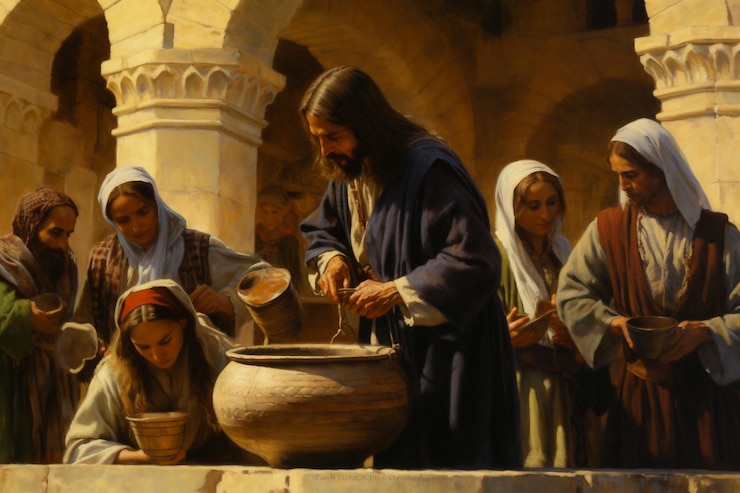
John 2 They Have No More Wine, reveals two very different sides of Jesus. At Cana, Jesus performs His first sign and reveals His glory, bringing abundance where there was need. In Jerusalem, He enters the temple with righteous zeal and confronts people who had turned His Father’s house into a marketplace. Through both events, Jesus reveals His authority, His compassion, and His knowledge of the human heart.
Obedience • God’s Covenant • Judgment • Wine • Temple • Faith • Zeal • Redemption Plan • Jesus Christ.
📖 John 2:1 (NIV)
“2 On the third day a wedding took place at Cana in Galilee. Jesus’ mother was there,”
Jesus and His disciples were invited to a wedding in Cana.
The celebration suddenly faced a problem:
There was no more wine.
Jesus’ mother brought the situation to Him. Jesus told the servants to do whatever He commanded.
Nearby were six stone jars used for ceremonial washing.
Jesus told the servants to fill them with water.
They obeyed.
When the master of the banquet tasted what had been drawn from the jars, the water had become wine.
The master was amazed that the best wine had been saved until then.
John tells us this was the first of Jesus’ signs through which He revealed His glory.
His disciples believed in Him.
Jesus then traveled to Jerusalem for Passover.
There He entered the temple courts and found people selling animals and exchanging money.
The place intended for worship had become a marketplace.
Jesus drove them out.
He overturned the tables and commanded them to stop turning His Father’s house into a market.
His disciples remembered the Scripture:
“Zeal for your house will consume me.”
When the religious leaders demanded a sign proving His authority, Jesus spoke about destroying the temple and raising it again in three days.
They misunderstood Him.
Jesus was speaking about His body.
After His resurrection, the disciples understood what He meant.
John then gives us an important final observation.
Many people saw Jesus’ signs and believed.
But Jesus did not entrust Himself to them.
Why?
He knew all people.
Jesus did not need anyone to explain humanity to Him.
He knew what was in each person.
📖 John 2:2-4 (NIV)
“2 and Jesus and his disciples had also been invited to the wedding. 3 When the wine was gone, Jesus’ mother said to him, “They have no more wine.”
“4 “Woman,[a] why do you involve me?” Jesus replied. “My hour has not yet come.”
The wedding had reached a moment of need.
There was no more wine.
Jesus did not simply solve a practical problem.
John tells us that this was a sign revealing His glory.
The water jars had been used for ceremonial washing.
Jesus used them as part of a miracle that revealed something greater about Himself.
The disciples witnessed what happened and believed in Him.
Throughout Scripture, God repeatedly takes what appears ordinary, empty, or impossible and uses it for His purposes.
At Cana, Jesus demonstrated that He has authority over creation.
He could take water and transform it.
The sign points beyond the wine.
It points toward Jesus.
When Jesus is present, what appears empty is not beyond His ability to transform.
📖 John 2:5-8 (NIV)
“5 His mother said to the servants, “Do whatever he tells you.”
“6 Nearby stood six stone water jars, the kind used by the Jews for ceremonial washing, each holding from twenty to thirty gallons.[b]”
“7 Jesus said to the servants, “Fill the jars with water”; so they filled them to the brim.”
“8 Then he told them, “Now draw some out and take it to the master of the banquet.
They did so,”
Jesus gave the servants simple instructions.
Fill the jars.
Draw some out.
Take it to the master of the banquet.
The servants did not receive an explanation of how the miracle would happen.
They simply obeyed.
Their obedience placed them in the middle of something they could not have produced themselves.
This is an important lesson about faith.
We will not always understand what God is doing before we obey.
Sometimes the next step is simply to trust His direction.
The servants did not create the miracle.
Jesus did.
But their obedience allowed them to participate in what He was doing.
Faith does not always require knowing how God will work. Sometimes it requires trusting Him enough to take the next step.
📖 John 2:9-12 (NIV)
“9 and the master of the banquet tasted the water that had been turned into wine. He did not realize where it had come from, though the servants who had drawn the water knew. Then he called the bridegroom aside 10 and said, “Everyone brings out the choice wine first and then the cheaper wine after the guests have had too much to drink; but you have saved the best till now.”
“11 What Jesus did here in Cana of Galilee was the first of the signs through which he revealed his glory; and his disciples believed in him.”
“12 After this he went down to Capernaum with his mother and brothers and his disciples. There they stayed for a few days.”
John specifically calls the miracle at Cana a sign.
A sign points somewhere.
The miracle was not merely about providing wine for a wedding.
It revealed something about Jesus.
His disciples saw His glory and believed in Him.
John’s Gospel repeatedly uses signs to help the reader understand who Jesus is.
The miracles are evidence.
They reveal authority.
Then reveal compassion.
Then reveal God’s power.
But they are never meant to become the destination.
The destination is Jesus.
The miracle points to the One who performed it.
When we see what Jesus does, we should ask the greater question: What does this reveal about who He is?
📖 John 2:13-15 (NIV)
“13 When it was almost time for the Jewish Passover, Jesus went up to Jerusalem. 14 In the temple courts he found people selling cattle, sheep and doves, and others sitting at tables exchanging money. 15 So he made a whip out of cords, and drove all from the temple courts, both sheep and cattle; he scattered the coins of the money changers and overturned their tables. “
When Jesus entered the temple, He saw something that deeply troubled Him.
The Father’s house had become a marketplace.
Jesus responded with righteous zeal.
He drove out the animals.
Jesus overturned the tables.
Jesus confronted those who had taken something intended for worship and turned it into commerce.
This was not uncontrolled anger.
It was zeal for God’s holiness.
Jesus cared about what happened in His Father’s house.
His actions demonstrated authority.
They also demonstrated that worship cannot simply become a means of personal gain.
Only God deserves reverence.
God deserves honor.
God deserves our hearts.
Jesus’ zeal reminds us that God is not merely looking at what happens outwardly—He is looking at whether our worship is genuine.
📖 John 2:16-19 (NIV)
“16 To those who sold doves he said, “Get these out of here! Stop turning my Father’s house into a market!” 17 His disciples remembered that it is written: “Zeal for your house will consume me.”[c]
“18 The Jews then responded to him, “What sign can you show us to prove your authority to do all this?”
“19 Jesus answered them, “Destroy this temple, and I will raise it again in three days.”
The religious leaders demanded a sign.
Jesus responded:
“Destroy this temple, and I will raise it again in three days.”
They thought He was talking about the physical temple.
He was talking about His body.
John explains this clearly.
The temple had taken decades to build, but Jesus was speaking about something much greater.
His body would be destroyed.
But three days later, He would rise.
The disciples did not fully understand this at the time.
After Jesus was raised from the dead, they remembered His words.
Then they believed.
This shows how Jesus’ teachings sometimes become clearer after God completes what He has promised.
The temple was a place where people encountered God, but Jesus is the greater meeting place between God and humanity.
📖 John 2:20 -25 (NIV)
“20 They replied, “It has taken forty-six years to build this temple, and you are going to raise it in three days?” 21 But the temple he had spoken of was his body. 22 After he was raised from the dead, his disciples recalled what he had said. Then they believed the scripture and the words that Jesus had spoken.”
“23 Now while he was in Jerusalem at the Passover Festival, many people saw the signs he was performing and believed in his name.[d] 24 But Jesus would not entrust himself to them, for he knew all people. 25 He did not need any testimony about mankind, for he knew what was in each person.”
John ends the chapter with a powerful statement about Jesus.
Many people saw His signs and believed in His name.
Yet Jesus did not entrust Himself to them.
Why?
Because He knew all people.
He knew what was inside them.
Jesus could see beyond words.
He could see beyond appearances.
Jesus could see beyond public declarations.
He knew the human heart.
This becomes an important theme throughout John’s Gospel.
People may impress one another.
They may hide motives from one another.
People may say one thing and believe another.
But nothing is hidden from Jesus.
That should both humble us and encourage us.
Jesus knows our failures.
He knows our weaknesses.
He knows our motives.
And He still calls us toward Him.
The One who knows everything about us is the One we can trust with everything about us.
Jesus events of John 2 are part of a much larger story.
The miracle at Cana reveals Jesus’ glory.
The cleansing of the temple reveals His authority.
His words about the temple point toward His death and resurrection.
None of this happens outside God’s plan.
The Old Testament had already established the importance of God’s house, sacrifice, worship, covenant, and redemption.
Jesus now begins revealing that God’s plan is moving toward something greater.
His physical temple points forward.
The sacrifices point forward.
The signs point forward.
Everything begins converging on Jesus Christ.
His body would become the place where the ultimate sacrifice would take place.
God’s Covenant was not being replaced by a new idea—it was moving toward its fulfillment in Jesus Christ.
Jesus can bring transformation out of situations that appear empty.
Obedience may come before understanding.
Faith requires trusting Jesus.
Miracles are signs pointing us toward Christ.
Jesus has authority over creation.
God deserves genuine worship.
Righteous zeal should never be confused with selfish anger.
We should examine whether our worship is truly centered on God.
Jesus’ body was the temple He spoke about.
His death and resurrection were part of God’s Redemption Plan.
Jesus sees beyond outward appearances.
He knows what is inside every person.
Human belief must become genuine faith.
God’s Covenant continues moving toward fulfillment through Christ.
Jesus knows us completely and still invites us to follow Him.
John 2 gives us two powerful pictures of Jesus.
At Cana, He reveals His glory through His first sign.
At the temple, He reveals His authority.
Then He speaks about something the disciples would not fully understand until after His resurrection:
His own body.
The temple would be destroyed.
But Jesus would rise.
His miracle at Cana points to His power.
The cleansing of the temple points to His authority.
The statement about the temple points directly toward the cross and resurrection.
And the final verses remind us that Jesus knows the human heart.
He knows what is hidden.
He knows our sin.
Jesus knows our motives.
Jesus knows our weakness.
And He came anyway.
The One who knows what is in each person is also the One who came to redeem each person.
Jesus transforms what is empty, cleanses what has been corrupted, and gives new life through His death and resurrection.