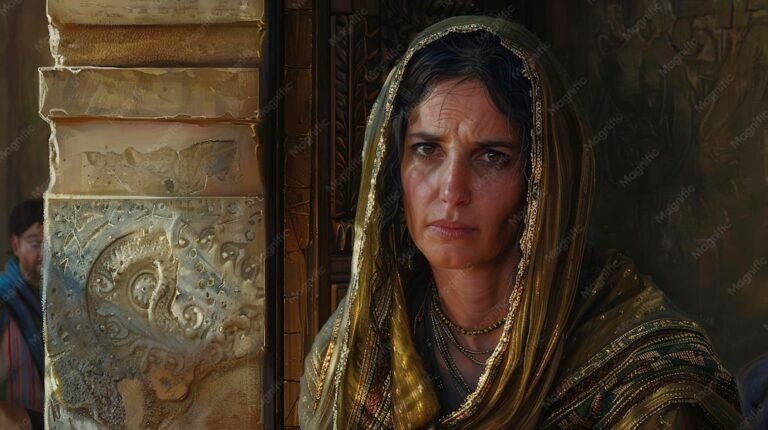
Mark 12 Then Began To Speak brings Jesus into a series of confrontations with people who want to test, trap, or challenge Him. Yet Jesus continues teaching truth with authority. Through a vineyard, a coin, a question about resurrection, the greatest commandments, warnings about pride, and a poor widow’s offering, Jesus reveals what God values. The chapter ultimately points beyond outward appearances toward faith, obedience, humility, and a heart completely surrendered to God.
Obedience, God’s Covenant, Humility, Judgment, Faith, Teachers of the Law, Parables, Redemption Plan, Jesus Christ
📖 Mark 12:1-3 (NIV)
“12 Jesus then began to speak to them in parables: “A man planted a vineyard. He put a wall around it, dug a pit for the winepress and built a watchtower. Then he rented the vineyard to some farmers and moved to another place. 2 At harvest time he sent a servant to the tenants to collect from them some of the fruit of the vineyard. 3 But they seized him, beat him and sent him away empty-handed.”
Mark 12 is another chapter in God’s Story, and Jesus is now teaching in Jerusalem as the opposition against Him continues to grow.
The son is killed, pointing toward what is about to happen to Jesus Himself.
The religious leaders continue trying to trap Jesus with questions about taxes, marriage, resurrection, and the commandments.
Each time, Jesus answers with wisdom that exposes the weakness of their thinking.
He teaches that earthly authority has its place, but God deserves what belongs to God.
He teaches that God is the God of the living and that eternal life is greater than the circumstances of this present world.
Jesus then identifies the greatest commandments: love God completely and love your neighbor as yourself.
Finally, He watches people giving offerings at the temple. Many wealthy people give large amounts, but a poor widow gives two small coins—everything she has to live on.
What appears small to people is great before God.
God looks at the heart, and every lesson continues pointing toward Jesus Christ and God’s Redemption Plan.
6 “He had one left to send, a son, whom he loved. He sent him last of all, saying, ‘They will respect my son.’”
7 “But the tenants said to one another, ‘This is the heir. Come, let’s kill him, and the inheritance will be ours.’ “
Jesus begins speaking in a parable about a vineyard.
The owner carefully prepares it, places a wall around it, builds a watchtower, and rents it to farmers.
When harvest time comes, he sends servants to collect what belongs to him.
Instead of receiving them, the tenants beat one, strike another, and kill others.
Finally, the owner sends his beloved son.
He says:
“They will respect my son.”
But the tenants see an opportunity.
They decide that if they kill the son, the inheritance will become theirs.
So they take him, kill him, and throw him out of the vineyard.
Jesus then asks what the owner will do.
The answer is judgment.
This parable carries a powerful message about God’s relationship with His people.
God had repeatedly sent His messengers and prophets.
Many were rejected.
Many were mistreated.
Yet God continued reaching out.
Finally, God sent His Son.
Jesus was telling the religious leaders that they were standing in the story.
They were rejecting the One God had sent.
The rejected stone would become the cornerstone.
Human rejection cannot cancel God’s plan.
The leaders could reject Jesus, but they could not stop God’s Redemption Plan.
📖 Mark 12:8-11 (NIV)
” 8 So they took him and killed him, and threw him out of the vineyard.”
“9 “What then will the owner of the vineyard do? He will come and kill those tenants and give the vineyard to others. 10 Haven’t you read this passage of Scripture:
“‘The stone the builders rejected
has become the cornerstone;
“11
the Lord has done this,
and it is marvelous in our eyes’[a]?”
The Pharisees and Herodians attempted to trap Jesus with a question about paying taxes to Caesar.
They thought they had created a question Jesus could not answer safely.
If He opposed the tax, they could accuse Him.
If He supported it, they could attempt to use His answer against Him.
Jesus asked for a coin.
They answered:
“Caesar’s.”
Jesus responded:
“Give back to Caesar what is Caesar’s and to God what is God’s.”
His answer went much deeper than taxes.
The coin carried Caesar’s image.
But human beings bear the image of God.
Jesus was teaching that earthly responsibilities exist, but God has a claim that is greater.
Money belongs within the proper place.
Government has its responsibilities.
But our hearts belong to God.
Peoples lives belong to God.
Our worship belongs to God.
Our obedience belongs to God.
The question is not simply what belongs in our hands. The greater question is what belongs in our hearts.
📖 Mark 12:12-16 (NIV)
“12 Then the chief priests, the teachers of the law and the elders looked for a way to arrest him because they knew he had spoken the parable against them. But they were afraid of the crowd; so they left him and went away.”
“13 Later they sent some of the Pharisees and Herodians to Jesus to catch him in his words. 14 They came to him and said, “Teacher, we know that you are a man of integrity. You aren’t swayed by others, because you pay no attention to who they are; but you teach the way of God in accordance with the truth. Is it right to pay the imperial tax[b] to Caesar or not? 15 Should we pay or shouldn’t we?”
But Jesus knew their hypocrisy. “Why are you trying to trap me?” he asked. “Bring me a denarius and let me look at it.” 16 They brought the coin, and he asked them, “Whose image is this? And whose inscription?”
“Caesar’s,” they replied.
Their purpose was to challenge the resurrection.
Jesus immediately identified the problem.
They did not understand Scripture or the power of God.
Their thinking was trapped within the limitations of earthly life.
Jesus explained that the resurrection is not simply a continuation of everything exactly as it exists now.
Then He reminded them of God’s words to Moses:
“I am the God of Abraham, the God of Isaac, and the God of Jacob.”
Jesus concluded:
“He is not the God of the dead, but of the living.”
This is an important message for anyone thinking about eternity.
We live in a temporary world.
Our bodies age.
Our possessions disappear.
Earthly relationships and circumstances change.
But God’s promises reach beyond this present life.
Eternity is not something humanity can fully understand through earthly experience alone.
We must trust the God who created life and holds eternity in His hands.
📖 Mark 12:17-23 (NIV)
“17 Then Jesus said to them, “Give back to Caesar what is Caesar’s and to God what is God’s.”
And they were amazed at him.
“18 Then the Sadducees, who say there is no resurrection, came to him with a question. 19 “Teacher,” they said, “Moses wrote for us that if a man’s brother dies and leaves a wife but no children, the man must marry the widow and raise up offspring for his brother. 20 Now there were seven brothers. The first one married and died without leaving any children. 21 The second one married the widow, but he also died, leaving no child. It was the same with the third. 22 In fact, none of the seven left any children. Last of all, the woman died too. 23 At the resurrection[c] whose wife will she be, since the seven were married to her?”
Jesus answered with extraordinary clarity.
First:
Love the Lord your God with all your heart, soul, mind, and strength.
Then:
Love your neighbor as yourself.
Jesus placed love at the center of obedience.
This does not mean that obedience becomes unnecessary.
It means genuine obedience begins with the heart.
We can follow rules while our hearts remain distant from God.
We can perform religious actions without truly loving God.
Jesus was showing that God’s commandments are not merely a collection of regulations.
They reveal God’s desire for a relationship with His people.
Love God completely.
Love people genuinely.
Serve rather than dominate.
Forgive rather than hold hatred.
Show mercy rather than pride.
When the heart is turned toward God, obedience begins to have meaning.
📖 Mark 12:24-31 (NIV)
“24 Jesus replied, “Are you not in error because you do not know the Scriptures or the power of God? 25 When the dead rise, they will neither marry nor be given in marriage; they will be like the angels in heaven. 26 Now about the dead rising—have you not read in the Book of Moses, in the account of the burning bush, how God said to him, ‘I am the God of Abraham, the God of Isaac, and the God of Jacob’[d]? 27 He is not the God of the dead, but of the living. You are badly mistaken!”
“28 One of the teachers of the law came and heard them debating. Noticing that Jesus had given them a good answer, he asked him, “Of all the commandments, which is the most important?”
“29 “The most important one,” answered Jesus, “is this: ‘Hear, O Israel: The Lord our God, the Lord is one.[e] 30 Love the Lord your God with all your heart and with all your soul and with all your mind and with all your strength.’[f] 31 The second is this: ‘Love your neighbor as yourself.’[g] There is no commandment greater than these.”
They wanted attention.
People wanted respect.
They wanted important seats and public recognition.
Their outward appearance suggested religious importance.
But Jesus saw something deeper.
He said they “devour widows’ houses” while making lengthy prayers for show.
This is a serious warning.
Religious appearance is not the same as righteousness.
A person can know Scripture and still have a heart controlled by pride.
Any person can pray publicly and still live selfishly.
A person can receive respect from people while being far from God.
Jesus was not condemning knowledge of Scripture.
He was exposing hypocrisy.
God sees what people cannot see.
He sees our motives.
God sees our intentions.
He sees whether our obedience is genuine.
God sees what happens when nobody is watching.
Judgment therefore belongs to God because only God sees the entire heart.
📖 Mark 12:32-37 (NIV)
“32 “Well said, teacher,” the man replied. “You are right in saying that God is one and there is no other but him. 33 To love him with all your heart, with all your understanding and with all your strength, and to love your neighbor as yourself is more important than all burnt offerings and sacrifices.”
“34 When Jesus saw that he had answered wisely, he said to him, “You are not far from the kingdom of God.” And from then on no one dared ask him any more questions.”
“35 While Jesus was teaching in the temple courts, he asked, “Why do the teachers of the law say that the Messiah is the son of David? 36 David himself, speaking by the Holy Spirit, declared:
“‘The Lord said to my Lord:
“Sit at my right hand
until I put your enemies
under your feet.”’[h]
37 David himself calls him ‘Lord.’ How then can he be his son?”
Many wealthy people placed large amounts into the offering.
Then a poor widow came forward.
She had only two small copper coins.
By human measurement, her gift appeared insignificant.
Jesus saw something completely different.
He called His disciples to Him and said:
“This poor widow has put more into the treasury than all the others.”
Why?
The wealthy gave out of their abundance.
She gave out of her poverty.
She gave everything she had to live on.
Jesus was not measuring the size of the gift.
He was measuring the heart behind it.
This is one of the most powerful lessons in Mark 12.
God does not measure our sacrifice the same way people do.
People see the amount.
God sees the heart.
People see the public action.
God sees the private sacrifice.
People may see something as small.
God may see something enormous.
The widow had little to offer.
But she gave everything.
📖 Mark 12:36-4 (NIV)
“38 As he taught, Jesus said, “Watch out for the teachers of the law. They like to walk around in flowing robes and be greeted with respect in the marketplaces, 39 and have the most important seats in the synagogues and the places of honor at banquets. 40 They devour widows’ houses and for a show make lengthy prayers. These men will be punished most severely.”
“41 Jesus sat down opposite the place where the offerings were put and watched the crowd putting their money into the temple treasury. Many rich people threw in large amounts. 42 But a poor widow came and put in two very small copper coins, worth only a few cents.”
“43 Calling his disciples to him, Jesus said, “Truly I tell you, this poor widow has put more into the treasury than all the others. 44 They all gave out of their wealth; but she, out of her poverty, put in everything—all she had to live on.”
He stopped and taught His disciples through her example.
She had very little.
Yet she gave.
Her offering represented trust.
She could have kept the coins because she needed them.
Instead, she placed them into the treasury.
Her faith was not measured by how much she possessed.
It was demonstrated by what she was willing to surrender.
This gives us another picture of humility.
The rich could give much and still have much remaining.
The widow gave little and had nothing left.
Jesus did not praise poverty itself.
He praised the heart behind her sacrifice.
Her story asks each of us an important question:
What are we willing to place in God’s hands?
Our time?
My abilities?
Our resources?
My plans?
Our future?
My pride?
Our fears?
Our lives?
Faith is not simply believing that God exists.
Faith means trusting God enough to surrender what we have placed in our own control.
The widow gave all she had to live on, and her small offering became a lesson that has lived for generations.
Mark 12 shows humanity repeatedly challenging God’s truth.
Then they rejected the owner’s son.
The religious leaders tried to trap Jesus.
The Sadducees rejected the resurrection.
The teachers of the law struggled with the heart of God’s commandments.
Yet none of this changed God’s plan.
Jesus knew what was coming.
He knew rejection was coming.
Jesus knew suffering was coming.
He knew the cross was coming.
Still, He continued teaching.
The cornerstone rejected by the builders would not remain rejected forever.
God’s Covenant stands because it is based upon God’s faithfulness—not humanity’s approval.
The people may reject the messenger.
They may reject the Son.
They may reject the truth.
But they cannot rewrite God’s plan.
God’s Covenant stands, and His Redemption Plan continues through Jesus Christ.
Mark 12 challenges us to look beyond appearances.
It teaches us that:
Obedience must come from the heart.
God’s authority is greater than human authority.
Eternity is greater than this temporary life.
Love for God must come first.
Love for our neighbor is part of genuine obedience.
Pride can hide behind religious appearance.
God sees motives that people cannot see.
Faith may require sacrifice.
Small acts can have great meaning before God.
God measures the heart differently than humanity measures success.
The widow did not have much.
But she trusted God with what she had.
That is the lesson.
We should not wait until we have more money, more influence, more knowledge, or more ability before we serve God.
God can use what we have today.
The question is not how much we have. The question is whether we are willing to place it in God’s hands.
Mark 12 begins with Jesus telling a parable about a beloved son who is rejected.
It ends with Jesus pointing to a poor widow who gives everything she has.
Between those two stories, Jesus teaches about authority, resurrection, love, humility, judgment, faith, and sacrifice.
And all of it points toward Him.
Jesus is the beloved Son.
He is the rejected cornerstone.
Jesus is the One with authority.
He teaches the truth about eternal life.
Jesus reveals the greatest commandments.
He exposes religious hypocrisy.
Jesus recognizes faith that others overlook.
The widow gave all she had to live on.
Jesus would give His very life.
Her offering was a picture of complete surrender.
His sacrifice would become the fulfillment of God’s Redemption Plan.
The religious leaders would reject Him.
The cross would appear to be defeat.
But God would turn what humanity rejected into the cornerstone of salvation.
The story does not end with rejection.
It moves toward resurrection.
It moves toward grace.
He moves toward salvation.
He moves toward eternal life.
Every story leads to Jesus Christ—the beloved Son, the rejected cornerstone, the Savior who gave everything for us.