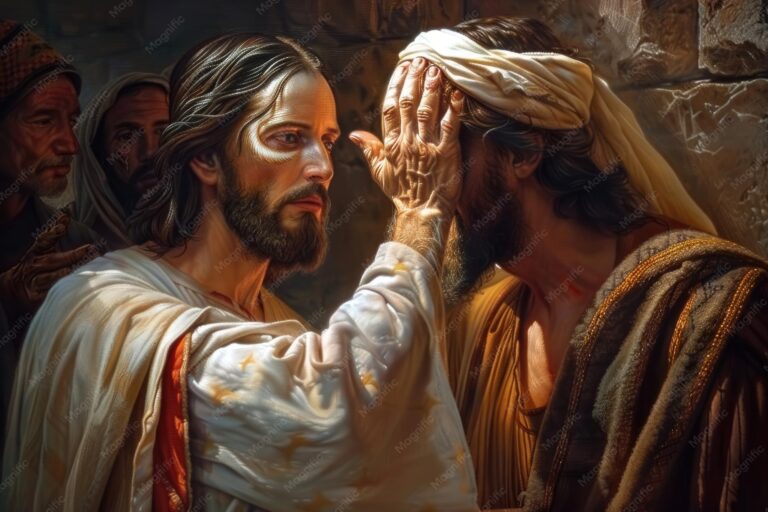
Mark 8 brings together several powerful lessons that may seem separate at first, but they are deeply connected. Jesus feeds four thousand people with The Seven Loaves, warns His disciples about the yeast of the Pharisees and Herod, restores the sight of a blind man, and asks His disciples who they believe He is. Peter declares that Jesus is the Messiah, yet moments later struggles to understand what Jesus must suffer. Jesus then asks a question that reaches beyond everything this world can offer: “What good is it for someone to gain the whole world, yet forfeit their soul?”
Obedience, God’s Covenant, Faith, Healing, Grace, Belief, Lack of Faith, Blessings, Spiritual Blindness, Salvation, Sacrifice, Discipleship, Judgment, Satan, Eternity, Redemption Plan, Jesus Christ
📖 Mark 8:1-3 (NIV)
“8 During those days another large crowd gathered. Since they had nothing to eat, Jesus called his disciples to him and said, 2 “I have compassion for these people; they have already been with me three days and have nothing to eat. 3 If I send them home hungry, they will collapse on the way, because some of them have come a long distance.”
The story begins with Jesus seeing a hungry crowd and having compassion on them.
After giving thanks, He breaks the bread and feeds about four thousand people, with seven baskets remaining.
Yet even after witnessing His provision, the disciples struggle to understand His warning about the yeast of the Pharisees and Herod.
Their thoughts remain focused on bread while Jesus is teaching them about something much deeper—the influence of unbelief, pride, corruption, and hardened hearts.
Then Jesus heals a blind man, but the healing happens in stages.
At first, the man sees imperfectly.
Jesus touches him again, and his sight becomes clear.
This becomes a powerful picture of the disciples themselves.
They have seen Jesus perform miracles, but they are still learning to see who He truly is.
When Jesus asks, “Who do you say I am?”, Peter answers, “You are the Messiah.” But Peter immediately struggles when Jesus explains that the Messiah must suffer, be rejected, killed, and rise again.
Jesus then teaches that following Him means denying ourselves, taking up our cross, and placing eternity above everything this world can offer.
The seven loaves reveal God’s provision.
The blind man reveals the journey toward spiritual understanding.
Peter’s confession reveals belief.
The cross reveals the Redemption Plan.
And Jesus’ question about gaining the whole world reveals the eternal value of the human soul.
📖 Mark 8:4-7 (NIV)
“4 His disciples answered, “But where in this remote place can anyone get enough bread to feed them?”
“5 “How many loaves do you have?” Jesus asked.
“Seven,” they replied.
“6 He told the crowd to sit down on the ground. When he had taken the seven loaves and given thanks, he broke them and gave them to his disciples to distribute to the people, and they did so. 7 They had a few small fish as well; he gave thanks for them also and told the disciples to distribute them.”
Jesus did not simply teach the crowds; He called people to respond to what they heard.
The disciples had watched Jesus feed thousands, heal the sick, cast out demons, and perform miracles.
Yet Jesus still challenged them because seeing miracles does not automatically produce obedience.
Following Jesus requires more than being amazed by what He can do.
It requires listening to His words and allowing those words to change our decisions.
Jesus eventually tells the crowd that anyone who wants to be His disciple must deny themselves, take up their cross, and follow Him.
That is obedience.
Putting God’s direction above our own desires.
Understanding that salvation is not simply about receiving blessings—it is about belonging to Christ.
The disciples were learning that Jesus was not calling them merely to watch Him.
He was calling them to follow Him.
Obedience turns belief into action.
📖 Mark 8:8-12 (NIV)
“8 The people ate and were satisfied. Afterward the disciples picked up seven basketfuls of broken pieces that were left over. 9 About four thousand were present. After he had sent them away, 10 he got into the boat with his disciples and went to the region of Dalmanutha.”
“11 The Pharisees came and began to question Jesus. To test him, they asked him for a sign from heaven. 12 He sighed deeply and said, “Why does this generation ask for a sign? Truly I tell you, no sign will be given to it.”
The feeding of the four thousand demonstrates God’s continuing faithfulness.
The people had followed Jesus for three days and had nothing to eat.
Jesus did not ignore their physical needs.
He had compassion on them.
This is consistent with the character of God throughout Scripture.
God’s Covenant is not an empty promise.
God sees, provides, disciplines, teaches, and ultimately fulfills His plan.
The disciples looked at the seven loaves and saw insufficiency.
Jesus looked at the same seven loaves and saw enough.
That distinction matters.
God does not require us to begin with everything we need.
He asks us to trust Him with what we have.
The seven loaves became enough because they were placed in Jesus’ hands.
God’s Covenant ultimately points toward His greatest provision—Jesus Christ.
Through Christ, God provides what humanity cannot provide for itself: forgiveness, salvation, reconciliation, and the hope of eternal life.
📖 Mark 8:13-18 (NIV)
“13 Then he left them, got back into the boat and crossed to the other side.”
“14 The disciples had forgotten to bring bread, except for one loaf they had with them in the boat. 15 “Be careful,” Jesus warned them. “Watch out for the yeast of the Pharisees and that of Herod.”
“16 They discussed this with one another and said, “It is because we have no bread.”
“17 Aware of their discussion, Jesus asked them: “Why are you talking about having no bread? Do you still not see or understand? Are your hearts hardened? 18 Do you have eyes but fail to see, and ears but fail to hear? And don’t you remember?”
Jesus had already shown the disciples that God could provide more than enough.
They had witnessed the feeding of the five thousand and the four thousand, yet when they entered the boat with only one loaf of bread, their minds immediately turned to what they did not have.
Jesus was teaching them something greater than bread.
He warned them to watch out for the “yeast” of the Pharisees and Herod—the influence of unbelief, pride, hypocrisy, and worldly thinking that can slowly spread through the heart.
The disciples misunderstood His warning because they were focused on their physical circumstances.
Jesus reminded them of what they had already witnessed.
He wanted them to remember the twelve baskets left over from the five loaves and the seven baskets left over from the seven loaves.
His question reaches beyond the disciples:
“Do you still not see or understand? Are your hearts hardened?”
Faith requires us to remember what God has already done.
When we forget His faithfulness, fear can become louder than faith.
When we focus only on what we lack, we can miss what Jesus is trying to teach us.
The lesson is not simply about bread. It is about seeing with spiritual eyes, hearing with spiritual ears, and trusting Jesus even when we do not yet understand.
God had already provided. Jesus was still with them. They needed to remember.
📖 Mark 8:19-22 (NIV)
“19 When I broke the five loaves for the five thousand, how many basketfuls of pieces did you pick up?”
“Twelve,” they replied.
“20 “And when I broke the seven loaves for the four thousand, how many basketfuls of pieces did you pick up?”
They answered, “Seven.”
“21 He said to them, “Do you still not understand?”
“22 They came to Bethsaida, and some people brought a blind man and begged Jesus to touch him.”
The healing of the blind man is unusual because Jesus heals him in stages.
At first, the man says:
“I see people; they look like trees walking around.”
Jesus touches his eyes again, and the man’s sight is completely restored.
It fits the spiritual lesson of the chapter.
The disciples had eyes, but Jesus had already asked them whether they were failing to see and understand.
They had witnessed the feeding of thousands, yet they still worried about bread.
They had seen Jesus’ authority, yet they were still struggling to understand His identity and mission.
The blind man’s healing gives us a picture of spiritual growth.
Sometimes we do not immediately understand everything God is showing us.
See something partially.
We may misunderstand.
Need another touch from God through His Word, His teaching, His correction, and His Spirit.
The goal is not to remain partially sighted.
The goal is to see Jesus clearly.
Healing can restore physical sight, but Christ also calls us to spiritual sight.
📖 Mark 8:23-26 (NIV)
“23 He took the blind man by the hand and led him outside the village. When he had spit on the man’s eyes and put his hands on him, Jesus asked, “Do you see anything?”
“24 He looked up and said, “I see people; they look like trees walking around.”
“25 Once more Jesus put his hands on the man’s eyes. Then his eyes were opened, his sight was restored, and he saw everything clearly. 26 Jesus sent him home, saying, “Don’t even go into[a] the village.”
Feeding of the four thousand is an extraordinary picture of grace.
Crowd had nothing to eat.
Disciples did not have enough resources.
Yet Jesus had compassion.
The people did not create the miracle.
The disciples did not manufacture the food.
They simply brought what they had and allowed Jesus to use it.
That is an important lesson for us.
We can sometimes look at our limitations and conclude that we have nothing meaningful to offer.
But Jesus repeatedly demonstrates that He can take what is placed in His hands and use it for His purposes.
The greatest example is salvation.
Humanity cannot earn its way into eternal life.
We cannot buy forgiveness.
We cannot become perfect through our own efforts.
God’s grace provides the answer through Jesus Christ.
The bread satisfied physical hunger for a time.
Christ offers something greater:
life for the soul.
📖 Mark 8:27-30 (NIV)
“27 Jesus and his disciples went on to the villages around Caesarea Philippi. On the way he asked them, “Who do people say I am?”
“28 They replied, “Some say John the Baptist; others say Elijah; and still others, one of the prophets.”
“29 “But what about you?” he asked. “Who do you say I am?”
Peter answered, “You are the Messiah.”
“30 Jesus warned them not to tell anyone about him.”
The crowd experienced an incredible blessing.
They were hungry, and Jesus fed them.
But the chapter does not stop with the blessing.
Jesus moves the disciples toward a deeper question.
What are we doing with what God has given us?
Blessings are not necessarily the destination.
They can become opportunities to recognize the One who provides them.
The danger is that we can become so focused on the blessing that we forget the One who gave it.
The disciples had bread in the boat, but Jesus was teaching them something more important than bread.
The crowd received food, but Jesus was pointing toward spiritual truth.
God’s blessings should move us toward gratitude, obedience, humility, and faith.
The greatest blessing is not gaining everything this world offers.
The greatest blessing is knowing Jesus Christ and receiving the promise of eternal life.
📖 Mark 8:31-34 (NIV)
“31 He then began to teach them that the Son of Man must suffer many things and be rejected by the elders, the chief priests and the teachers of the law, and that he must be killed and after three days rise again. 32 He spoke plainly about this, and Peter took him aside and began to rebuke him.”
“33 But when Jesus turned and looked at his disciples, he rebuked Peter. “Get behind me, Satan!” he said. “You do not have in mind the concerns of God, but merely human concerns.”
“34 Then he called the crowd to him along with his disciples and said: “Whoever wants to be my disciple must deny themselves and take up their cross and follow me. “
Jesus gives one of the most sobering teachings in Mark 8:
This question places everything into perspective.
The world measures success by possessions, influence, wealth, power, reputation, achievement, and recognition.
Jesus measures something differently.
He asks about the soul.
Possess tremendous earthly wealth and still lose what matters eternally.
Become famous and still be spiritually lost.
Gain power and still stand before God empty.
The warning is not that possessions themselves are automatically evil.
The warning is about allowing the temporary things of this world to become more important than eternal truth.
Jesus asks another question:
“Or what can anyone give in exchange for their soul?”
The answer is sobering.
Nothing.
There is no earthly possession valuable enough to purchase a soul.
This is why God’s Redemption Plan matters so deeply.
Jesus knew the value of the human soul, and He was preparing His disciples to understand that His coming suffering and death were not an accident.
The cross would become the pathway through which God’s salvation would be offered.
📖 Mark 8:35-38 (NIV)
“35 For whoever wants to save their life[b] will lose it, but whoever loses their life for me and for the gospel will save it. 36 What good is it for someone to gain the whole world, yet forfeit their soul? 37 Or what can anyone give in exchange for their soul? 38 If anyone is ashamed of me and my words in this adulterous and sinful generation, the Son of Man will be ashamed of them when he comes in his Father’s glory with the holy angels.”
Peter correctly identified Jesus as the Messiah.
But Peter did not yet understand the Redemption Plan.
Peter struggled with this.
He wanted the Messiah, but he did not understand the cross.
Jesus’ response was extremely strong because Peter’s thinking was focused on human expectations rather than God’s purposes.
This is one of the great lessons of Scripture.
Sometimes God’s plan does not look like the plan we would choose.
The disciples expected the Messiah to bring victory, but they had not yet understood that the path to redemption would pass through suffering and the cross.
Jesus was not abandoning God’s Covenant.
He was fulfilling it.
The suffering, death, and resurrection of Jesus Christ would become the center of God’s Redemption Plan.
The cross would appear to be defeat to the world.
But God would use it to accomplish salvation.
And the resurrection would reveal that death did not have the final word.
Mark 8 reminds us that God’s Covenant does not depend upon human understanding.
The disciples misunderstood the bread.
Peter misunderstood the Messiah’s mission.
The crowds misunderstood what Jesus was doing.
Yet God’s plan continued.
The seven loaves demonstrated God’s provision.
The healing demonstrated God’s compassion.
Peter’s confession demonstrated growing faith.
Jesus’ teaching about the cross revealed God’s Redemption Plan.
Even when people could not see the entire picture, God remained faithful.
This is important for us because we may not understand everything God is doing in our own lives.
We may see only part of the picture.
We may wonder why certain doors close, why certain struggles come, or why God’s timing is different from ours.
But God’s Covenant stands.
His promises do not become weaker because our understanding is incomplete.
Jesus was moving toward the cross exactly as God had planned.
And through Jesus Christ, God’s promise of salvation reaches beyond one generation and toward eternity.
Mark 8 teaches us that spiritual blindness can be more dangerous than physical blindness.
A person can have perfect eyesight and still fail to see who Jesus is.
The disciples saw miracles but still struggled with understanding.
Peter recognized Jesus as the Messiah but struggled to accept the suffering that would come.
The blind man’s gradual healing reminds us that understanding can develop.
Not allow temporary confusion to become permanent unbelief.
Continue seeking God through His Word.
Listen when Jesus corrects us.
Remain humble enough to admit when we do not understand.
Remember that the question Jesus asked Peter is ultimately a question for every person:
Who do you say Jesus is?
Our answer matters because eternity matters.
The world can offer temporary rewards, but none of them can replace the value of a soul.
Seven loaves lead us to Jesus because He is the One who provides.
Hungry crowd leads us to Jesus because He is compassionate.
Disciples’ lack of understanding leads us to Jesus because He patiently teaches.
The blind man’s healing leads us to Jesus because He restores what is broken.
Peter’s confession leads us to Jesus because He is the Messiah.
Peter’s misunderstanding leads us to the cross because Jesus came to accomplish something greater than human expectations.
And the question about gaining the whole world leads us directly to salvation.
Everything in this chapter points toward the same truth:
Jesus Christ is worth more than everything this world can offer.
The world can offer wealth, success, possessions, recognition, and power.
But none of those things can save a soul.
Jesus came knowing that the road ahead would lead to rejection, suffering, death, and resurrection.
He would give His life so that others could have life.
That is the heart of the Redemption Plan.
The seven loaves fed thousands for a day.
Jesus Christ offers life that reaches beyond this world and into eternity.
And that leaves us with the question Jesus placed before His disciples:
What good is it to gain the whole world if we lose our soul?
The answer is clear.
Nothing in this world is worth more than knowing Jesus Christ.