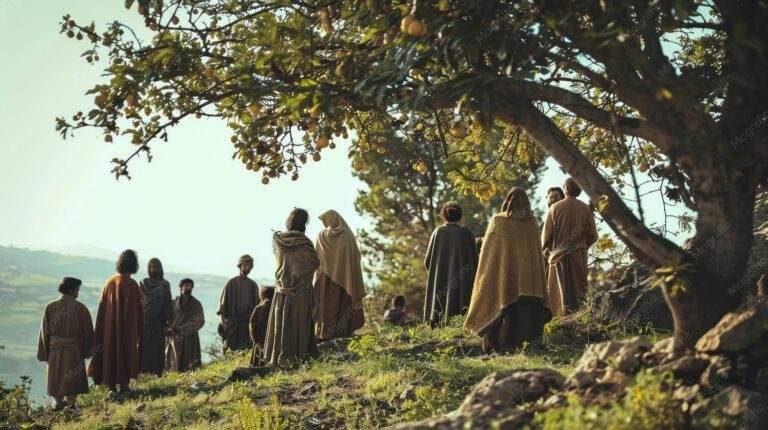
Mark 11, The Lord Needs It shows Jesus entering Jerusalem with purpose. From the colt to the temple, from the fig tree to faith-filled prayer, every event reveals something about God’s character and His plan. Jesus teaches obedience, humility, faith, and forgiveness while confronting pride and empty religion. As we follow this chapter, we see guidance, judgment, grace, and the continuing Redemption Plan through Jesus Christ.
Obedience, God’s Covenant, Blessings, Faith, Fig Tree, Temple Courts, Judgment, Humility, Guidance, Redemption Plan, Jesus Christ
📖 Mark 11:1-3 (NIV)
“11 As they approached Jerusalem and came to Bethphage and Bethany at the Mount of Olives, Jesus sent two of his disciples, 2 saying to them, “Go to the village ahead of you, and just as you enter it, you will find a colt tied there, which no one has ever ridden. Untie it and bring it here. 3 If anyone asks you, ‘Why are you doing this?’ say, ‘The Lord needs it and will send it back here shortly.’”
Mark 11 is not simply the story of Jesus entering Jerusalem. It is another chapter in God’s Story Unfolds, where events that may appear separate are moving toward one purpose.
Jesus tells His disciples to bring a colt, and they find everything exactly as He said.
He enters the temple and sees that God’s house has been turned away from its intended purpose.
He confronts what has become corrupted and reminds the people that God’s house is to be a house of prayer.
The fig tree becomes another lesson.
Jesus teaches His disciples about faith, prayer, and forgiveness.
He then faces religious leaders who question His authority, revealing the difference between humble obedience to God and pride that refuses to recognize God’s truth.
Through all of this, God’s covenant continues moving forward.
Jesus is not acting without purpose.
He is fulfilling the Father’s plan and preparing the way for the greatest act of redemption the world would ever know.
God’s Story is moving toward Jesus Christ.
📖 Mark 11:4-9 (NIV)
“4 They went and found a colt outside in the street, tied at a doorway. As they untied it, 5 some people standing there asked, “What are you doing, untying that colt?” 6 They answered as Jesus had told them to, and the people let them go. 7 When they brought the colt to Jesus and threw their cloaks over it, he sat on it. 8 Many people spread their cloaks on the road, while others spread branches they had cut in the fields. 9 Those who went ahead and those who followed shouted,”
“Hosanna![a]”
“Blessed is he who comes in the name of the Lord!”[b]
Jesus sent two disciples ahead with a simple instruction: find a colt, untie it, and bring it to Him.
The disciples did not need to understand every detail before obeying.
They simply followed the instructions Jesus gave them.
This is an important lesson for us.
God may place something in front of us that we do not completely understand.
He may ask us to move, serve, give, speak, wait, or trust before we can see the entire plan.
The disciples found everything exactly as Jesus had told them.
Their obedience became part of God’s greater purpose.
The colt would carry Jesus into Jerusalem, fulfilling what had been spoken concerning the coming King.
Obedience can become part of God’s work long before we understand where it is going.
God’s covenant is not built upon our ability to see the future.
It is built upon His faithfulness.
📖 Mark 11:10-14 (NIV)
“10
“Blessed is the coming kingdom of our father David!”
“Hosanna in the highest heaven!”
“11 Jesus entered Jerusalem and went into the temple courts. He looked around at everything, but since it was already late, he went out to Bethany with the Twelve.”
“12 The next day as they were leaving Bethany, Jesus was hungry. 13 Seeing in the distance a fig tree in leaf, he went to find out if it had any fruit. When he reached it, he found nothing but leaves, because it was not the season for figs. 14 Then he said to the tree, “May no one ever eat fruit from you again.” And his disciples heard him say it.”
As Jesus entered Jerusalem, crowds spread their cloaks and branches along the road.
They shouted:
“Hosanna!”
They were celebrating the coming kingdom.
Jesus was not entering Jerusalem as an earthly king surrounded by armies.
He came humbly, riding on a colt.
This is another important lesson.
God’s power does not always arrive in the way humanity expects.
The people were looking at Jesus, but many did not yet understand everything about the King who stood before them.
Jesus was coming toward Jerusalem knowing what awaited Him.
Coss was ahead.
Suffering was ahead.
Rejection was ahead.
But so was God’s redemption plan.
Jesus was not entering Jerusalem by accident.
He was moving toward the purpose for which He had come.
The King was entering the city, but the King was also moving toward the sacrifice that would open the way to salvation.
📖 Mark 11:15-19 (NIV)
“15 On reaching Jerusalem, Jesus entered the temple courts and began driving out those who were buying and selling there. He overturned the tables of the money changers and the benches of those selling doves, 16 and would not allow anyone to carry merchandise through the temple courts. 17 And as he taught them, he said, “Is it not written: ‘My house will be called a house of prayer for all nations’[c]? But you have made it ‘a den of robbers.’[d]”
“18 The chief priests and the teachers of the law heard this and began looking for a way to kill him, for they feared him, because the whole crowd was amazed at his teaching.”
“19 When evening came, Jesus and his disciples[e] went out of the city.”
Jesus saw a fig tree covered with leaves but found no fruit.
This becomes a powerful picture of spiritual life.
It is possible to look faithful on the outside while producing little fruit on the inside.
We can have words without obedience.
People can have appearances without humility.
People can know Scripture without allowing Scripture to change our hearts.
We can look like we are following God while our hearts are following something else.
Jesus teaches that God is not simply looking for leaves.
He is looking for fruit.
Faith should produce something in our lives.
Obedience should produce something.
Grace should produce something.
God’s Word should produce something.
A life connected to Jesus should begin changing the way we live, love, forgive, serve, and treat others.
The question is not simply:
“Do I look like I belong to God?”
The deeper question is:
“Is my life producing fruit for God?”
📖 Mark 11:20-24 (NIV)
“20 In the morning, as they went along, they saw the fig tree withered from the roots. 21 Peter remembered and said to Jesus, “Rabbi, look! The fig tree you cursed has withered!”
“22 “Have faith in God,” Jesus answered. 23 “Truly[f] I tell you, if anyone says to this mountain, ‘Go, throw yourself into the sea,’ and does not doubt in their heart but believes that what they say will happen, it will be done for them. 24 Therefore I tell you, whatever you ask for in prayer, believe that you have received it, and it will be yours”
Jesus entered the temple courts and saw buying and selling taking place.
Jesus said:
“My house will be called a house of prayer for all nations.”
The temple was supposed to direct people toward God.
Instead, people had allowed human interests to interfere with worship.
This teaches us about priorities.
Something designed for God can become corrupted when people put themselves first.
The temple was holy because it belonged to God.
Our lives should also point toward God.
The lesson is bigger than the physical temple.
It asks us to examine our own hearts.
What has taken God’s place?
He receives our attention?
What controls our decisions?
What are we willing to sacrifice for?
Humility means recognizing that our lives belong to God before they belong to ourselves.
Jesus was not merely cleansing a building.
He was exposing what happens when people allow human desires to replace God’s purpose.
📖 Mark 11:25-28 (NIV)
“25 And when you stand praying, if you hold anything against anyone, forgive them, so that your Father in heaven may forgive you your sins.” [26] [g]”
“27 They arrived again in Jerusalem, and while Jesus was walking in the temple courts, the chief priests, the teachers of the law and the elders came to him. 28 “By what authority are you doing these things?” they asked. “And who gave you authority to do this?”
When Peter noticed that the fig tree had withered from the roots, Jesus responded:”
“Have faith in God.”
But notice that Jesus connected prayer with forgiveness.
Faith is not simply asking God for what we want.
Faith means trusting God.
Prayer means bringing our lives before God.
And forgiveness means refusing to allow bitterness to control our hearts.
Jesus teaches that when we pray, we should also examine what we are holding against others.
This does not make forgiveness easy.
It makes forgiveness important.
God’s grace toward us should influence the grace we extend to others.
The person who understands God’s mercy begins to understand why mercy matters.
Faith looks upward toward God, while forgiveness changes how we treat the people around us.
Prayer is not simply about receiving blessings.
Prayer also changes the person who prays.
📖 Mark 11:29-33 (NIV)
“29 Jesus replied, “I will ask you one question. Answer me, and I will tell you by what authority I am doing these things. 30 John’s baptism—was it from heaven, or of human origin? Tell me!”
“31 They discussed it among themselves and said, “If we say, ‘From heaven,’ he will ask, ‘Then why didn’t you believe him?’ 32 But if we say, ‘Of human origin’ …” (They feared the people, for everyone held that John really was a prophet.)”
“33 So they answered Jesus, “We don’t know.”
Jesus said, “Neither will I tell you by what authority I am doing these things.”
The chief priests, teachers of the law, and elders confronted Jesus.
They wanted to know:
“By what authority are you doing these things?”
Jesus knew what was behind their question.
They were not simply seeking truth.
They were challenging Him.
They could not answer honestly because they were more concerned about what people would think than about what God wanted.
This reveals the danger of pride.
Sometimes people already know the truth but resist it because accepting it would require them to change.
The leaders had witnessed what Jesus was doing.
They had heard His teaching.
They had seen the response of the people.
Yet instead of humbling themselves before God, they questioned His authority.
Pride can make a person argue with the truth rather than surrender to it.
Jesus demonstrates something different.
He does not need human approval to possess God’s authority.
His authority comes from the Father.
Throughout Scripture, God’s covenant continues even when humanity struggles to remain faithful.
Mark 11 shows Jesus entering Jerusalem exactly as God’s greater plan required.
Jesus a crowd celebrated Him.
The religious leaders challenged Him.
The disciples struggled to understand.
Yet none of these circumstances could stop God’s plan.
The covenant promises of God do not depend upon humanity having everything figured out.
God remains faithful.
Jesus was moving toward Jerusalem because redemption was moving toward fulfillment.
The same Jesus who entered Jerusalem as King would soon give His life for sinners.
God’s covenant stands because God stands behind His covenant.
Mark 11 teaches us to examine more than what people can see.
Are we obedient when God asks us to move?
Do we recognize Jesus as King?
Are we producing fruit or merely displaying leaves?
Have we allowed worldly priorities to interfere with our relationship with God?
Do we truly trust God in prayer?
Are we willing to forgive?
Do we place God’s authority above human approval?
These questions bring the chapter into our own lives.
Jesus does not call us to a perfect life.
He calls us to a faithful life.
We will have moments when our faith is weak.
We will have moments when we do not understand.
But those moments should lead us back to God rather than away from Him.
Faith means continuing to follow when we cannot yet see the entire road.
Mark 11 is another step toward the cross.
Jesus enters Jerusalem.
He teaches about faith.
He confronts false religion.
Jesus speaks about prayer and forgiveness.
Jesus challenges pride.
And He demonstrates divine authority.
But everything is moving toward something greater.
Jesus knows that Jerusalem will lead to His suffering, death, and resurrection.
Colt in Jerusalem
Temple in Jerusalem
The fig tree.
The crowds.
His questions about authority.
The lessons about faith.
Each part points toward the identity and mission of Jesus Christ.
jesus is not simply another teacher.
Jesus is not simply another prophet.
He is the Son of God and the One carrying God’s redemption plan forward.
The road through Jerusalem will lead to the cross.
The cross will lead to the resurrection.
And the resurrection will open the message of salvation to the world.
Every story leads us back to Jesus Christ—the fulfillment of God’s covenant, the source of grace, and the hope of eternal life.