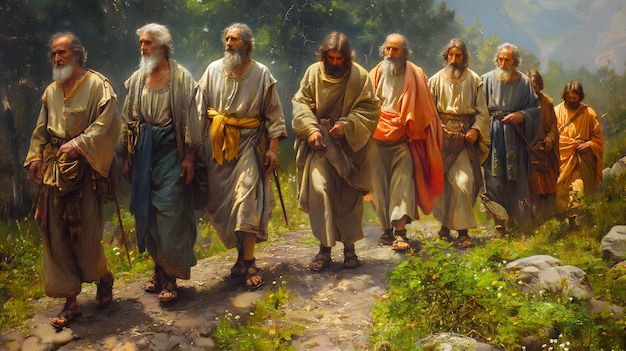
Acts 14, Poisoned Their Minds shows that the Gospel will not always be welcomed. Paul and Barnabas faced opposition, false understanding, physical suffering, and rejection, yet they continued preaching Jesus Christ. Through their obedience, God opened a door of faith to the Gentiles. Their journey reminds us that faith is not the absence of hardship. Faith is continuing to trust God when hardship comes.
Obedience, God’s Covenant, Faith, Judgment, Belief, Repent, Gentiles, Grace, Redemption Plan, Jesus Christ
📖 Acts 14:1 (NIV)
“14 At Iconium Paul and Barnabas went as usual into the Jewish synagogue. There they spoke so effectively that a great number of Jews and Greeks believed.”
Paul and Barnabas entered Iconium and preached the Gospel, and many Jews and Greeks believed.
But those who rejected the message stirred up others and poisoned their minds against the believers.
Even when opposition grew, Paul and Barnabas continued speaking boldly about the Lord.
God confirmed the message of His grace through signs and wonders.
They eventually traveled to Lystra, where Paul encountered a man who had never walked.
Seeing his faith, Paul told him to stand, and the man began to walk.
The crowd misunderstood what had happened and began treating Paul and Barnabas as gods.
The apostles immediately rejected this praise and pointed the people toward the living God, the Creator of everything.
The opposition returned, and Paul was stoned and left for dead.
Yet he rose and continued the work.
Paul and Barnabas later returned to strengthen the believers, encouraging them to remain true to the faith.
Their journey ended by reporting that God had opened a door of faith to the Gentiles.
📖 Acts 14:1-4 (NIV)
“14 At Iconium Paul and Barnabas went as usual into the Jewish synagogue. There they spoke so effectively that a great number of Jews and Greeks believed. 2 But the Jews who refused to believe stirred up the other Gentiles and poisoned their minds against the brothers. 3 So Paul and Barnabas spent considerable time there, speaking boldly for the Lord, who confirmed the message of his grace by enabling them to perform signs and wonders. 4 The people of the city were divided; some sided with the Jews, others with the apostles. “
The Gospel brought belief to many people in Iconium, but others refused to believe and began influencing the Gentiles against Paul and Barnabas.
This shows how quickly rejection can become opposition. A person may hear truth but choose to reject it, and that choice can influence others.
We must be careful about allowing someone else’s rejection to determine what we believe.
God’s Word should be examined for ourselves.
Faith requires listening, seeking truth, and allowing God—not human pressure—to shape our understanding.
📖 Acts 14:5-8 (NIV)
“5 There was a plot afoot among both Gentiles and Jews, together with their leaders, to mistreat them and stone them. 6 But they found out about it and fled to the Lycaonian cities of Lystra and Derbe and to the surrounding country, 7 where they continued to preach the gospel.”
“8 In Lystra there sat a man who was lame. He had been that way from birth and had never walked. “
Paul and Barnabas did not stop speaking because opposition appeared.
They spent considerable time in Iconium, boldly proclaiming the Lord.
Their confidence was not based on themselves.
They trusted God to confirm the message of His grace.
Obedience does not mean that every path will be easy.
Sometimes obedience means continuing when circumstances become difficult.
Paul and Barnabas demonstrated that the Gospel was greater than the opposition surrounding them.
📖 Acts 14:9-12 (NIV)
“9 He listened to Paul as he was speaking. Paul looked directly at him, saw that he had faith to be healed 10 and called out, “Stand up on your feet!” At that, the man jumped up and began to walk.”
“11 When the crowd saw what Paul had done, they shouted in the Lycaonian language, “The gods have come down to us in human form!” 12 Barnabas they called Zeus, and Paul they called Hermes because he was the chief speaker. “
When the people of Lystra believed Paul and Barnabas were gods, the apostles immediately corrected them.
They declared that they were only human and directed the crowd toward the living God who created heaven, earth, the sea, and everything in them.
They did not accept worship that belonged to God.
Their message was simple: turn away from worthless things and turn toward the Creator.
Repentance begins when we recognize that nothing created can replace the One who created it.
📖 Acts 14:13-16 (NIV)
“13 The priest of Zeus, whose temple was just outside the city, brought bulls and wreaths to the city gates because he and the crowd wanted to offer sacrifices to them.”
“14 But when the apostles Barnabas and Paul heard of this, they tore their clothes and rushed out into the crowd, shouting: 15 “Friends, why are you doing this? We too are only human, like you. We are bringing you good news, telling you to turn from these worthless things to the living God, who made the heavens and the earth and the sea and everything in them. 16 In the past, he let all nations go their own way.”
The man in Lystra had never walked, yet Paul saw that he had faith.
When Paul told him to stand, he jumped up and began to walk.
The miracle became a testimony to the power of God.
The important lesson is not to place faith in the messenger, but in the God behind the message.
Paul and Barnabas refused to take God’s glory for themselves.
Faith looks beyond the person delivering the message and recognizes the One who provides grace.
📖 Acts 14:17-20 (NIV)
“17 Yet he has not left himself without testimony: He has shown kindness by giving you rain from heaven and crops in their seasons; he provides you with plenty of food and fills your hearts with joy.” 18 Even with these words, they had difficulty keeping the crowd from sacrificing to them.”
“19 Then some Jews came from Antioch and Iconium and won the crowd over. They stoned Paul and dragged him outside the city, thinking he was dead. 20 But after the disciples had gathered around him, he got up and went back into the city. The next day he and Barnabas left for Derbe.”
Paul was eventually stoned and dragged outside the city because his enemies thought he was dead.
Yet the disciples gathered around him, and Paul got up. Instead of abandoning the mission, he continued.
Paul and Barnabas later told the disciples, “We must go through many hardships to enter the kingdom of God.”
Following Jesus does not promise a life without difficulty.
Hardship can become part of the journey of faith.
The goal is not to avoid every trial, but to remain faithful through them.
📖 Acts 14:21-24 (NIV)
“21 They preached the gospel in that city and won a large number of disciples. Then they returned to Lystra, Iconium and Antioch, 22 strengthening the disciples and encouraging them to remain true to the faith. “We must go through many hardships to enter the kingdom of God,” they said. 23 Paul and Barnabas appointed elders[a] for them in each church and, with prayer and fasting, committed them to the Lord, in whom they had put their trust. 24 After going through Pisidia, they came into Pamphylia, “
Paul and Barnabas returned to the cities where they had already preached.
They strengthened the disciples and encouraged them to remain true to the faith.
They also appointed elders in the churches and committed them to the Lord through prayer and fasting.
The work of the Gospel was not simply about gaining new believers.
It was also about helping believers grow stronger.
Faith needs encouragement, prayer, teaching, and people willing to serve one another.
📖 Acts 14:25-28 (NIV)
“25 and when they had preached the word in Perga, they went down to Attalia.”
“26 From Attalia they sailed back to Antioch, where they had been committed to the grace of God for the work they had now completed. 27 On arriving there, they gathered the church together and reported all that God had done through them and how he had opened a door of faith to the Gentiles. 28 And they stayed there a long time with the disciples.”
When Paul and Barnabas returned to Antioch, they gathered the church and reported what God had done through them.
Their greatest report was that God had opened a door of faith to the Gentiles.
What began with preaching in one city had expanded into a larger part of God’s Redemption Plan.
The Gospel was moving beyond familiar boundaries.
God was bringing people from the nations into faith through Jesus Christ.
The work belonged to God, and Paul and Barnabas were obedient servants through whom He worked.
God’s Covenant does not depend upon every person accepting it.
Throughout Scripture, people have responded to God in different ways. Some believe, some reject, and some allow opposition to influence others.
Yet God’s purposes continue. In Acts 14, the Gospel reaches Gentiles, believers are strengthened, churches are established, and the message continues despite persecution.
God’s grace remains available, and His Redemption Plan continues moving forward.
The door of faith opened to the Gentiles because God was fulfilling His purpose through Jesus Christ.
Acts 14 teaches us to examine what we believe rather than allowing others to poison our minds.
It teaches us to remain humble when others praise us, remembering that only God deserves worship.
It teaches us that faith can lead through difficult circumstances and that hardship does not mean God has abandoned us.
We also learn that believers need encouragement and spiritual strength.
Most importantly, we see that obedience can take us places we never expected and that God can use ordinary people to carry His message forward.
Acts 14 points beyond Paul and Barnabas to Jesus Christ.
The apostles were not gods, nor did they claim power for themselves.
They pointed people to the living God and continued proclaiming the Gospel despite suffering.
Their obedience helped open a door of faith to the Gentiles. The same Gospel continues to call people to turn from worthless things, believe, repent, and receive God’s grace.
The journey of Paul and Barnabas reminds us that the messenger may be imperfect, but Jesus Christ is the Savior.
Through Him, God’s Redemption Plan reaches people everywhere.