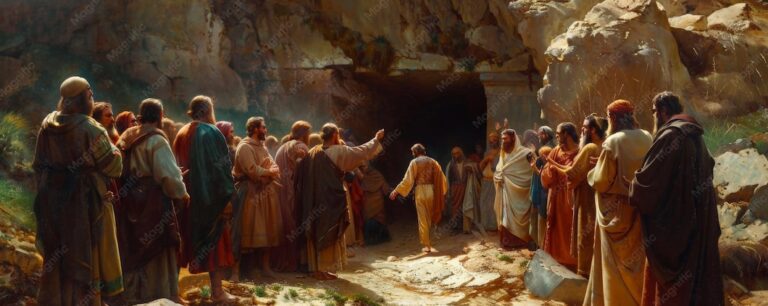
The message reached Jesus: “Lord, the one you love, Lazuras was sick.” Yet Jesus did not immediately go to Bethany. He remained where He was for two more days. To those watching, this may have seemed like delay, but Jesus knew something they did not. Lazarus’s sickness would become an opportunity for God’s glory, strengthening faith and revealing that Jesus Christ is “the resurrection and the life.”
Obedience, God’s Covenant, Blessings, Back to Life, The Tomb, Pharisees, Grace, Mercy, Redemption Plan, Jesus Christ
📖 John 11:1-3 (NIV)
“11 Now a man named Lazarus was sick. He was from Bethany, the village of Mary and her sister Martha. 2 (This Mary, whose brother Lazarus now lay sick, was the same one who poured perfume on the Lord and wiped his feet with her hair.) 3 So the sisters sent word to Jesus, “Lord, the one you love is sick.”
Jesus loved Lazarus, Martha, and Mary, yet He allowed the situation to reach a point that seemed impossible.
Martha believed in the resurrection at the last day, but Jesus revealed something greater:
He Himself is the resurrection and the life.
At the tomb, Jesus wept. His compassion showed that He understood their sorrow, even though He already knew what He was about to do.
He commanded the stone to be removed and called Lazarus from the grave. The dead man came out alive.
This miracle was not simply about Lazarus. It pointed toward the greater Redemption Plan.
Jesus would soon face His own death, burial, and resurrection.
Lazarus coming out of the tomb became a powerful sign of the authority Jesus holds over death.
📖 John 11:4-9 (NIV)
“4 When he heard this, Jesus said, “This sickness will not end in death. No, it is for God’s glory so that God’s Son may be glorified through it.” 5 Now Jesus loved Martha and her sister and Lazarus. 6 So when he heard that Lazarus was sick, he stayed where he was two more days, 7 and then he said to his disciples, “Let us go back to Judea.”
“8 “But Rabbi,” they said, “a short while ago the Jews there tried to stone you, and yet you are going back?”
“9 Jesus answered, “Are there not twelve hours of daylight? Anyone who walks in the daytime will not stumble, for they see by this world’s light. “
Lazarus’s family knew Jesus could have come sooner.
They believed that if He had arrived earlier, Lazarus would not have died.
But God’s timing was different.
Sometimes we look at circumstances and think God is late.
Yet Jesus demonstrated that what appears to be a delay may be part of something much greater.
Jesus said Lazarus’s sickness was “for God’s glory.”
Faith does not mean understanding every moment.
Faith means trusting God when we cannot yet see what He is doing.
📖 John 11:10-15 (NIV)
“10 It is when a person walks at night that they stumble, for they have no light.”
“11 After he had said this, he went on to tell them, “Our friend Lazarus has fallen asleep; but I am going there to wake him up.”
“12 His disciples replied, “Lord, if he sleeps, he will get better.” 13 Jesus had been speaking of his death, but his disciples thought he meant natural sleep.”
“14 So then he told them plainly, “Lazarus is dead, 15 and for your sake I am glad I was not there, so that you may believe. But let us go to him.”
Martha believed Lazarus would rise on the last day.
Jesus then gave her a truth that reaches far beyond Lazarus:
“I am the resurrection and the life.”
Jesus was not merely teaching about resurrection.
He was revealing Himself as the source of life.
The Christian hope is not simply that death will someday end.
Our hope is found in Jesus Christ. Whoever believes in Him has the promise of life beyond the grave.
Lazarus was brought back to earthly life, but Jesus was pointing toward something eternal.
📖 John 11:16-21 (NIV)
“16 Then Thomas (also known as Didymus[a]) said to the rest of the disciples, “Let us also go, that we may die with him.”
“17 On his arrival, Jesus found that Lazarus had already been in the tomb for four days. 18 Now Bethany was less than two miles[b] from Jerusalem, 19 and many Jews had come to Martha and Mary to comfort them in the loss of their brother. 20 When Martha heard that Jesus was coming, she went out to meet him, but Mary stayed at home.”
“21 “Lord,” Martha said to Jesus, “if you had been here, my brother would not have died. “
Jesus asked Martha:
“Did I not tell you that if you believe, you will see the glory of God?”
The stone was still covering the tomb. Lazarus was still dead.
The circumstances had not changed yet.
But Jesus asked them to believe before they saw the miracle.
That is an important lesson in faith.
We often want to see the answer before we trust God. Jesus teaches us that sometimes belief comes before the stone is removed.
📖 John 11:22-27 (NIV)
“22 But I know that even now God will give you whatever you ask.”
“23 Jesus said to her, “Your brother will rise again.”
“24 Martha answered, “I know he will rise again in the resurrection at the last day.”
“25 Jesus said to her, “I am the resurrection and the life. The one who believes in me will live, even though they die; 26 and whoever lives by believing in me will never die. Do you believe this?”
“27 “Yes, Lord,” she replied, “I believe that you are the Messiah, the Son of God, who is to come into the world.”
Jesus told them to remove the stone.
Martha immediately pointed out the reality of the situation: Lazarus had been dead four days.
Yet obedience was required.
The people could not raise Lazarus themselves. They could, however, obey Jesus when He told them what to do.
This reminds us that God does not ask us to accomplish what only He can accomplish.
He asks us to trust, obey, and participate in His work.
📖 John 11:28-34 (NIV)
“28 After she had said this, she went back and called her sister Mary aside. “The Teacher is here,” she said, “and is asking for you.” 29 When Mary heard this, she got up quickly and went to him. 30 Now Jesus had not yet entered the village, but was still at the place where Martha had met him. 31 When the Jews who had been with Mary in the house, comforting her, noticed how quickly she got up and went out, they followed her, supposing she was going to the tomb to mourn there.”
“32 When Mary reached the place where Jesus was and saw him, she fell at his feet and said, “Lord, if you had been here, my brother would not have died.”
“33 When Jesus saw her weeping, and the Jews who had come along with her also weeping, he was deeply moved in spirit and troubled. 34 “Where have you laid him?” he asked.”
“Come and see, Lord,” they replied.”
Jesus wept.
Those two words reveal something powerful about the heart of Christ.
Jesus knew Lazarus would soon walk out of the tomb, yet He still entered into the sorrow of those who were grieving.
His power did not make Him distant from human suffering.
His grace and mercy were present before the miracle, during the miracle, and after the miracle.
Jesus cares about people—not simply about the outcome.
📖 John 11:35-41 (NIV)
“35 Jesus wept.”
“36 Then the Jews said, “See how he loved him!”
“37 But some of them said, “Could not he who opened the eyes of the blind man have kept this man from dying?”
“38 Jesus, once more deeply moved, came to the tomb. It was a cave with a stone laid across the entrance. 39 “Take away the stone,” he said.
“But, Lord,” said Martha, the sister of the dead man, “by this time there is a bad odor, for he has been there four days.”
40 Then Jesus said, “Did I not tell you that if you believe, you will see the glory of God?”
“41 So they took away the stone. Then Jesus looked up and said, “Father, I thank you that you have heard me.”
Others reported the miracle to the Pharisees.
Instead of celebrating the work of God, the religious leaders became concerned about their own authority and what might happen if everyone followed Jesus.
Their response eventually led to a plot to kill Him.
This creates a powerful contrast:
Some saw the miracle and believed.
Others saw the same miracle and wanted to stop Jesus.
The evidence was before them, but belief still required a heart willing to accept the truth.
📖 John 11:42-46 (NIV)
“42 I knew that you always hear me, but I said this for the benefit of the people standing here, that they may believe that you sent me.”
“43 When he had said this, Jesus called in a loud voice, “Lazarus, come out!” 44 The dead man came out, his hands and feet wrapped with strips of linen, and a cloth around his face.
Jesus said to them, “Take off the grave clothes and let him go.”
“45 Therefore many of the Jews who had come to visit Mary, and had seen what Jesus did, believed in him. 46 But some of them went to the Pharisees and told them what Jesus had done. “
The raising of Lazarus was connected directly to the coming sacrifice of Jesus.
Caiaphas declared that it was better for one man to die for the people than for the whole nation to perish. John explains that his words pointed prophetically toward Jesus dying not only for the Jewish nation, but also to gather God’s scattered children together.
The miracle at Lazarus’s tomb therefore points toward another tomb.
Lazarus would come out because Jesus called him.
Jesus would later enter the grave Himself—and rise again through the power of God.
Lazarus was a sign. Jesus is the Savior.
📖 John 11:47-57 (NIV)
“47 Then the chief priests and the Pharisees called a meeting of the Sanhedrin.
“What are we accomplishing?” they asked. “Here is this man performing many signs. 48 If we let him go on like this, everyone will believe in him, and then the Romans will come and take away both our temple and our nation.”
“49 Then one of them, named Caiaphas, who was high priest that year, spoke up, “You know nothing at all! 50 You do not realize that it is better for you that one man die for the people than that the whole nation perish.”
“51 He did not say this on his own, but as high priest that year he prophesied that Jesus would die for the Jewish nation, 52 and not only for that nation but also for the scattered children of God, to bring them together and make them one. 53 So from that day on they plotted to take his life.”
“54 Therefore Jesus no longer moved about publicly among the people of Judea. Instead he withdrew to a region near the wilderness, to a village called Ephraim, where he stayed with his disciples.”
“55 When it was almost time for the Jewish Passover, many went up from the country to Jerusalem for their ceremonial cleansing before the Passover. 56 They kept looking for Jesus, and as they stood in the temple courts they asked one another, “What do you think? Isn’t he coming to the festival at all?” 57 But the chief priests and the Pharisees had given orders that anyone who found out where Jesus was should report it so that they might arrest him.”
“The one who believes in me will live, even though they die.”
That promise reaches beyond Lazarus and reaches us today.
Death does not have the final word for those who belong to Christ.
The tomb is not the end of the story.
Jesus Christ is the answer to death.
God’s Covenant stands even when circumstances appear impossible.
Lazarus was dead, the tomb was sealed, and those around him could not see a way forward.
Yet Jesus knew exactly what He was doing.
His delay did not mean abandonment;
it became an opportunity for God’s glory to be revealed.
Jesus called Lazarus from the tomb, demonstrating that God’s promises are greater than death itself.
The miracle also pointed toward Christ’s own death and resurrection and the eternal life promised to those who believe.
God’s Covenant does not depend on what we see. It depends on who God is.
When Jesus says, “I am the resurrection and the life,” His promise reaches beyond Lazarus and reaches every believer.
The tomb may appear to be the end, but in God’s Redemption Plan, Jesus Christ has the final word over death.
Obedience — Trust Jesus even when His timing is difficult to understand.
God’s Covenant — God remains faithful to His promises.
Faith — Believe even when the stone has not yet been moved.
Blessings — God can use impossible circumstances to reveal His glory.
Grace — Jesus meets people in their sorrow.
Mercy — Christ cares about those who are hurting.
Back To Life — Lazarus became a living testimony of Jesus’ authority.
Judgment — People can witness God’s work and still choose unbelief.
Eternity — Jesus promises life beyond physical death.
Redemption Plan — Lazarus points forward to Christ’s death and resurrection.
Lazarus was sick.
Lazarus died.
He was placed in a tomb.
Jesus came.
Jesus wept.
He prayed.
Jesus called.
“Lazarus, come out!”
And the dead man walked out of the tomb.
But this was more than a miracle for one family.
It was a preview of the authority Jesus possesses over death and a powerful sign pointing toward His own resurrection.
The story ultimately asks each of us the same question Jesus asked Martha:
“Do you believe this?”
Our answer matters because Jesus Christ is not simply the One who brings people back from the grave.
He is the Resurrection and the Life.