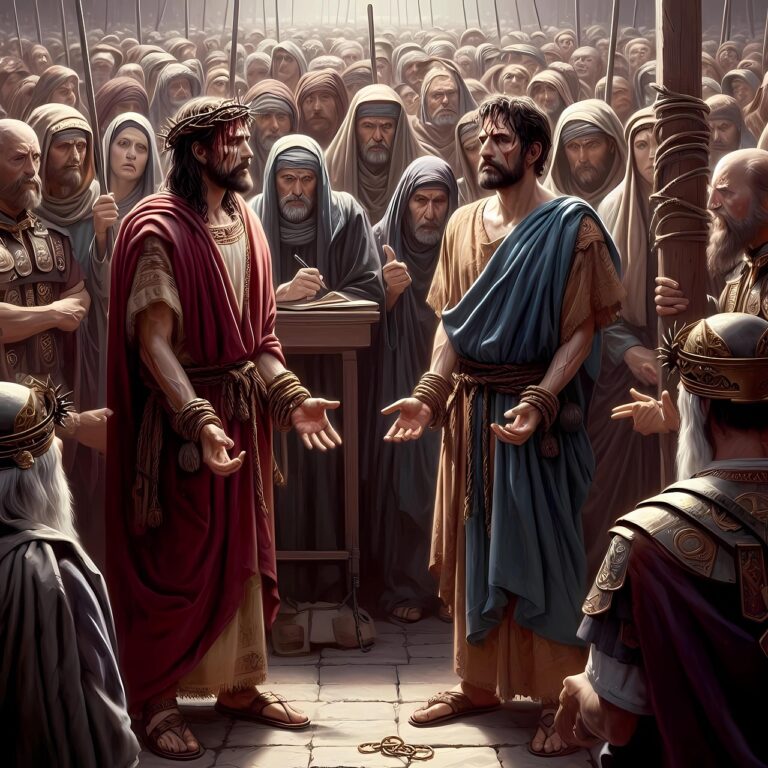
John 18 begins the final journey to the cross. Jesus Knew The Place exactly where Judas would find Him, knew the soldiers were coming, and knew what awaited Him. Yet Jesus did not run. Peter reached for a sword, but Jesus stopped him. Peter later denied knowing Him, while Jesus continued speaking truth. Then Pilate offered the crowd a choice: Jesus or Barabbas. They chose Barabbas. In that choice, we see humanity’s sin—and God’s Redemption Plan unfolding.
Obedience, God’s Covenant, Jesus’ Arrest, Peter’s Denials, Rooster Crows, Peter Uses Sword, Jesus Stops Him, Redemption Plan, Jesus Christ
📖 John 18:1-3 (NIV)
“18 When he had finished praying, Jesus left with his disciples and crossed the Kidron Valley. On the other side there was a garden, and he and his disciples went into it.”
“2 Now Judas, who betrayed him, knew the place, because Jesus had often met there with his disciples. 3 So Judas came to the garden, guiding a detachment of soldiers and some officials from the chief priests and the Pharisees. They were carrying torches, lanterns and weapons.”
Jesus entered the garden knowing that Judas knew the place. Nothing about His arrest surprised Him.
He knew the Father’s plan, and He willingly stepped forward.
When the soldiers said they were looking for Jesus of Nazareth, Jesus answered, “I am he.”
The soldiers fell backward. Even in His arrest, Jesus demonstrated authority.
Jesus did not ask His disciples to fight for Him. When Peter used a sword and cut off the servant’s ear, Jesus commanded him to put it away.
Jesus understood that the Father had given Him a cup to drink.
He was not being defeated.
He was fulfilling the mission.
Peter then faced another battle—not with a sword, but with fear.
Three times he denied knowing Jesus, and the rooster crowed.
Pilate eventually presented the crowd with a choice.
Jesus or Barabbas.
The crowd chose Barabbas.
The innocent One would go toward the cross while the guilty man would go free.
This was not merely a political decision.
It became a picture of the Gospel.
📖 John 18:4-9 (NIV)
“4 Jesus, knowing all that was going to happen to him, went out and asked them, “Who is it you want?”
“5 “Jesus of Nazareth,” they replied.
“I am he,” Jesus said. (And Judas the traitor was standing there with them.) 6 When Jesus said, “I am he,” they drew back and fell to the ground.”
“7 Again he asked them, “Who is it you want?”
“Jesus of Nazareth,” they said.
“8 Jesus answered, “I told you that I am he. If you are looking for me, then let these men go.” 9 This happened so that the words he had spoken would be fulfilled: “I have not lost one of those you gave me.”[a]”
Jesus knew where Judas would come.
Jesus knew soldiers were coming.
knew He would be arrested.
Jesus knew Peter would deny Him.
Jesus knew the cross was ahead.
Yet He went into the garden.
This is obedience.
He obeyed because He knew the Father’s will.
Sometimes obedience means walking forward when we already know the road will be difficult.
Jesus shows us that obedience is not based upon comfort.
Obedience is trusting God even when we cannot see the outcome.
📖 John 18:10-14 (NIV)
“10 Then Simon Peter, who had a sword, drew it and struck the high priest’s servant, cutting off his right ear. (The servant’s name was Malchus.)”
“11 Jesus commanded Peter, “Put your sword away! Shall I not drink the cup the Father has given me?”
“12 Then the detachment of soldiers with its commander and the Jewish officials arrested Jesus. They bound him 13 and brought him first to Annas, who was the father-in-law of Caiaphas, the high priest that year. 14 Caiaphas was the one who had advised the Jewish leaders that it would be good if one man died for the people.”
Peter saw the soldiers and reacted with a sword.
Jesus did not need Peter’s sword to accomplish God’s plan.
This teaches us something important about faith.
Sometimes we think we must fight every battle ourselves.
But Jesus told Peter to put the sword away.
There was a greater purpose unfolding.
Faith means learning when to act, when to wait, and when to trust God.
Peter would eventually become a powerful witness for Christ, but on this night he discovered that human courage alone was not enough.
📖 John 18:15- 19 (NIV)
“15 Simon Peter and another disciple were following Jesus. Because this disciple was known to the high priest, he went with Jesus into the high priest’s courtyard, 16 but Peter had to wait outside at the door. The other disciple, who was known to the high priest, came back, spoke to the servant girl on duty there and brought Peter in.”
“17 “You aren’t one of this man’s disciples too, are you?” she asked Peter.
He replied, “I am not.”
“18 It was cold, and the servants and officials stood around a fire they had made to keep warm. Peter also was standing with them, warming himself.”
“19 Meanwhile, the high priest questioned Jesus about his disciples and his teaching.”
Jesus was thinking about His disciples even while facing arrest.
He protected them.
This is the mercy of Christ.
Jesus knew what was coming for Him, yet His concern remained with others.
That points directly toward the cross.
Jesus would take what belonged to us so that we could receive what belonged to Him—mercy, forgiveness, and the opportunity for salvation.
📖 John 18:20- 25 (NIV)
“20 “I have spoken openly to the world,” Jesus replied. “I always taught in synagogues or at the temple, where all the Jews come together. I said nothing in secret. 21 Why question me? Ask those who heard me. Surely they know what I said.”
“22 When Jesus said this, one of the officials nearby slapped him in the face. “Is this the way you answer the high priest?” he demanded.”
:23 “If I said something wrong,” Jesus replied, “testify as to what is wrong. But if I spoke the truth, why did you strike me?” 24 Then Annas sent him bound to Caiaphas the high priest.”
“25 Meanwhile, Simon Peter was still standing there warming himself. So they asked him, “You aren’t one of his disciples too, are you?”
He denied it, saying, “I am not.”
Jesus did not hide His teaching.
He did not create a false defense.
He said that He had spoken openly.
When struck, Jesus responded by asking why He was struck if He had spoken the truth.
The scene reminds us that human judgment is not the final judgment.
There are People that may accuse.
People may misunderstand.
People may reject the truth.
Pilate would ask:
“What is truth?”
The answer was standing directly in front of him.
📖 John 18:26- 30 (NIV)
“26 One of the high priest’s servants, a relative of the man whose ear Peter had cut off, challenged him, “Didn’t I see you with him in the garden?” 27 Again Peter denied it, and at that moment a rooster began to crow.”
“28 Then the Jewish leaders took Jesus from Caiaphas to the palace of the Roman governor. By now it was early morning, and to avoid ceremonial uncleanness they did not enter the palace, because they wanted to be able to eat the Passover. 29 So Pilate came out to them and asked, “What charges are you bringing against this man?”
“30 “If he were not a criminal,” they replied, “we would not have handed him over to you.”
Peter had just drawn a sword for Jesus.
Three times Peter was given an opportunity to identify himself with Jesus.
Three times he denied Him.
Peter’s failure is painful, but it is also important because Scripture does not hide the failures of Jesus’ followers.
Peter loved Jesus, but fear overcame him that night.
His story reminds us that claiming faith is easier when everything is going well.
The real test comes when following Christ costs us something.
Yet Peter’s story does not end with failure.
Jesus would later restore him.
Failure does not have to be the end of our story when we return to Christ.
📖 John 18:31- 35 (NIV)
“31 Pilate said, “Take him yourselves and judge him by your own law.”
“But we have no right to execute anyone,” they objected. 32 This took place to fulfill what Jesus had said about the kind of death he was going to die.”
“33 Pilate then went back inside the palace, summoned Jesus and asked him, “Are you the king of the Jews?”
“34 “Is that your own idea,” Jesus asked, “or did others talk to you about me?”
“35 “Am I a Jew?” Pilate replied. “Your own people and chief priests handed you over to me. What is it you have done?”
Perhaps one of the most powerful moments in this chapter is the crowd’s choice.
Pilate offered Jesus.
The crowd asked for Barabbas.
The guilty man was released.
The innocent man remained.
This becomes a powerful picture of grace.
Barabbas did not earn his freedom.
He did not pay for it.
Someone else stood in his place.
The Gospel tells us that Jesus would ultimately stand in the place of sinners.
We do not receive salvation because we have earned it.
We receive salvation through the grace of Jesus Christ.
📖 John 18:36- 40 (NIV)
“36 Jesus said, “My kingdom is not of this world. If it were, my servants would fight to prevent my arrest by the Jewish leaders. But now my kingdom is from another place.”
“37 “You are a king, then!” said Pilate.
Jesus answered, “You say that I am a king. In fact, the reason I was born and came into the world is to testify to the truth. Everyone on the side of truth listens to me.”
“38 “What is truth?” retorted Pilate. With this he went out again to the Jews gathered there and said, “I find no basis for a charge against him. 39 But it is your custom for me to release to you one prisoner at the time of the Passover. Do you want me to release ‘the king of the Jews’?”
“40 They shouted back, “No, not him! Give us Barabbas!” Now Barabbas had taken part in an uprising”
Jesus explained that His kingdom was not of this world.
His kingdom was greater than Rome.
Bigger than Jerusalem.
Greater than earthly governments.
Greater than human authority.
Jesus came into the world to testify to the truth.
Jesus kingdom is eternal.
His mission was salvation.
His authority came from the Father.
And His path to the throne would pass through the cross.
Jesus told Peter:
“Shall I not drink the cup the Father has given me?”
That statement connects John 18 directly to God’s Covenant and Redemption Plan.
The arrest was not an accident.
The cross was not an accident.
Jesus was moving toward the sacrifice that had been part of God’s plan.
The prophets had pointed forward to the suffering Messiah.
The covenant promises were moving toward fulfillment.
Jesus willingly accepted the cup.
God’s Covenant Stands even when humanity fails.
Peter failed.
Judas betrayed.
The religious leaders rejected.
The crowd demanded Barabbas.
Pilate hesitated.
But God’s plan continued.
John 18 teaches us that Jesus was never out of control.
He knew the place.
He knew the betrayer.
Jesus knew the soldiers were coming.
Jesus knew Peter would deny Him.
He knew Pilate would question Him.
He knew the crowd would choose Barabbas.
And He still went forward.
That changes how we should view the cross.
Jesus was not simply caught in a terrible series of events.
He willingly entered the suffering necessary to accomplish God’s Redemption Plan.
Peter’s sword could not stop it.
The soldiers could not prevent it.
The religious leaders could not control it.
Pilate could not cancel it.
God’s plan was moving forward.
The story of John 18 brings us directly to the cross.
Jesus is the innocent One.
Barabbas represents the guilty man who goes free.
Peter represents the follower who fails.
Pilate represents human authority unable to find guilt in Jesus.
The religious leaders represent those who reject the truth even when it stands before them.
And Jesus stands at the center of it all.
Jesus knows the place.
Jesus knows the hour.
He knows the cup.
And He accepts it.
One who could have called for rescue does not fight back.
The One who could have escaped does not run.
The One who is innocent allows Himself to be taken.
Why?
Because humanity needed a Savior.
The Redemption Plan was moving toward the cross.