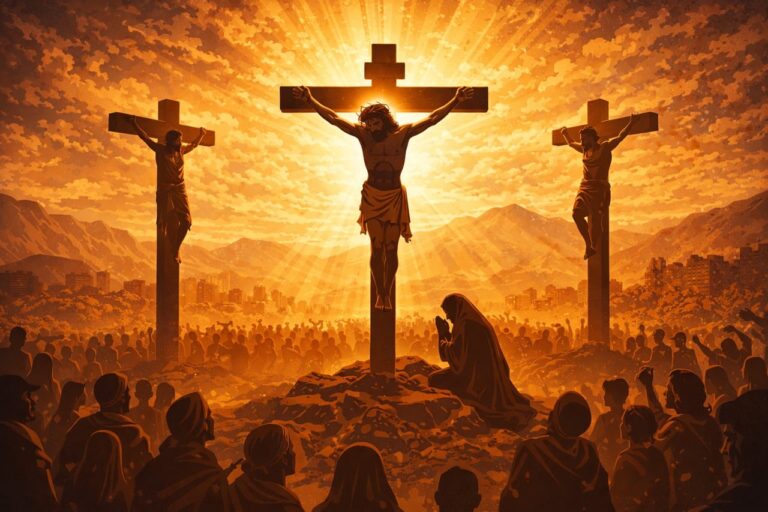
John 19 takes us to the cross. Jesus is mocked, beaten, crowned with thorns, and condemned even though Pilate repeatedly finds no basis for a charge against Him. The soldiers call Him Hail King of the Jews as an insult, yet their words declare a truth they do not understand. Jesus carries His cross to Golgotha, gives His life willingly, and declares, “It is finished.” God’s Redemption Plan has reached its appointed moment.
Obedience, God’s Covenant, Salvation, Faith, Grace, Eternity, Judgment, Redemption Plan, Jesus Christ
📖 John 19:1-3 (NIV)
“19 Then Pilate took Jesus and had him flogged. 2 The soldiers twisted together a crown of thorns and put it on his head. They clothed him in a purple robe 3 and went up to him again and again, saying, “Hail, king of the Jews!” And they slapped him in the face.”
Jesus stands before Pilate wearing a crown of thorns and a purple robe. The soldiers mock Him as a king, but Jesus is far more than the political king they imagine.
Pilate says, “Here is the man.”
The crowd demands His crucifixion.
Jesus is handed over and carries His own cross to Golgotha. There He is crucified between two others.
Above Him, Pilate places a sign declaring:
“Jesus of Nazareth, the King of the Jews.”
The religious leaders object, but Pilate refuses to change it.
Even in the suffering, Scripture continues to be fulfilled.
The soldiers divide His clothing.
His garment is not torn.
His bones are not broken.
And after Jesus gives up His spirit, a soldier pierces His side with a spear, and blood and water flow.
John emphasizes that he personally witnessed these things and gives testimony so that others may believe.
This is more than the death of a man.
This is the fulfillment of God’s Covenant and the central event of His Redemption Plan.
📖 John 19:4-7 (NIV)
“4 Once more Pilate came out and said to the Jews gathered there, “Look, I am bringing him out to you to let you know that I find no basis for a charge against him.” 5 When Jesus came out wearing the crown of thorns and the purple robe, Pilate said to them, “Here is the man!”
“6 As soon as the chief priests and their officials saw him, they shouted, “Crucify! Crucify!”
But Pilate answered, “You take him and crucify him. As for me, I find no basis for a charge against him.”
“7 The Jewish leaders insisted, “We have a law, and according to that law he must die, because he claimed to be the Son of God.”
Jesus knew what was coming.
Jeus knew the suffering.
He knew the cross.
He knew the humiliation.
Yet He continued forward.
He said:
“It is finished.”
Those three words carry enormous meaning.
The work the Father gave Him to accomplish had reached completion.
Jesus had remained obedient.
He had fulfilled Scripture.
He had carried the burden placed before Him.
And He willingly gave up His spirit.
Obedience brought Jesus to the cross, but the cross was not the end of God’s plan.
📖 John 19:8-11 (NIV)
“8 When Pilate heard this, he was even more afraid, 9 and he went back inside the palace. “Where do you come from?” he asked Jesus, but Jesus gave him no answer. 10 “Do you refuse to speak to me?” Pilate said. “Don’t you realize I have power either to free you or to crucify you?”
“11 Jesus answered, “You would have no power over me if it were not given to you from above. Therefore the one who handed me over to you is guilty of a greater sin.”
John makes a remarkable statement after describing the piercing of Jesus’ side.
Faith is not presented as something we hide from evidence.
John witnessed what happened and recorded it.
The Gospel calls us to listen, examine, believe, and follow Christ.
The events surrounding Jesus’ death were connected to Scripture written long before the crucifixion.
His bones were not broken.
He was pierced.
His clothing was divided.
The details point toward God’s faithfulness.
Faith recognizes that God’s promises do not fail.
📖 John 19:12-16 (NIV)
“12 From then on, Pilate tried to set Jesus free, but the Jewish leaders kept shouting, “If you let this man go, you are no friend of Caesar. Anyone who claims to be a king opposes Caesar.”
“13 When Pilate heard this, he brought Jesus out and sat down on the judge’s seat at a place known as the Stone Pavement (which in Aramaic is Gabbatha). 14 It was the day of Preparation of the Passover; it was about noon.
“Here is your king,” Pilate said to the Jews.
“15 But they shouted, “Take him away! Take him away! Crucify him!”
“Shall I crucify your king?” Pilate asked.
“We have no king but Caesar,” the chief priests answered.
“16 Finally Pilate handed him over to them to be crucified.”
So the soldiers took charge of Jesus
Pilate repeatedly found no basis for a charge against Jesus.
Yet Jesus was crucified.
That is where grace becomes visible.
Jesus did not deserve the cross.
We do not earn salvation by our own goodness.
Jesus willingly gave Himself so that sinners could receive forgiveness and the opportunity for eternal life.
Grace does not pretend sin does not matter.
Grace provides a Savior for sinners.
The cross shows us both the seriousness of sin and the greatness of God’s mercy.
📖 John 19:17-21 (NIV)
“17 Carrying his own cross, he went out to the place of the Skull (which in Aramaic is called Golgotha). 18 There they crucified him, and with him two others—one on each side and Jesus in the middle.”
“19 Pilate had a notice prepared and fastened to the cross. It read: jesus of nazareth, the king of the jews. 20 Many of the Jews read this sign, for the place where Jesus was crucified was near the city, and the sign was written in Aramaic, Latin and Greek. 21 The chief priests of the Jews protested to Pilate, “Do not write ‘The King of the Jews,’ but that this man claimed to be king of the Jews.”
The crowd had a choice.
They chose crucifixion.
The religious leaders rejected Jesus.
Human judgment condemned the One who came to save.
But earthly judgment was not the final word.
The cross would become the place where God’s justice and mercy meet.
Sin would be confronted.
The price would be paid.
And salvation would be offered.
The world judged Jesus.
But God was accomplishing something far greater than the crowd understood.
📖 John 19:22-26 (NIV)
“22 Pilate answered, “What I have written, I have written.”
“23 When the soldiers crucified Jesus, they took his clothes, dividing them into four shares, one for each of them, with the undergarment remaining. This garment was seamless, woven in one piece from top to bottom.”
“24 “Let’s not tear it,” they said to one another. “Let’s decide by lot who will get it.”
This happened that the scripture might be fulfilled that said,
“They divided my clothes among them
and cast lots for my garment.”[a]
So this is what the soldiers did.”
“25 Near the cross of Jesus stood his mother, his mother’s sister, Mary the wife of Clopas, and Mary Magdalene. 26 When Jesus saw his mother there, and the disciple whom he loved standing nearby, he said to her, “Woman,[b] here is your son,”
Throughout John 19, Scripture is repeatedly shown being fulfilled.
They cast lots for His garment.
He was pierced.
These details demonstrate that God’s Covenant did not disappear when Jesus was crucified.
It was being fulfilled.
Old Testament had pointed forward to the Messiah.
The Passover imagery points toward sacrifice.
Prophets pointed toward suffering.
The covenant promises pointed toward redemption.
Now those promises were converging at the cross.
📖 John 19:27-31 (NIV)
” 27 and to the disciple, “Here is your mother.” From that time on, this disciple took her into his home.”
“28 Later, knowing that everything had now been finished, and so that Scripture would be fulfilled, Jesus said, “I am thirsty.” 29 A jar of wine vinegar was there, so they soaked a sponge in it, put the sponge on a stalk of the hyssop plant, and lifted it to Jesus’ lips. 30 When he had received the drink, Jesus said, “It is finished.” With that, he bowed his head and gave up his spirit.”
“31 Now it was the day of Preparation, and the next day was to be a special Sabbath. Because the Jewish leaders did not want the bodies left on the crosses during the Sabbath, they asked Pilate to have the legs broken and the bodies taken down.”
Jesus’ statement, “It is finished,” is at the heart of this chapter.
The work required for salvation had reached its appointed completion.
He had taught the truth.
Jesus had shown God’s love.
He had remained obedient.
And now He had given His life.
Salvation would not come through human achievement.
It would come through Jesus Christ.
📖 John 19:32-36 (NIV)
” 32 The soldiers therefore came and broke the legs of the first man who had been crucified with Jesus, and then those of the other. 33 But when they came to Jesus and found that he was already dead, they did not break his legs. 34 Instead, one of the soldiers pierced Jesus’ side with a spear, bringing a sudden flow of blood and water. 35 The man who saw it has given testimony, and his testimony is true. He knows that he tells the truth, and he testifies so that you also may believe. 36 These things happened so that the scripture would be fulfilled: “Not one of his bones will be broken,”[c] “
The sign above Jesus said:
“Jesus of Nazareth, the King of the Jews.”
Then people wanted to reject His kingship.
The soldiers mocked it.
Then leaders wanted the wording changed.
But Pilate answered:
The irony is powerful.
They intended the sign as a political accusation.
But it proclaimed a deeper truth.
Jesus is King.
His kingdom is not limited to one nation.
His authority is not temporary.
The victory is not measured by earthly power.
A King went to the cross, but the story would continue beyond the tomb.
The cross points toward resurrection, and resurrection points toward eternity.
📖 John 19:37-42 (NIV)
“37 and, as another scripture says, “They will look on the one they have pierced.”[d]
“38 Later, Joseph of Arimathea asked Pilate for the body of Jesus. Now Joseph was a disciple of Jesus, but secretly because he feared the Jewish leaders. With Pilate’s permission, he came and took the body away. 39 He was accompanied by Nicodemus, the man who earlier had visited Jesus at night. Nicodemus brought a mixture of myrrh and aloes, about seventy-five pounds.[e] 40 Taking Jesus’ body, the two of them wrapped it, with the spices, in strips of linen. This was in accordance with Jewish burial customs. 41 At the place where Jesus was crucified, there was a garden, and in the garden a new tomb, in which no one had ever been laid. 42 Because it was the Jewish day of Preparation and since the tomb was nearby, they laid Jesus there.”
Even while suffering, Jesus thought about His mother.
Jesus’ suffering did not erase His compassion.
He continued to care for others.
That is the heart of Christ.
He was not only dying for humanity in some distant sense.
He remained the compassionate Savior who cared about the people standing around Him.
Grace and mercy were present even in the darkest hour/
The cross is one of the greatest demonstrations that God’s promises cannot be defeated by human decisions.
People rejected Jesus.
Yet Scripture was fulfilled.
People mock Jesus.
Yet He remained King.
People crucified Jesus.
Yet God’s Redemption Plan continued.
The soldiers pierced His side.
Yet even that fulfilled Scripture.
God was working through events that appeared to be completely out of control.
That gives us hope.
Our circumstances do not determine whether God is faithful.
God’s Covenant Stands because God Himself stands behind His promises.
John 19 teaches us that God’s plan can look completely different from what humanity expects.
The crowd saw defeat.
The religious leaders saw a threat removed.
The soldiers saw another crucifixion.
Pilate saw a difficult political decision.
But God saw redemption.
Jesus was not losing His kingdom.
He was accomplishing His mission.
Jesus was not abandoning God’s Covenant.
He was fulfilling it.
He was not overcome by evil.
Jesus was willingly giving Himself so that salvation could come through Him.
The entire Bible moves toward this moment.
There promises.
Then sacrifices.
There was prophets.
The covenant.
The Passover.
Then expectation of a Messiah.
All point toward Jesus Christ.
At Golgotha, Jesus became the center of God’s Redemption Plan.
Then he was mocked as King.
Then was crowned with thorns.
He carried the cross.
He was crucified.
His side was pierced.
And then He said:
“It is finished.”
But finished did not mean defeated.
Finished meant the work had been accomplished.
The sacrifice had been made.
The Savior had given Himself.
And the next chapter of God’s story would reveal that death would not have the final word.