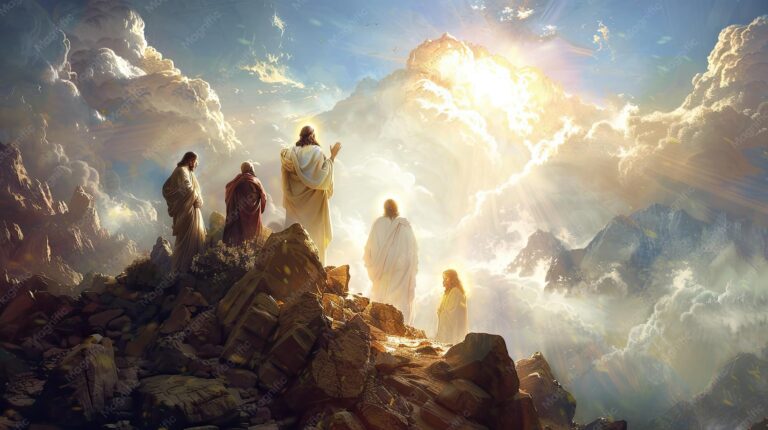
Mark 9 reveals Jesus in His glory, God Has Come With Power over evil, His compassion for the suffering, and His warnings about sin, judgment, and eternity. From the mountain of transfiguration to the valley of human need, Jesus teaches faith, humility, obedience, and sacrifice. God’s Covenant stands, and through Jesus Christ, the Redemption Plan unfolds, calling every person to listen, believe, follow, and remain faithful.
Obedience, God’s Covenant, Humility, Blessing, Judgment, Impure Spirits, Hell, Redemption Plan, Jesus Christ
📖 Mark 9:1-3 (NIV)
“9 And he said to them, “Truly I tell you, some who are standing here will not taste death before they see that the kingdom of God has come with power.”
“2 After six days Jesus took Peter, James and John with him and led them up a high mountain, where they were all alone. There he was transfigured before them. 3 His clothes became dazzling white, whiter than anyone in the world could bleach them. “
Mark 9 opens with Jesus telling His disciples that some standing with Him would not taste death before seeing the kingdom of God come with power.
Six days later, Peter, James, and John were taken up a high mountain, where they witnessed something they could not have fully imagined.
His clothes became dazzling white, and Moses and Elijah appeared speaking with Him.
Then came the voice from heaven:
“This is my Son, whom I love. Listen to him!”
The disciples were given a glimpse of the glory of Jesus Christ.
They saw that Jesus was not simply another teacher, prophet, or miracle worker.
He was the Son of God.
Yet the mountain experience was not where their journey ended.
They had to come back down.
And when they did, they immediately encountered suffering, confusion, unbelief, spiritual opposition, and people in need.
This is an important lesson for us.
There may be moments when our faith feels strong and God’s presence seems unmistakable.
But eventually we come down from the mountain and face the challenges of everyday life.
Faith is not only about what we experience on the mountain.
Faith is about what we do when we come down from it.
📖 Mark 8:4-8 (NIV)
“4 And there appeared before them Elijah and Moses, who were talking with Jesus.”
“5 Peter said to Jesus, “Rabbi, it is good for us to be here. Let us put up three shelters—one for you, one for Moses and one for Elijah.” 6 (He did not know what to say, they were so frightened.)”
“7 Then a cloud appeared and covered them, and a voice came from the cloud: “This is my Son, whom I love. Listen to him!”
“8 Suddenly, when they looked around, they no longer saw anyone with them except Jesus.”
Peter wanted to build shelters for Jesus, Moses, and Elijah. He was overwhelmed and did not know what to say.
But God made the message clear.
There was no need to place Jesus alongside Moses and Elijah as though they were equal.
The Father said:
Moses had served God’s covenant.
Elijah had served as God’s prophet.
But Jesus was the Son.
Disciples were being prepared to understand something much greater than the miracles they had witnessed.
Jesus was revealing God’s Redemption Plan, and that plan would require Him to suffer, die, and rise again.
Glory of the mountain would eventually lead to the suffering of the cross.
The disciples did not understand this yet.
But Jesus did.
📖 Mark 8:9-13 (NIV)
“9 As they were coming down the mountain, Jesus gave them orders not to tell anyone what they had seen until the Son of Man had risen from the dead. 10 They kept the matter to themselves, discussing what “rising from the dead” meant.”
“11 And they asked him, “Why do the teachers of the law say that Elijah must come first?”
“12 Jesus replied, “To be sure, Elijah does come first, and restores all things. Why then is it written that the Son of Man must suffer much and be rejected? 13 But I tell you, Elijah has come, and they have done to him everything they wished, just as it is written about him.”
When Jesus returned to the other disciples, a large crowd had gathered. A father had brought his son, who was suffering because of an impure spirit.
The disciples had tried to drive the spirit out but could not.
The father pleaded with Jesus for help.
Jesus responded:
“Everything is possible for one who believes.”
The father’s answer is one of the most honest expressions of faith in Scripture:
“I do believe; help me overcome my unbelief!”
There is a powerful lesson here.
Faith does not mean pretending that we have no doubts.
Faith means bringing those doubts to Jesus.
The father did not hide his weakness. He admitted it.
And Jesus acted.
Jesus commanded the impure spirit to leave the boy, and the boy was restored.
The disciples later asked why they could not drive it out.
Jesus pointed them toward prayer.
They were learning that spiritual work cannot be accomplished through human confidence alone.
God’s power is greater than Satan’s power, but dependence upon God matters.
📖 Mark 8:14-18 (NIV)
“14 When they came to the other disciples, they saw a large crowd around them and the teachers of the law arguing with them. 15 As soon as all the people saw Jesus, they were overwhelmed with wonder and ran to greet him.”
“16 “What are you arguing with them about?” he asked.”
“17 A man in the crowd answered, “Teacher, I brought you my son, who is possessed by a spirit that has robbed him of speech. 18 Whenever it seizes him, it throws him to the ground. He foams at the mouth, gnashes his teeth and becomes rigid. I asked your disciples to drive out the spirit, but they could not.”
Jesus again told His disciples that the Son of Man would be delivered into the hands of men, killed, and after three days rise again.
They still did not understand.
They were afraid to ask.
This shows how difficult God’s Redemption Plan was for human beings to comprehend.
The disciples were seeing miracles.
Jesus was thinking about the cross.
They were thinking about greatness.
Jesus was preparing to become the servant who would give His life.
The road to salvation would not be built around earthly power.
It would be built around sacrifice.
📖 Mark 8:19-23 (NIV)
“19 “You unbelieving generation,” Jesus replied, “how long shall I stay with you? How long shall I put up with you? Bring the boy to me.”
“20 So they brought him. When the spirit saw Jesus, it immediately threw the boy into a convulsion. He fell to the ground and rolled around, foaming at the mouth.”
“21 Jesus asked the boy’s father, “How long has he been like this?”
“From childhood,” he answered.
“22 “It has often thrown him into fire or water to kill him. But if you can do anything, take pity on us and help us.”
“23 “‘If you can’?” said Jesus. “Everything is possible for one who believes.”
On the road, the disciples had argued about who was the greatest.
Jesus knew what they had been discussing.
Instead of praising ambition, He taught them something completely different:
“Anyone who wants to be first must be the very last, and the servant of all.”
Then Jesus placed a child among them.
The world often measures greatness by position, money, influence, power, and recognition.
Serve.
Be humble.
Welcome the overlooked.
Care for those who cannot repay you.
Do God’s will rather than seeking attention for yourself.
This is obedience.
And obedience is not always about doing something enormous.
Sometimes it is as simple as giving someone a cup of water in Jesus’ name.
God sees those things.
📖 Mark 8:24-28 (NIV)
“24 Immediately the boy’s father exclaimed, “I do believe; help me overcome my unbelief!”
“25 When Jesus saw that a crowd was running to the scene, he rebuked the impure spirit. “You deaf and mute spirit,” he said, “I command you, come out of him and never enter him again.”
“26 The spirit shrieked, convulsed him violently and came out. The boy looked so much like a corpse that many said, “He’s dead.” 27 But Jesus took him by the hand and lifted him to his feet, and he stood up.
“28 After Jesus had gone indoors, his disciples asked him privately, “Why couldn’t we drive it out?”
John told Jesus that they had seen someone driving out demons in Jesus’ name and tried to stop him because he was not one of them.
Jesus corrected them.
“Do not stop him.”
The disciples were beginning to think in terms of our group and their group.
Jesus was teaching them that God’s work is bigger than their personal circle.
This does not mean truth does not matter.
It means God’s servants should not turn spiritual work into competition.
There is no room for pride when the purpose is to glorify Jesus Christ.
The question is not:
Who gets the credit?
The question is:
Is Jesus being honored?
📖 Mark 8:29-33 (NIV)
“29 He replied, “This kind can come out only by prayer.[a]”
“30 They left that place and passed through Galilee. Jesus did not want anyone to know where they were, 31 because he was teaching his disciples. He said to them, “The Son of Man is going to be delivered into the hands of men. They will kill him, and after three days he will rise.” 32 But they did not understand what he meant and were afraid to ask him about it.”
“33 They came to Capernaum. When he was in the house, he asked them, “What were you arguing about on the road?”
Jesus then gave one of the strongest warnings in the chapter.
He spoke about those who cause little ones who believe in Him to stumble.
This is where the message becomes extremely serious.
Choices affect other people.
Words affect other people.
Example affects other people.
A person who claims to follow Jesus cannot treat sin as though it does not matter.
Jesus used strong language to demonstrate the seriousness of removing anything from our lives that causes us to stumble.
The message is not that people should literally harm themselves.
The message is that we must deal seriously with sin.
If something continually pulls us away from God, we cannot casually embrace it and expect there to be no consequences.
Sin is not something to play with.
📖 Mark 8:34-39 (NIV)
“34 But they kept quiet because on the way they had argued about who was the greatest.”
“35 Sitting down, Jesus called the Twelve and said, “Anyone who wants to be first must be the very last, and the servant of all.”
“36 He took a little child whom he placed among them. Taking the child in his arms, he said to them, 37 “Whoever welcomes one of these little children in my name welcomes me; and whoever welcomes me does not welcome me but the one who sent me.”
“38 “Teacher,” said John, “we saw someone driving out demons in your name and we told him to stop, because he was not one of us.”
“39 “Do not stop him,” Jesus said. “For no one who does a miracle in my name can in the next moment say anything bad about me, “
The final words of the chapter bring a remarkable image:
“Everyone will be salted with fire.”
Salt preserves.
Salt flavors.
It was valuable.
Jesus then said:
“Salt is good, but if it loses its saltiness, how can you make it salty again?”
The follower of Jesus is called to remain spiritually useful in a world that desperately needs truth.
Fire can represent testing, purification, and judgment throughout Scripture.
Mark 9 places this powerful imagery beside Jesus’ warnings about Hell and His teaching about living faithfully.
Cost to following Christ.
There is a seriousness to sin.
There is a reality to judgment.
And there is a greater promise in God’s Redemption Plan.
Jesus does not call us to simply hear His words.
He calls us to live them.
📖 Mark 8:40-45 (NIV)
“40 for whoever is not against us is for us. 41 Truly I tell you, anyone who gives you a cup of water in my name because you belong to the Messiah will certainly not lose their reward.”
“42 “If anyone causes one of these little ones—those who believe in me—to stumble, it would be better for them if a large millstone were hung around their neck and they were thrown into the sea. 43 If your hand causes you to stumble, cut it off. It is better for you to enter life maimed than with two hands to go into hell, where the fire never goes out. [44] [b] 45 And if your foot causes you to stumble, cut it off. It is better for you to enter life crippled than to have two feet and be thrown into hell.”
Jesus’ teaching about Hell cannot simply be ignored because it is uncomfortable.
The warning is connected directly to the choices people make.
God offers grace.
Jesus offers salvation.
The Holy Spirit leads.
God’s covenant stands.
But human beings still have choices to make.
The existence of God’s grace does not make judgment disappear.
Instead, grace makes the choice even more meaningful.
Jesus did not warn people about Hell to take away hope.
He warned them because He came to provide a way of salvation.
The same Jesus who warned about judgment also went to the cross to make redemption possible.
📖 Mark 8:46-50 (NIV)
“[46] [c] 47 And if your eye causes you to stumble, pluck it out. It is better for you to enter the kingdom of God with one eye than to have two eyes and be thrown into hell, 48 where
“‘the worms that eat them do not die,
and the fire is not quenched.’[d]
“49 Everyone will be salted with fire.
“50 “Salt is good, but if it loses its saltiness, how can you make it salty again? Have salt among yourselves, and be at peace with each other.”
The Father said:
“Listen to him!”
Jesus speaks about faith.
When He speaks about humility.
He speaks about serving.
Listen when He warns about sin.
He warns about judgment.
Jesus He tells us to remove whatever causes us to stumble.
And listen when He tells us that salvation is worth more than everything this world can offer.
Obedience begins with listening.
But it cannot end there.
We hear God’s Word so that we can live God’s Word.
God’s Covenant does not change because people struggle to understand it.
Disciples did not understand everything Jesus told them.
Father struggled with unbelief.
Disciples struggled with spiritual power.
They argued about greatness.
They misunderstood Jesus’ mission.
Yet God’s plan continued.
Transfiguration revealed God’s glory.
Healing revealed God’s mercy.
Teaching revealed God’s truth.
Warnings revealed God’s judgment.
And Jesus’ coming death and resurrection revealed God’s Redemption Plan.
Human weakness did not cancel God’s promise.
God’s Covenant stands even when our understanding is incomplete.
Mark 9 teaches us that faith is a journey.
We may have moments of great confidence and moments when we say, “Help me overcome my unbelief.”
We may understand one lesson today and another tomorrow.
But Jesus continues to teach.
We learn that:
Obedience matters.
Faith must depend upon God.
Humility is greater than pride.
Serving others is true greatness.
Sin must be taken seriously.
Judgment is real.
Hell is not something Jesus treated lightly.
Prayer keeps us dependent upon God.
Our example can influence others.
Jesus Christ is greater than everything else.
The disciples wanted to understand greatness.
Jesus showed them the cross.
They wanted power.
Jesus taught them service.
They struggled with faith.
Jesus taught them to believe.
They faced evil.
Jesus demonstrated authority.
They worried about who was greatest.
Jesus placed a child before them.
Again and again, Jesus turned their thinking away from themselves and toward God.
Mark 9 brings together glory, suffering, faith, healing, humility, spiritual warfare, obedience, judgment, and eternity.
But every part points toward Jesus Christ.
Voice from heaven identifies Him:
“This is my Son.”
Demons recognize His authority.
Suffering father runs to Him.
Disciples learn from Him.
Child is restored by His power.
Proud are challenged by His teaching.
Humble are lifted by His example.
And those who hear His warnings are being called to make a choice.
Jesus is not simply showing people how to live better lives.
He is revealing God’s Redemption Plan.
Mountain points to His glory.
Valley points to His mission.
Healing points to His authority.
Warnings point to judgment.
Call to obedience points to discipleship.
And everything ultimately leads toward the cross and the empty tomb.
Jesus came with power.
Jesus came with mercy.
He came with truth.
Came with a warning about eternity.
And He came to give salvation.
The question is not simply whether we have seen Jesus’ power.
The question is whether we will listen to Him, believe Him, obey Him, and follow Him.