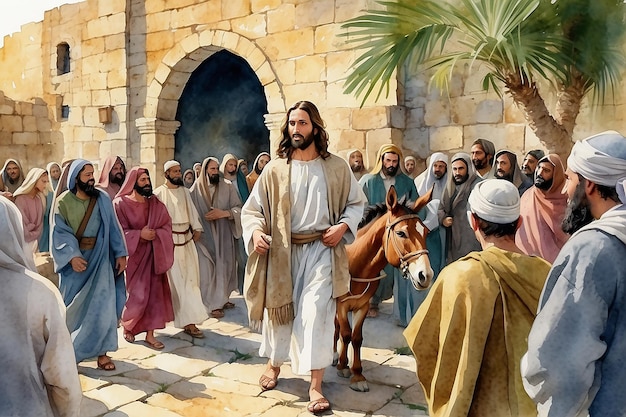
John 7 reveals they Did Not Believe In Him a growing division around Jesus. His own brothers did not believe in Him, religious leaders wanted to kill Him, crowds argued about His identity, and even the temple guards were amazed by His words. Yet Jesus continued teaching the truth He had received from the Father. The chapter asks a question that still matters: Will we believe Jesus, or judge Him by appearances?
Obedience • God’s Covenant • Belief • Faith • Pharisees • Brothers • Truth • Eternity • Redemption Plan • Jesus Christ
📖 John 7:1-3 (NIV)
“7 After this, Jesus went around in Galilee. He did not want[a] to go about in Judea because the Jewish leaders there were looking for a way to kill him. 2 But when the Jewish Festival of Tabernacles was near, 3 Jesus’ brothers said to him, “Leave Galilee and go to Judea, so that your disciples there may see the works you do. “
Jesus remained in Galilee because the Jewish leaders in Judea were looking for a way to kill Him.
As the Festival of Tabernacles approached, His brothers encouraged Him to go publicly to Judea and display His works.
But John gives us an important detail:
Even His own brothers did not believe in Him.
Jesus explained that His time had not yet come.
He eventually went to the festival, but He went quietly.
People were already divided over Him.
Some believed He was a good man.
Others accused Him of deceiving people.
Fear kept many from speaking openly.
Halfway through the festival, Jesus went to the temple courts and began teaching.
Jesus explained that His teaching came from the One who sent Him.
He challenged them to stop judging by appearances and instead judge correctly.
The conflict continued.
Some wanted to seize Him.
The religious leaders sent guards to arrest Him.
But no one could take Jesus because His hour had not yet come.
On the final and greatest day of the festival, Jesus stood and called out to those who were thirsty:
“Let anyone who is thirsty come to me and drink.”
He promised living water to those who believed in Him.
The crowd became even more divided.
Some believed He was the Messiah.
Others questioned how the Messiah could come from Galilee.
The Pharisees rejected Him.
But the temple guards returned without arresting Him because they had never heard anyone speak like Jesus.
Nicodemus then reminded the leaders that their own law required them to hear a person before judging him.
Instead of listening, they dismissed the possibility that anything good could come from Galilee.
They were judging Jesus by what they thought they knew rather than discovering who He truly was.
📖 John 7:4-9 (NIV)
“4 No one who wants to become a public figure acts in secret. Since you are doing these things, show yourself to the world.” 5 For even his own brothers did not believe in him.”
“6 Therefore Jesus told them, “My time is not yet here; for you any time will do.7 The world cannot hate you, but it hates me because I testify that its works are evil. 8 You go to the festival. I am not[b] going up to this festival, because my time has not yet fully come.” 9 After he had said this, he stayed in Galilee.”
The people became divided because they believed they already understood Jesus.
People knew He was from Galilee.
They knew His family.
They knew what they thought His background was.
But they did not understand where He truly came from.
This reveals a danger in human judgment.
We can become so focused on what we think we know that we fail to discover what God is showing us.
The religious leaders judged Jesus by earthly expectations.
But Jesus came from above.
Faith requires us to look beyond appearances and listen to God’s truth.
📖 John 7:10-16 (NIV)
“10 However, after his brothers had left for the festival, he went also, not publicly, but in secret. 11 Now at the festival the Jewish leaders were watching for Jesus and asking, “Where is he?”
“12 Among the crowds there was widespread whispering about him. Some said, “He is a good man.”
Others replied, “No, he deceives the people.” 13 But no one would say anything publicly about him for fear of the leaders.”
“14 Not until halfway through the festival did Jesus go up to the temple courts and begin to teach. 15 The Jews there were amazed and asked, “How did this man get such learning without having been taught?”
“16 Jesus answered, “My teaching is not my own. It comes from the one who sent me.”
John specifically tells us that Jesus’ own brothers did not believe in Him.
Being related to Jesus did not automatically mean they understood Him.
They had to come to faith just like everyone else.
This is an important lesson.
The person’s parents may believe.
A spouse may believe.
A brother or sister may believe.
But every person must eventually decide what they believe about Jesus Christ.
Jesus does not ask us simply to be connected to people who believe.
He calls us to believe in Him ourselves.
Faith becomes personal when we stop relying on someone else’s belief and place our trust in Jesus.
📖 John 7:17-23 (NIV)
“17 Anyone who chooses to do the will of God will find out whether my teaching comes from God or whether I speak on my own. 18 Whoever speaks on their own does so to gain personal glory, but he who seeks the glory of the one who sent him is a man of truth; there is nothing false about him. 19 Has not Moses given you the law? Yet not one of you keeps the law. Why are you trying to kill me?”
“20 “You are demon-possessed,” the crowd answered. “Who is trying to kill you?”
“21 Jesus said to them, “I did one miracle, and you are all amazed. 22 Yet, because Moses gave you circumcision (though actually it did not come from Moses, but from the patriarchs), you circumcise a boy on the Sabbath. 23 Now if a boy can be circumcised on the Sabbath so that the law of Moses may not be broken, why are you angry with me for healing a man’s whole body on the Sabbath? “
The religious leaders questioned how Jesus could have such knowledge.
Jesus gave them the answer.
It came from the One who sent Him.
Jesus sought the glory of the Father.
This separates Jesus from those who teach for personal recognition.
Truth does not exist to make the messenger famous.
Truth points beyond the messenger to God.
Jesus’ authority came from the Father.
His mission came from the Father.
His teaching came from the Father.
And His purpose was to fulfill the Father’s Redemption Plan.
Jesus did not come to create His own message—He came to reveal the Father’s truth.
📖 John 7:24-30 (NIV)
“24 Stop judging by mere appearances, but instead judge correctly.”
“25 At that point some of the people of Jerusalem began to ask, “Isn’t this the man they are trying to kill? 26 Here he is, speaking publicly, and they are not saying a word to him. Have the authorities really concluded that he is the Messiah? 27 But we know where this man is from; when the Messiah comes, no one will know where he is from.”
“28 Then Jesus, still teaching in the temple courts, cried out, “Yes, you know me, and you know where I am from. I am not here on my own authority, but he who sent me is true. You do not know him, 29 but I know him because I am from him and he sent me.”
“30 At this they tried to seize him, but no one laid a hand on him, because his hour had not yet come”
Jesus challenged the people directly:
“Stop judging by mere appearances, but instead judge correctly.”
They were focused on the rule they believed had been violated.
Jesus directed them toward the greater purpose of God’s law.
They were looking at the outward action while missing the work God was doing.
This is a warning for all of us.
It is easy to judge quickly.
We see circumstances.
Were hearing rumors.
We form opinions.
But God sees the entire picture.
The religious leaders thought they understood Jesus.
They did not.
Truth requires more than appearances—it requires humility, understanding, and a willingness to listen.
📖 John 7:31-38 (NIV)
“31 Still, many in the crowd believed in him. They said, “When the Messiah comes, will he perform more signs than this man?”
“32 The Pharisees heard the crowd whispering such things about him. Then the chief priests and the Pharisees sent temple guards to arrest him.”
“33 Jesus said, “I am with you for only a short time, and then I am going to the one who sent me. 34 You will look for me, but you will not find me; and where I am, you cannot come.”
“35 The Jews said to one another, “Where does this man intend to go that we cannot find him? Will he go where our people live scattered among the Greeks, and teach the Greeks? 36 What did he mean when he said, ‘You will look for me, but you will not find me,’ and ‘Where I am, you cannot come’?”
“37 On the last and greatest day of the festival, Jesus stood and said in a loud voice, “Let anyone who is thirsty come to me and drink. 38 Whoever believes in me, as Scripture has said, rivers of living water will flow from within them.”[c]
On the final day of the festival, Jesus made a powerful invitation.
This connects directly to the message of John 4, where Jesus offered the Samaritan woman living water.
But here Jesus speaks to a much larger crowd.
He explains that those who believe in Him will receive the Spirit.
Earthly water satisfies physical thirst temporarily.
The living water Jesus offers reaches deeper.
It points toward spiritual life.
Human beings can spend their lives trying to satisfy a thirst that possessions, success, recognition, and temporary pleasures cannot satisfy.
Jesus offers something the world cannot provide.
Come to Jesus. Drink. Believe. Receive the life that comes from God.
📖 John 7:39-45 (NIV)
“39 By this he meant the Spirit, whom those who believed in him were later to receive. Up to that time the Spirit had not been given, since Jesus had not yet been glorified.”
“40 On hearing his words, some of the people said, “Surely this man is the Prophet.”
“41 Others said, “He is the Messiah.”
Still others asked, “How can the Messiah come from Galilee? 42 Does not Scripture say that the Messiah will come from David’s descendants and from Bethlehem, the town where David lived?” 43 Thus the people were divided because of Jesus. 44 Some wanted to seize him, but no one laid a hand on him.”
“45 Finally the temple guards went back to the chief priests and the Pharisees, who asked them, “Why didn’t you bring him in?”
The crowd could not agree about Jesus.
Some said He was the Prophet.
Some said He was the Messiah.
The crowd was divided.
Religious leaders rejected Him.
The guards were impressed by Him.
Nicodemus defended the need for a fair hearing.
Jesus continued teaching.
The division reveals something important.
Jesus does not leave people neutral.
His identity demands a response.
People must decide whether they will believe Him or reject Him.
The question is not simply what others think about Jesus.
The question is what you believe about Jesus.
📖 John 7:46-53 (NIV)
“46 “No one ever spoke the way this man does,” the guards replied.”
“47 “You mean he has deceived you also?” the Pharisees retorted. 48 “Have any of the rulers or of the Pharisees believed in him? 49 No! But this mob that knows nothing of the law—there is a curse on them.”
“50 Nicodemus, who had gone to Jesus earlier and who was one of their own number, asked, 51 “Does our law condemn a man without first hearing him to find out what he has been doing?”
“52 They replied, “Are you from Galilee, too? Look into it, and you will find that a prophet does not come out of Galilee.”
“53 Then they all went home,”
They knew the prophecies.
They knew the law.
Yet they refused to investigate Jesus honestly.
Their conclusion was already made.
They believed that a prophet could not come from Galilee.
But their certainty became an obstacle to discovering the truth.
Nicodemus at least asked them to follow their own law and hear Jesus before condemning Him.
This teaches us that knowledge without humility can become dangerous.
A person can know Scripture and still misunderstand what God is doing.
We should never allow our assumptions to become stronger than our willingness to seek the truth.
The conflict in John 7 does not mean God’s plan is failing.
Quite the opposite.
Everything is moving according to God’s timing.
Jesus repeatedly says that His time had not yet come.
People wanted to seize Him.
The religious leaders wanted Him arrested.
But they could not take Him.
Why?
Because God’s plan was greater than human plans.
Jesus would not be killed simply because His enemies wanted Him dead.
He would give His life at the appointed time.
The Messiah had to fulfill what God had promised.
The rejection, opposition, and division surrounding Jesus were becoming part of the path toward the cross.
God’s Covenant stands even when people reject the One through whom the covenant’s Redemption Plan will be fulfilled.
Faith must become personal.
Even family members must make their own decision about Jesus.
We should not judge by appearances.
God’s truth requires humility.
Jesus’ teaching came from the Father.
Jesus sought God’s glory rather than human recognition.
People can know Scripture and still misunderstand its message.
Human assumptions can become barriers to faith.
Jesus offers living water through the Spirit.
Jesus’ identity requires a response.
God’s timing is greater than human plans.
Opposition cannot stop God’s Redemption Plan.
Truth should be investigated rather than rejected because of assumptions.
Jesus knows exactly where He came from and why He was sent.
Eternal life requires more than knowing about Jesus—it requires believing in Him.
John 7 shows a world divided over Jesus.
His own brothers did not believe in Him.
The crowds argued about Him.
Pharisees rejected Him.
The guards were amazed by His words.
Nicodemus asked for fairness.
And Jesus continued declaring the truth.
But beneath all of this disagreement was the greater question:
Who is Jesus?
The answer is found throughout the chapter.
He was sent by the Father.
His teaching came from God.
He offered living water.
Jesus promised the Spirit to those who believed.
He continued toward the time appointed by God.
The people focused on Galilee.
God was revealing the Son of God.
They looked at where they thought Jesus came from.
Jesus wanted them to understand where He truly came from:
He came from the Father.
The people were thirsty, divided, confused, and searching.
Jesus stood among them and said:
“Let anyone who is thirsty come to me and drink.”
That invitation reaches beyond the crowd in Jerusalem.
It reaches us today.
The world may argue about Jesus, but the Redemption Plan of God calls us to do more than argue—we are called to believe.
Jesus Christ is the One sent by the Father, offering living water, eternal life, and salvation to everyone who comes to Him in faith.