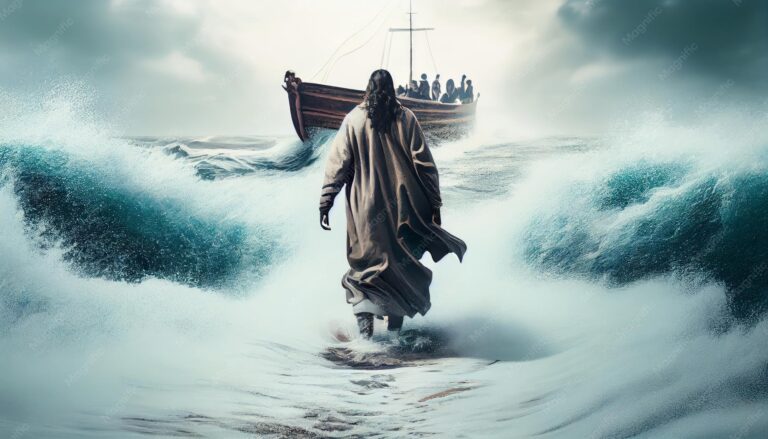
Mark 6 shows us Lack Of Faith, that faith can be tested in many different ways. Jesus is rejected in His hometown, yet He continues teaching and sending His disciples forward. John the Baptist stands for truth even when it costs him his life. Jesus feeds thousands with what appears insufficient, walks upon the water, and heals those who reach for Him. Through every event, Mark reveals that God’s power does not depend upon human approval. Faith, obedience, humility, and trust remain central to following Jesus Christ.
Obedience, God’s Covenant, Faith, Grace, Blessings, Amazed, John the Baptist, Judgment, Redemption Plan, Jesus Christ
📖 Mark 6:1-3 (NIV)
“6 Jesus left there and went to his hometown, accompanied by his disciples. 2 When the Sabbath came, he began to teach in the synagogue, and many who heard him were amazed.
“Where did this man get these things?” they asked. “What’s this wisdom that has been given him? What are these remarkable miracles he is performing? 3 Isn’t this the carpenter? Isn’t this Mary’s son and the brother of James, Joseph,[a] Judas and Simon? Aren’t his sisters here with us?” And they took offense at him.”
Mark 6 brings together ordinary people, difficult circumstances, and extraordinary works of God.
Their lack of faith becomes a warning that familiarity can sometimes prevent people from recognizing what God is doing.
Jesus then sends the Twelve out with authority, teaching them to depend upon God rather than material possessions.
Their ministry is followed by the tragic death of John the Baptist, whose commitment to truth reminds us that obedience to God can come with a cost.
Jesus sees the crowds as sheep without a shepherd and responds with compassion.
Five loaves and two fish become enough to feed five thousand men. Later, Jesus walks on the water and calms the disciples’ fear.
Yet Mark tells us something important: even after witnessing miracles, the disciples struggled to understand.
Their hearts were hardened. Then, at Gennesaret, people simply reached out and touched Jesus’ cloak, and all who touched it were healed.
The chapter shows both the weakness of human faith and the limitless power of Jesus.
God continues His Redemption Plan even when people struggle to understand what He is doing.
📖 Mark 6:4-10 (NIV)
“4 Jesus said to them, “A prophet is not without honor except in his own town, among his relatives and in his own home.” 5 He could not do any miracles there, except lay his hands on a few sick people and heal them. 6 He was amazed at their lack of faith.”
Then Jesus went around teaching from village to village. 7 Calling the Twelve to him, he began to send them out two by two and gave them authority over impure spirits.”
“8 These were his instructions: “Take nothing for the journey except a staff—no bread, no bag, no money in your belts. 9 Wear sandals but not an extra shirt. 10 Whenever you enter a house, stay there until you leave that town. “
Jesus returned to His hometown and taught in the synagogue, but many people questioned how someone they knew could possess such wisdom and authority.
Instead of allowing the evidence of His teaching and miracles to strengthen their faith, they took offense at Him.
This is an important lesson about faith.
The people knew Jesus as the carpenter and as Mary’s son, but they failed to recognize Him as the Son of God.
Jesus was amazed at their lack of faith.
Their response reminds us that seeing God’s work and believing God’s truth are not always the same thing.
Faith requires more than familiarity. It requires humility, an open heart, and a willingness to believe what God reveals.
📖 Mark 6:11-17 (NIV)
“11 And if any place will not welcome you or listen to you, leave that place and shake the dust off your feet as a testimony against them.”
“12 They went out and preached that people should repent. 13 They drove out many demons and anointed many sick people with oil and healed them.”
“14 King Herod heard about this, for Jesus’ name had become well known. Some were saying,[b] “John the Baptist has been raised from the dead, and that is why miraculous powers are at work in him.”
“15 Others said, “He is Elijah.”
And still others claimed, “He is a prophet, like one of the prophets of long ago.”
“16 But when Herod heard this, he said, “John, whom I beheaded, has been raised from the dead!”
“17 For Herod himself had given orders to have John arrested, and he had him bound and put in prison. He did this because of Herodias, his brother Philip’s wife, whom he had married.”
Jesus called the Twelve and sent them out two by two. He gave them authority over impure spirits and instructed them to preach repentance, drive out demons, and heal the sick.
They were ordinary people being given an extraordinary responsibility.
This becomes part of God’s pattern throughout Scripture. God repeatedly works through people who are willing to obey Him.
The disciples did not need to possess everything before beginning their mission. They needed to trust the One who sent them.
Obedience becomes the first step.
God provides the strength, authority, and opportunity.
📖 Mark 6:18-23 (NIV)
“18 For John had been saying to Herod, “It is not lawful for you to have your brother’s wife.” 19 So Herodias nursed a grudge against John and wanted to kill him. But she was not able to, 20 because Herod feared John and protected him, knowing him to be a righteous and holy man. When Herod heard John, he was greatly puzzled[c]; yet he liked to listen to him.”
“21 Finally the opportune time came. On his birthday Herod gave a banquet for his high officials and military commanders and the leading men of Galilee. 22 When the daughter of[d] Herodias came in and danced, she pleased Herod and his dinner guests.”
The king said to the girl, “Ask me for anything you want, and I’ll give it to you.” 23 And he promised her with an oath, “Whatever you ask I will give you, up to half my kingdom.”
John the Baptist spoke truth to Herod about his unlawful relationship with Herodias.
Eventually, Herodias sought John’s death, and John was executed.
This is one of the difficult lessons of Mark 6: obedience does not always produce an easy life.
John was faithful, yet he suffered.
His story reminds us that God’s people are not promised freedom from every earthly trial.
They are called to remain faithful through those trials.
John had prepared the way for Jesus. His earthly life ended, but his testimony did not become meaningless.
His faithfulness became part of the greater story of God’s Redemption Plan.
📖 Mark 6:24-30 (NIV)
“24 She went out and said to her mother, “What shall I ask for?”
“The head of John the Baptist,” she answered.
“25 At once the girl hurried in to the king with the request: “I want you to give me right now the head of John the Baptist on a platter.”
“26 The king was greatly distressed, but because of his oaths and his dinner guests, he did not want to refuse her. 27 So he immediately sent an executioner with orders to bring John’s head. The man went, beheaded John in the prison, 28 and brought back his head on a platter. He presented it to the girl, and she gave it to her mother. 29 On hearing of this, John’s disciples came and took his body and laid it in a tomb.”
“30 The apostles gathered around Jesus and reported to him all they had done and taught.”
After the disciples returned and reported everything they had done, Jesus wanted them to rest.
But the crowds followed them.
Jesus could have dismissed them.
His response was compassion.
This reveals something important about the heart of Jesus Christ.
He does not simply see crowds as numbers.
He sees people who need truth, guidance, mercy, and hope.
Jesus teaches His disciples, feeds the hungry, heals the sick, and cares for those who come to Him.
The Christian life cannot be separated from compassion. If we follow Jesus, we should learn to see people differently—not simply by what they possess or what they can do for us, but as people who need God’s love and truth.
📖 Mark 6:31-36 (NIV)
“31 Then, because so many people were coming and going that they did not even have a chance to eat, he said to them, “Come with me by yourselves to a quiet place and get some rest.”
“32 So they went away by themselves in a boat to a solitary place. 33 But many who saw them leaving recognized them and ran on foot from all the towns and got there ahead of them. 34 When Jesus landed and saw a large crowd, he had compassion on them, because they were like sheep without a shepherd. So he began teaching them many things.”
“35 By this time it was late in the day, so his disciples came to him. “This is a remote place,” they said, “and it’s already very late. 36 Send the people away so that they can go to the surrounding countryside and villages and buy themselves something to eat.”
Jesus saw an opportunity to demonstrate God’s provision.
Yet Jesus gave thanks, broke the bread, and gave it to the disciples to distribute.
Everyone ate and was satisfied, and twelve basketfuls remained.
The lesson is not simply about food.
It is about what happens when human limitations are placed into God’s hands.
We may look at what we have and say, “It isn’t enough.”
God may be teaching us to ask a different question:
“What can God do with what I am willing to give?”
Faith does not require us to possess everything.
It requires us to trust God with what we have.
📖 Mark 6:37-44 (NIV)
“37 But he answered, “You give them something to eat.”
They said to him, “That would take more than half a year’s wages[e]! Are we to go and spend that much on bread and give it to them to eat?”
“38 “How many loaves do you have?” he asked. “Go and see.”
When they found out, they said, “Five—and two fish.”
“39 Then Jesus directed them to have all the people sit down in groups on the green grass. 40 So they sat down in groups of hundreds and fifties. 41 Taking the five loaves and the two fish and looking up to heaven, he gave thanks and broke the loaves. Then he gave them to his disciples to distribute to the people. He also divided the two fish among them all. 42 They all ate and were satisfied, 43 and the disciples picked up twelve basketfuls of broken pieces of bread and fish. 44 The number of the men who had eaten was five thousand.”
After feeding the crowd, Jesus sent the disciples ahead while He went to pray.
Then they saw Jesus walking on the lake.
They were terrified because they did not understand what they were seeing.
Jesus immediately told them to take courage and not be afraid.
When He entered the boat, the wind died down.
Yet Mark points out that the disciples still had not understood the miracle of the loaves.
Their hearts were hardened.
This is a powerful reminder that faith is a journey.
A person can witness God’s blessings and still struggle with fear and understanding.
Jesus did not abandon the disciples because they were struggling.
He came to them.
Sometimes faith means trusting Jesus before we understand what He is doing.
📖 Mark 6:45-51 (NIV)
“45 Immediately Jesus made his disciples get into the boat and go on ahead of him to Bethsaida, while he dismissed the crowd. 46 After leaving them, he went up on a mountainside to pray.”
“47 Later that night, the boat was in the middle of the lake, and he was alone on land. 48 He saw the disciples straining at the oars, because the wind was against them. Shortly before dawn he went out to them, walking on the lake. He was about to pass by them, 49 but when they saw him walking on the lake, they thought he was a ghost. They cried out, 50 because they all saw him and were terrified.”
Immediately he spoke to them and said, “Take courage! It is I. Don’t be afraid.” 51 Then he climbed into the boat with them, and the wind died down. They were completely amazed,”
When Jesus arrived in Gennesaret, people immediately recognized Him.
They carried the sick to wherever they heard He was.
They begged Him for permission to touch even the edge of His cloak.
And Mark records that all who touched it were healed.
They knew they needed help, and they believed Jesus could provide it.
Throughout the Gospels, healing points beyond the physical body.
Jesus demonstrates authority over sickness, demons, nature, sin, and ultimately death.
His miracles reveal who He is.
Jesus is not simply a teacher who speaks about God’s power.
He is the Son of God through whom God’s power is revealed.
📖 Mark 6:52-56 (NIV)
“52 for they had not understood about the loaves; their hearts were hardened.”
“53 When they had crossed over, they landed at Gennesaret and anchored there. 54 As soon as they got out of the boat, people recognized Jesus. 55 They ran throughout that whole region and carried the sick on mats to wherever they heard he was. 56 And wherever he went—into villages, towns or countryside—they placed the sick in the marketplaces. They begged him to let them touch even the edge of his cloak, and all who touched it were healed.”
Mark 6 contains miracle after miracle, yet the disciples still struggled to understand.
Saw demons driven out.
Witnessed healings.
Saw Jesus walk on water.
Watched the wind become calm.
This should give us humility.
Following Jesus does not mean we immediately understand everything.
Faith grows through experience, obedience, correction, and continued learning.
The disciples were not perfect. They were being taught.
That is part of the beauty of Mark’s Gospel.
Jesus takes ordinary people and teaches them to participate in extraordinary work.
God can work through people who are still learning, as long as they continue following Him.
Mark 6 reminds us that God’s Covenant does not depend upon humanity being perfect.
We can doubt.
People can fear.
We can misunderstand.
People can even reject what God places directly before them.
Yet God continues His work.
John the Baptist remained faithful to God’s truth.
The disciples were sent to proclaim repentance.
Jesus showed compassion to the crowds, provided food for thousands, calmed the waters, and healed those who reached toward Him.
God’s promises remain steady even when human faith is inconsistent.
His Covenant points toward something greater than temporary earthly circumstances.
It points toward God’s continuing Redemption Plan and the salvation ultimately revealed through Jesus Christ.
Mark 6 teaches us that faith is more than believing when everything is easy.
Faith is trusting when we are rejected.
Faith is obeying when we do not have everything we think we need.
Standing for truth when there is a cost.
Giving God what we have, even when it seems too small.
Reaching toward Jesus when we need healing.
And faith is continuing to follow when we do not understand everything God is doing.
The chapter also teaches humility.
The disciples witnessed incredible things and still had much to learn.
We should not expect ourselves to understand everything immediately. Instead, we should continue learning, continue obeying, and continue looking toward Jesus.
Mark 6 continually points us toward the identity and authority of Jesus Christ.
Jesus teaches with authority.
Jesus sends His disciples with authority.
Has authority over demons.
Provides food for thousands.
Walks upon the water.
Commands the wind.
Heals the sick.
And people from every surrounding area come looking for Him.
Even John the Baptist’s story points forward to Christ because John had faithfully prepared the way for the One who would come after him.
The people may have struggled to understand who Jesus was, but His actions continued to reveal the answer.
Jesus is more than a teacher.
He is more than a healer.
He is more than a miracle worker.
Jesus is the Son of God and the center of God’s Redemption Plan.
Mark 6 shows ordinary people encountering an extraordinary Savior—and reminds us that when faith reaches toward Jesus Christ, we are reaching toward the One who has authority over every circumstance.