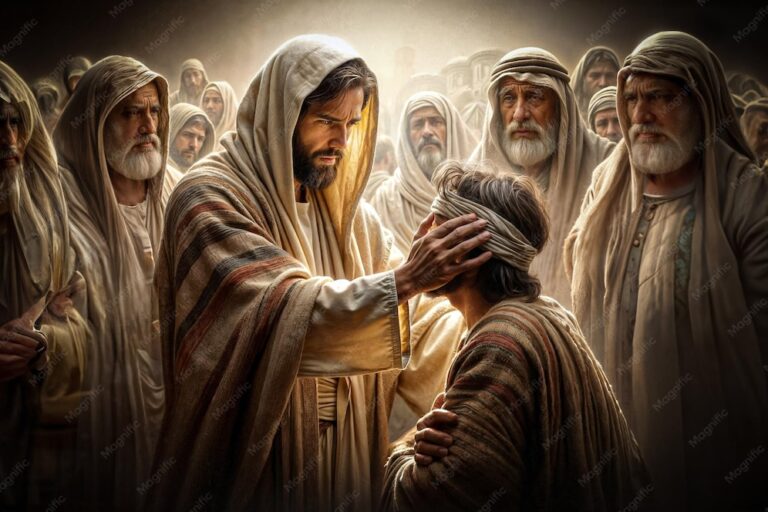
John 9 tells the story of a man who had been Blind From Birth and whose life was completely changed when Jesus gave him sight. But the chapter is about much more than physical healing. It reveals the difference between being physically blind and being spiritually blind.The man who could not see came to recognize who Jesus was. The Pharisees, who believed they could see clearly, refused to recognize the One standing before them.
Obedience • God’s Covenant • Mercy • Faith • Judgment • Grace • Belief • Glory • Redemption Plan • Jesus Christ
📖 John 9:1-3 (NIV)
“9 As he went along, he saw a man blind from birth. 2 His disciples asked him, “Rabbi, who sinned, this man or his parents, that he was born blind?”
“3 “Neither this man nor his parents sinned,” said Jesus, “but this happened so that the works of God might be displayed in him.”
As Jesus and His disciples traveled, they encountered a man who had been blind from birth.
The disciples asked whether his blindness was caused by his own sin or the sin of his parents.
Jesus corrected their understanding.
Jesus then declared:
“While I am in the world, I am the light of the world.”
He made mud, placed it on the man’s eyes, and told him to wash in the Pool of Siloam.
The man obeyed.
He washed.
And he came home seeing.
His neighbors could hardly believe what had happened.
They questioned the man.
Then questioned his parents.
Then questioned him again.
But the man could not deny what had happened.
“One thing I do know. I was blind but now I see!”
The Pharisees continued rejecting Jesus and eventually threw the man out.
Jesus heard what had happened.
He found the man and asked whether he believed in the Son of Man.
The man wanted to know who He was.
Jesus revealed Himself.
The man responded:
“Lord, I believe,”
and he worshiped Jesus.
Then Jesus explained the deeper meaning of the miracle.
He had come so that the blind could see and those who claimed to see could become blind.
The Pharisees asked whether they were blind.
Jesus answered that because they claimed to see, their guilt remained.
The man had received physical sight.
But more importantly, he received spiritual sight.
The Pharisees had physical sight.
But they refused to see Jesus.
📖 John 9:4-9 (NIV)
“4 As long as it is day, we must do the works of him who sent me. Night is coming, when no one can work. 5 While I am in the world, I am the light of the world.”
“6 After saying this, he spit on the ground, made some mud with the saliva, and put it on the man’s eyes. 7 “Go,” he told him, “wash in the Pool of Siloam” (this word means “Sent”). So the man went and washed, and came home seeing.”
“8 His neighbors and those who had formerly seen him begging asked, “Isn’t this the same man who used to sit and beg?” 9 Some claimed that he was.”
But he himself insisted, “I am the man.”
Others said, “No, he only looks like him.”
The blind man had lived his entire life without physical sight.
He saw him.
Jesus stopped for him.
Jesus gave him something he had never possessed before.
Sight.
The miracle reminds us that God’s mercy can enter circumstances that appear impossible.
The man could not change his condition by himself.
But when Jesus acted, everything changed.
God’s mercy is not limited by what appears impossible to us.
Sometimes we cannot see what God is doing.
But that does not mean God is not working.
📖 John 9:10-16 (NIV)
“10 “How then were your eyes opened?” they asked.”
“11 He replied, “The man they call Jesus made some mud and put it on my eyes. He told me to go to Siloam and wash. So I went and washed, and then I could see.”
“12 “Where is this man?” they asked him.
“I don’t know,” he said.”
“13 They brought to the Pharisees the man who had been blind. 14 Now the day on which Jesus had made the mud and opened the man’s eyes was a Sabbath. 15 Therefore the Pharisees also asked him how he had received his sight. “He put mud on my eyes,” the man replied, “and I washed, and now I see.”
“16 Some of the Pharisees said, “This man is not from God, for he does not keep the Sabbath.”
But others asked, “How can a sinner perform such signs?” So they were divided.
The man obeyed.
He did not understand everything about Jesus yet.
Then He simply followed the instruction he had been given.
His obedience was followed by a life-changing experience.
Faith does not always mean understanding everything before we move.
Sometimes faith means taking the next step because Jesus has told us where to go.
The man went blind and came back seeing.
His obedience became part of his testimony.
📖 John 9:17-22 (NIV)
17 Then they turned again to the blind man, “What have you to say about him? It was your eyes he opened.”
The man replied, “He is a prophet.”
“18 They still did not believe that he had been blind and had received his sight until they sent for the man’s parents. 19 “Is this your son?” they asked. “Is this the one you say was born blind? How is it that now he can see?”
“20 “We know he is our son,” the parents answered, “and we know he was born blind. 21 But how he can see now, or who opened his eyes, we don’t know. Ask him. He is of age; he will speak for himself.” 22 His parents said this because they were afraid of the Jewish leaders, who already had decided that anyone who acknowledged that Jesus was the Messiah would be put out of the synagogue. “
At first, the man referred to Jesus simply as “the man they call Jesus.”
Later, when questioned by the Pharisees, he called Jesus a prophet.
Finally, Jesus revealed Himself as the Son of Man.
The man’s faith had grown.
He went from knowing Jesus as a man who healed him to believing in Him as Lord.
This is an important picture of faith.
Sometimes understanding develops as we walk with God.
But every step toward Christ should move us closer to recognizing who He truly is.
📖 John 9:23-29 (NIV)
“23 That was why his parents said, “He is of age; ask him.”
“24 A second time they summoned the man who had been blind. “Give glory to God by telling the truth,” they said. “We know this man is a sinner.”
“25 He replied, “Whether he is a sinner or not, I don’t know. One thing I do know. I was blind but now I see!”
“26 Then they asked him, “What did he do to you? How did he open your eyes?”
“27 He answered, “I have told you already and you did not listen. Why do you want to hear it again? Do you want to become his disciples too?”
“28 Then they hurled insults at him and said, “You are this fellow’s disciple! We are disciples of Moses! 29 We know that God spoke to Moses, but as for this fellow, we don’t even know where he comes from.”
The Pharisees repeatedly questioned the man.
Then questioned his parents.
They questioned his testimony.
Then even tried to discredit Jesus.
But the man knew one thing that could not be taken away from him:
“I was blind but now I see!”
A personal experience with God’s work can become a powerful testimony.
The man did not know every answer.
He did not understand every theological question.
But he knew what Jesus had done.
Sometimes our testimony begins with something simple:
Jesus changed my life.
📖 John 9:30-35 (NIV)
“30 The man answered, “Now that is remarkable! You don’t know where he comes from, yet he opened my eyes. 31 We know that God does not listen to sinners. He listens to the godly person who does his will. 32 Nobody has ever heard of opening the eyes of a man born blind. 33 If this man were not from God, he could do nothing.”
“34 To this they replied, “You were steeped in sin at birth; how dare you lecture us!” And they threw him out.”
“35 Jesus heard that they had thrown him out, and when he found him, he said, “Do you believe in the Son of Man?”
The man was physically blind, but he became spiritually aware.
That is the deeper message of John 9.
Physical sight allows us to see the world.
Spiritual sight allows us to recognize God at work.
The greatest danger is not admitting that we cannot see.
The greatest danger is believing that we see perfectly while refusing the truth standing directly before us.
Pride can make a person spiritually blind.
Humility allows us to receive God’s truth.
📖 John 9:36-41 (NIV)
“36 “Who is he, sir?” the man asked. “Tell me so that I may believe in him.”
“37 Jesus said, “You have now seen him; in fact, he is the one speaking with you.”
“38 Then the man said, “Lord, I believe,” and he worshiped him.”
“39 Jesus said,[a] “For judgment I have come into this world, so that the blind will see and those who see will become blind.”
“40 Some Pharisees who were with him heard him say this and asked, “What? Are we blind too?”
“41 Jesus said, “If you were blind, you would not be guilty of sin; but now that you claim you can see, your guilt remains.”
Jesus said He came into the world for judgment so that the blind would see and those who see would become blind.
It revealed the hearts of everyone watching.
The blind man became a believer.
The Pharisees became more hardened.
The same Jesus stood before both.
One received Him.
The others rejected Him.
Jesus does not force belief.
But our response to Him matters.
The light reveals what is in the heart.
Throughout Scripture, God promised to bring light into darkness, restore His people, and reveal His salvation.
John 9 shows those promises becoming visible through Jesus Christ.
The man born blind received physical sight, but the greater work was spiritual.
Jesus came as the promised Light.
Jesus came to reveal the Father.
He came to confront sin.
He came to offer grace.
Jesus came to bring salvation.
The religious leaders believed their connection to Moses was enough, but Jesus showed that Scripture itself points beyond Moses toward Him.
God’s covenant was moving toward its ultimate fulfillment through Christ.
The promises of God were not ending with the law—they were leading humanity toward the Savior.
Not every hardship is the direct result of a person’s specific sin.
God’s mercy can work through circumstances we do not understand.
Obedience requires us to take the next step in faith.
A testimony does not require that we know every answer.
Truth cannot be destroyed simply because people reject it.
Physical sight does not guarantee spiritual understanding.
Pride can prevent people from recognizing God’s work.
Faith can grow as we experience God’s faithfulness.
Jesus brings light into spiritual darkness.
Our response to Jesus has eternal consequences.
Grace opens our eyes, but we must be willing to see.
Jesus Christ is the Son of Man and the Light sent from God.
John 9 begins with a man who could not see.
But by the end of the chapter, the person who had been physically blind was the one who truly saw.
He saw the miracle.
Then saw the truth.
Then saw Jesus.
And when Jesus revealed Himself, the man believed and worshiped Him.
The Pharisees had physical sight but refused to recognize the Son of God.
That is the warning of this chapter.
A person can know Scripture and still miss Jesus.
A person can know religious traditions and still reject the truth.
You can believe you see clearly while remaining spiritually blind.
Jesus came to open our eyes.
He came to bring light into darkness.
He came to offer grace to sinners.
Jesus came to fulfill God’s covenant and carry His redemption plan forward.
And ultimately, He came to lead us from spiritual blindness into eternal life.
The man was born blind, but Jesus gave him sight. The greater miracle was that he came to see who Jesus really was.
When Christ opens our eyes, we no longer walk in darkness—we see the Light of Life.