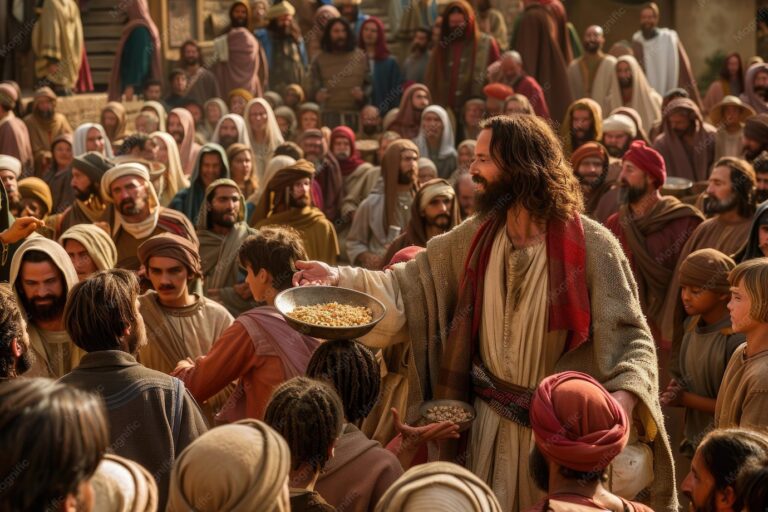
John 6 begins with a Great Crowd Of People following Jesus because they had seen His miracles. Jesus fed thousands with five loaves and two fish, walked on water, and then declared that He was the Bread of Life. But the chapter eventually reveals a deeper issue: many wanted what Jesus could provide without truly believing who He was. Even among the Twelve, Jesus knew one would betray Him.
Obedience • God’s Covenant • Faith • Eternity • Mercy • Grace • Judgment • Heaven • Redemption Plan • Jesus Christ
📖 John 6:1-3 (NIV)
“6 Some time after this, Jesus crossed to the far shore of the Sea of Galilee (that is, the Sea of Tiberias), 2 and a great crowd of people followed him because they saw the signs he had performed by healing the sick. 3 Then Jesus went up on a mountainside and sat down with his disciples.”
A great crowd followed Jesus because they had witnessed His miracles.
Jesus saw the people and knew they needed food.
He asked Philip where they could buy bread, but Philip could only see the size of the problem. Andrew found a boy with five barley loaves and two fish and wondered how such a small amount could feed so many.
Jesus took the food, gave thanks, and distributed it.
Everyone ate until they were satisfied.
Twelve baskets remained.
The crowd recognized the miracle and wanted to make Jesus king by force. But Jesus withdrew by Himself.
Later, His disciples crossed the Sea of Galilee. A strong wind came, and the water became rough.
Then they saw Jesus walking on the water.
He told them:
“It is I; don’t be afraid.”
The next day, the crowd searched for Jesus.
But Jesus knew why they were following Him.
They wanted more physical bread.
Jesus directed them toward something eternal.
He declared:
“I am the bread of life.”
The people struggled to understand.
But Jesus offered something greater.
He offered Himself.
He taught that whoever believes in Him has eternal life and that He will raise believers up at the last day.
Many found this teaching difficult.
Some disciples stopped following Him.
Jesus then asked the Twelve if they wanted to leave too.
Peter answered with one of the great declarations of faith:
“Lord, to whom shall we go? You have the words of eternal life.”
But Jesus knew that even among the Twelve was someone who did not truly believe.
Judas was there.
Jesus knew what was coming.
The crowd saw the miracle.
The disciples heard the teaching.
Peter believed.
Judas remained close.
But Jesus already knew the heart of each one.
📖 John 6:4-10 (NIV)
“4 The Jewish Passover Festival was near.”
“5 When Jesus looked up and saw a great crowd coming toward him, he said to Philip, “Where shall we buy bread for these people to eat?” 6 He asked this only to test him, for he already had in mind what he was going to do.”
“7 Philip answered him, “It would take more than half a year’s wages[a] to buy enough bread for each one to have a bite!”
“8 Another of his disciples, Andrew, Simon Peter’s brother, spoke up, 9 “Here is a boy with five small barley loaves and two small fish, but how far will they go among so many?”
“10 Jesus said, “Have the people sit down.” There was plenty of grass in that place, and they sat down (about five thousand men were there). “
The five loaves and two fish looked insignificant compared with the needs of thousands.
Philip saw the impossible cost.
Andrew saw the small supply.
Jesus saw what could be done.
The boy’s food became enough for everyone.
The lesson is not simply that Jesus can multiply bread.
We often measure our ability against the size of the problem.
God measures what is possible through His power.
The boy gave what he had.
Jesus used it.
We may not have everything we think we need, but God can use what we willingly place in His hands.
📖 John 6:11-17 (NIV)
” 11 Jesus then took the loaves, gave thanks, and distributed to those who were seated as much as they wanted. He did the same with the fish.”
“12 When they had all had enough to eat, he said to his disciples, “Gather the pieces that are left over. Let nothing be wasted.” 13 So they gathered them and filled twelve baskets with the pieces of the five barley loaves left over by those who had eaten.”
“14 After the people saw the sign Jesus performed, they began to say, “Surely this is the Prophet who is to come into the world.” 15 Jesus, knowing that they intended to come and make him king by force, withdrew again to a mountain by himself.”
“16 When evening came, his disciples went down to the lake, 17 where they got into a boat and set off across the lake for Capernaum. By now it was dark, and Jesus had not yet joined them. “
But Jesus challenged their motives.
They were looking for food that would satisfy them temporarily.
Jesus offered something that would last forever.
Physical bread satisfies hunger for a time.
Living water satisfies in a greater way.
But Jesus presents Himself as the Bread of Life.
He is not merely someone who provides blessings.
He is the blessing.
Jesus does not simply give something that sustains us for another day.
Jesus offers eternal life.
This changes how we should approach God.
We should not follow Jesus only because of what we hope He will give us.
We follow Him because of who He is.
📖 John 6:18-27 (NIV)
“18 A strong wind was blowing and the waters grew rough. 19 When they had rowed about three or four miles,[b] they saw Jesus approaching the boat, walking on the water; and they were frightened. 20 But he said to them, “It is I; don’t be afraid.” 21 Then they were willing to take him into the boat, and immediately the boat reached the shore where they were heading.”
“22 The next day the crowd that had stayed on the opposite shore of the lake realized that only one boat had been there, and that Jesus had not entered it with his disciples, but that they had gone away alone. 23 Then some boats from Tiberias landed near the place where the people had eaten the bread after the Lord had given thanks. 24 Once the crowd realized that neither Jesus nor his disciples were there, they got into the boats and went to Capernaum in search of Jesus.”
25 When they found him on the other side of the lake, they asked him, “Rabbi, when did you get here?”
“26 Jesus answered, “Very truly I tell you, you are looking for me, not because you saw the signs I performed but because you ate the loaves and had your fill. 27 Do not work for food that spoils, but for food that endures to eternal life, which the Son of Man will give you. For on him God the Father has placed his seal of approval.”
They heard His words and struggled to accept them.
Eventually, many disciples turned away.
Jesus did not change the truth simply to keep the crowd.
He allowed people to choose.
Then He asked the Twelve:
“You do not want to leave too, do you?”
Peter’s answer reveals the foundation of true faith:
“Lord, to whom shall we go?”
Peter did not claim to understand everything.
He knew enough to understand who Jesus was.
Faith does not require that we understand every mystery before we trust God.
Sometimes faith means saying:
I may not understand everything, but I know where I belong.
📖 John 6:28-38 (NIV)
“28 Then they asked him, “What must we do to do the works God requires?”
“29 Jesus answered, “The work of God is this: to believe in the one he has sent.”
“30 So they asked him, “What sign then will you give that we may see it and believe you? What will you do? 31 Our ancestors ate the manna in the wilderness; as it is written: ‘He gave them bread from heaven to eat.’[c]”
“32 Jesus said to them, “Very truly I tell you, it is not Moses who has given you the bread from heaven, but it is my Father who gives you the true bread from heaven. 33 For the bread of God is the bread that comes down from heaven and gives life to the world.”
“34 “Sir,” they said, “always give us this bread.”
“35 Then Jesus declared, “I am the bread of life. Whoever comes to me will never go hungry, and whoever believes in me will never be thirsty. 36 But as I told you, you have seen me and still you do not believe. 37 All those the Father gives me will come to me, and whoever comes to me I will never drive away. 38 For I have come down from heaven not to do my will but to do the will of him who sent me.”
The manna in the wilderness sustained people temporarily.
Those people eventually died.
Jesus offers something different.
He is the Bread that came down from heaven.
Whoever believes in Him has eternal life.
And Jesus promises to raise believers up at the last day.
This is the heart of God’s Redemption Plan.
Human life is temporary.
Earthly possessions disappear.
Physical food satisfies only for a while.
But Jesus offers life that death cannot destroy.
The greatest gift God offers is not a better temporary life—it is eternal life through Jesus Christ.
📖 John 6:39-48 (NIV)
“39 And this is the will of him who sent me, that I shall lose none of all those he has given me, but raise them up at the last day. 40 For my Father’s will is that everyone who looks to the Son and believes in him shall have eternal life, and I will raise them up at the last day.”
“41 At this the Jews there began to grumble about him because he said, “I am the bread that came down from heaven.” 42 They said, “Is this not Jesus, the son of Joseph, whose father and mother we know? How can he now say, ‘I came down from heaven’?”
“43 “Stop grumbling among yourselves,” Jesus answered. 44 “No one can come to me unless the Father who sent me draws them, and I will raise them up at the last day. 45 It is written in the Prophets: ‘They will all be taught by God.’[d] Everyone who has heard the Father and learned from him comes to me. 46 No one has seen the Father except the one who is from God; only he has seen the Father. 47 Very truly I tell you, the one who believes has eternal life. 48 I am the bread of life. “
One of the most sobering parts of John 6 comes near the end.
Jesus says:
“Yet one of you is a devil!”
He was speaking about Judas.
He had walked with Jesus.
He had heard His teachings.
Judas was counted among the Twelve.
Yet Jesus knew that Judas would betray Him.
This reminds us that being physically close to Jesus is not the same as believing in Jesus.
A person can be part of the crowd.
Someone can hear the teachings.
A person can witness God’s work.
Yet the heart can remain distant.
Jesus knows what is inside every person.
God does not merely look at our outward appearance; He knows the truth of our hearts.
📖 John 6:49-59 (NIV)
“49 Your ancestors ate the manna in the wilderness, yet they died. 50 But here is the bread that comes down from heaven, which anyone may eat and not die. 51 I am the living bread that came down from heaven. Whoever eats this bread will live forever. This bread is my flesh, which I will give for the life of the world.”
“52 Then the Jews began to argue sharply among themselves, “How can this man give us his flesh to eat?”
“53 Jesus said to them, “Very truly I tell you, unless you eat the flesh of the Son of Man and drink his blood, you have no life in you. 54 Whoever eats my flesh and drinks my blood has eternal life, and I will raise them up at the last day. 55 For my flesh is real food and my blood is real drink. 56 Whoever eats my flesh and drinks my blood remains in me, and I in them. 57 Just as the living Father sent me and I live because of the Father, so the one who feeds on me will live because of me. 58 This is the bread that came down from heaven. Your ancestors ate manna and died, but whoever feeds on this bread will live forever.” 59 He said this while teaching in the synagogue in Capernaum.”
John 6 shows people making different choices.
Some wanted Him to provide more bread.
Some struggled with His teaching.
Many disciples turned away.
Peter stayed.
Judas stayed physically but would eventually betray Him.
The chapter demonstrates that following Jesus is more than being part of a crowd.
Crowds change.
Opinions change.
Circumstances change.
Faith must go deeper.
Jesus asks each person to decide whether they will trust Him.
Peter understood the most important question:
“Lord, to whom shall we go?”
There is nowhere else that offers what Jesus offers.
Jesus has the words of eternal life.
📖 John 6:60-71 (NIV)
“60 On hearing it, many of his disciples said, “This is a hard teaching. Who can accept it?”
“61 Aware that his disciples were grumbling about this, Jesus said to them, “Does this offend you? 62 Then what if you see the Son of Man ascend to where he was before! 63 The Spirit gives life; the flesh counts for nothing. The words I have spoken to you—they are full of the Spirit[e] and life. 64 Yet there are some of you who do not believe.” For Jesus had known from the beginning which of them did not believe and who would betray him. 65 He went on to say, “This is why I told you that no one can come to me unless the Father has enabled them.”
“66 From this time many of his disciples turned back and no longer followed him.”
“67 “You do not want to leave too, do you?” Jesus asked the Twelve.”
“68 Simon Peter answered him, “Lord, to whom shall we go? You have the words of eternal life. 69 We have come to believe and to know that you are the Holy One of God.”
“70 Then Jesus replied, “Have I not chosen you, the Twelve? Yet one of you is a devil!” 71 (He meant Judas, the son of Simon Iscariot, who, though one of the Twelve, was later to betray him.)”
It was a miraculous provision from heaven.
But Jesus explains that manna was not the final answer.
Those who ate it eventually died.
Jesus is the greater Bread from Heaven.
The manna sustained physical life temporarily.
Jesus offers eternal life.
The manna pointed toward God’s ability to provide.
Jesus reveals God’s ultimate provision.
The Old Testament story was preparing the way for something greater.
God was teaching His people to depend upon Him.
Now Jesus reveals Himself as the ultimate provision from the Father.
The manna came from heaven, but Jesus is the Bread who came down from Heaven to give life to the world.
John 6 continues the story of God’s covenant and Redemption Plan.
God had provided manna in the wilderness.
He had sustained His people when they had no natural source of food.
But Jesus reveals that God’s provision was pointing toward something greater.
The promises of God were never merely about temporary blessings.
Jesus is the fulfillment of what God’s people had been waiting for.
He is the Bread of Life.
Jesus came from the Father.
He came to do the Father’s will.
He promises to raise His people at the last day.
God’s Covenant stands because God’s ultimate provision is Jesus Christ, and His promise of eternal life reaches beyond this temporary world into eternity.
God can multiply what appears insufficient.
We should surrender what we have to God.
Jesus knows what we need before we ask.
Miracles should lead us toward faith, not merely temporary blessings.
Jesus is greater than anything He can provide.
Earthly food satisfies temporarily; Jesus offers eternal life.
Faith sometimes requires trusting Jesus when we do not understand everything.
Following the crowd is not the same as following Christ.
People can witness God’s work and still refuse to believe.
Jesus knows the condition of every heart.
God’s judgment is real.
Jesus promises resurrection to those who believe.
Peter’s question remains important: “To whom shall we go?”
Jesus alone has the words of eternal life.
God’s provision ultimately points toward His Redemption Plan.
Jesus Christ is the Bread of Life.
John 6 begins with hungry people and five small loaves of bread.
Jesus provided enough for thousands.
But He wanted the crowd to see something greater than a miracle involving food.
He wanted them to understand who He was.
Jesus was not simply the One who could multiply bread.
He was the Bread of Life.
He was not simply a teacher.
Jesus came from Heaven.
He came to do the Father’s will.
Jesus came to give His life for the world.
Some walked away because the teaching was difficult.
Peter stayed because he understood the most important truth:
“Lord, to whom shall we go? You have the words of eternal life.”
Then comes the warning about Judas.
Jesus knew one of His own would betray Him.
The crowd could see the miracle.
Jesus could see the heart.
The greater lesson of John 6 is therefore not simply about bread, miracles, or crowds.
It is about belief.
Will we follow Jesus because of what He can give us, or because we truly believe He is the Son of God and the Bread of Life?
Jesus Christ is God’s provision for eternity—the Bread of Life who came down from Heaven to give life to the world.