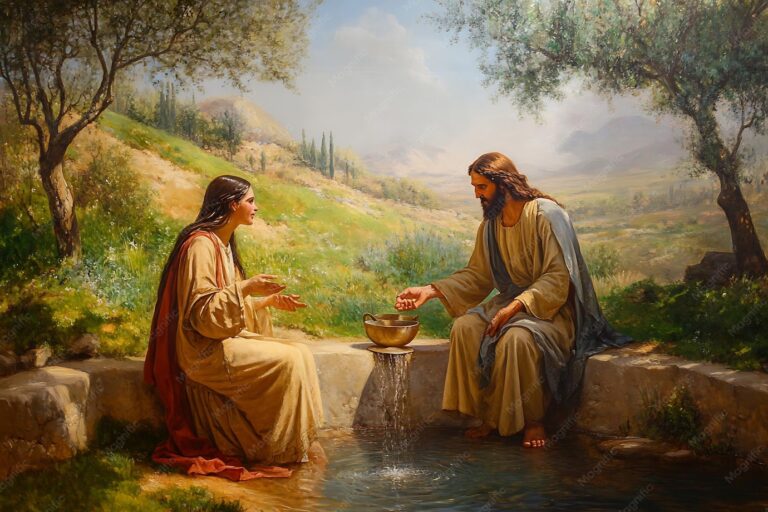
John 4 Will You Give Me A Drink. brings together two very different people who encounter Jesus: a Samaritan woman carrying a complicated past and a royal official desperately seeking healing for his son. Both come to Jesus with needs they cannot solve themselves. One discovers living water; the other learns to trust Jesus’ word. Together, their stories reveal that salvation, faith, and mercy are available to anyone who believes.
Obedience • God’s Covenant • Mercy • Grace • Faith • Salvation • Redemption Plan • Disciples • Jesus Christ
📖 John 4:1 (NIV)
“4 Now Jesus learned that the Pharisees had heard that he was gaining and baptizing more disciples than John— “
Jesus left Judea and traveled toward Galilee.
John tells us that He had to go through Samaria.
Jesus stopped at Jacob’s well, tired from His journey. Around noon, a Samaritan woman came to draw water.
Jesus asked her for a drink.
It was an ordinary request that opened the door to an extraordinary conversation.
The woman was surprised that a Jewish man would speak with a Samaritan woman.
Jesus then offered her something greater than the water in Jacob’s well.
Living water.
Jesus then revealed that He knew the woman’s past.
He knew about her five husbands and the man she was currently with.
Yet He did not walk away from her.
Instead, He continued the conversation and revealed Himself as the Messiah.
The woman left her water jar behind and returned to the town.
Her testimony brought people toward Jesus.
Many Samaritans believed.
Jesus remained with them for two days, and many more believed because they heard Him themselves.
The people eventually declared that Jesus was truly the Savior of the world.
Then Jesus returned to Cana.
A royal official came to Him because his son was dying.
The man begged Jesus to come and heal him.
Jesus simply said:
“Go…your son will live.”
The man believed Jesus’ word and left.
On the way home, his servants met him with the news that his son was alive.
The healing had happened at the exact time Jesus spoke.
The royal official and his entire household believed.
Two encounters.
Two desperate needs.
One Savior.
Jesus offered eternal life to a woman at a well and physical life to a dying child.
📖 John 4:2-7 (NIV)
“2 although in fact it was not Jesus who baptized, but his disciples. 3 So he left Judea and went back once more to Galilee.’
“4 Now he had to go through Samaria. 5 So he came to a town in Samaria called Sychar, near the plot of ground Jacob had given to his son Joseph. 6 Jacob’s well was there, and Jesus, tired as he was from the journey, sat down by the well. It was about noon.”
“7 When a Samaritan woman came to draw water, Jesus said to her, “Will you give me a drink?”
The Samaritan woman came to the well alone.
There were social, cultural, and religious barriers between her and Jesus.
Yet Jesus spoke with her.
Jesus did not define her by her nationality.
He did not define her by her past.
He did not walk away because her life was complicated.
Instead, He engaged her heart.
Jesus already knew everything she had done.
Still, He offered her living water.
This is an important picture of God’s mercy.
Jesus knows our history better than anyone.
Jesus knows our failures.
He knows our mistakes.
He knows the things we would rather keep hidden.
Yet He still invites us to come to Him.
Jesus does not need us to hide our past before we approach Him. He already knows it—and He offers grace anyway.
📖 John 4:8-15 (NIV)
“8 (His disciples had gone into the town to buy food.)”
“9 The Samaritan woman said to him, “You are a Jew and I am a Samaritan woman. How can you ask me for a drink?” (For Jews do not associate with Samaritans.[a])”
“10 Jesus answered her, “If you knew the gift of God and who it is that asks you for a drink, you would have asked him and he would have given you living water.”
“11 “Sir,” the woman said, “you have nothing to draw with and the well is deep. Where can you get this living water? 12 Are you greater than our father Jacob, who gave us the well and drank from it himself, as did also his sons and his livestock?”
“13 Jesus answered, “Everyone who drinks this water will be thirsty again, 14 but whoever drinks the water I give them will never thirst. Indeed, the water I give them will become in them a spring of water welling up to eternal life.”
“15 The woman said to him, “Sir, give me this water so that I won’t get thirsty and have to keep coming here to draw water.”
She was thinking about the well.
Jesus was talking about eternity.
The water Jacob’s well provided could satisfy thirst temporarily.
The living water Jesus offered would become a spring within a person leading to eternal life.
This is another example of Jesus taking an earthly subject and revealing a heavenly truth.
People need physical water to live.
But humanity also needs spiritual life.
The world can provide temporary satisfaction.
Possessions can provide temporary comfort.
Success can provide temporary happiness.
But none of these can provide eternal life.
Jesus offers something the world cannot manufacture.
The living water of Christ satisfies a need that nothing earthly can permanently satisfy.
📖 John 4:16-22 (NIV)
“16 He told her, “Go, call your husband and come back.”
“17 “I have no husband,” she replied.
Jesus said to her, “You are right when you say you have no husband. 18 The fact is, you have had five husbands, and the man you now have is not your husband. What you have just said is quite true.”
“19 “Sir,” the woman said, “I can see that you are a prophet. 20 Our ancestors worshiped on this mountain, but you Jews claim that the place where we must worship is in Jerusalem.”
“21 “Woman,” Jesus replied, “believe me, a time is coming when you will worship the Father neither on this mountain nor in Jerusalem. 22 You Samaritans worship what you do not know; we worship what we do know, for salvation is from the Jews. “
Jesus knew the woman’s history.
He knew she had been married five times and was currently living with a man who was not her husband.
Jesus did not pretend that her choices did not matter.
He brought truth into the conversation.
This is where grace and truth meet.
Grace does not mean saying sin does not matter.
Grace means God provides a way forward even though sin is real.
Jesus exposed the truth while continuing to offer mercy.
The woman’s encounter with Jesus changed the direction of her life.
She went from coming to the well alone to going back into the town and telling others about Jesus.
Jesus can confront our sin without abandoning us, because His purpose is redemption.
📖 John 4:23-29 (NIV)
“23 Yet a time is coming and has now come when the true worshipers will worship the Father in the Spirit and in truth, for they are the kind of worshipers the Father seeks. 24 God is spirit, and his worshipers must worship in the Spirit and in truth.”
“25 The woman said, “I know that Messiah” (called Christ) “is coming. When he comes, he will explain everything to us.”
“26 Then Jesus declared, “I, the one speaking to you—I am he.”
“27 Just then his disciples returned and were surprised to find him talking with a woman. But no one asked, “What do you want?” or “Why are you talking with her?”
“28 Then, leaving her water jar, the woman went back to the town and said to the people, 29 “Come, see a man who told me everything I ever did. Could this be the Messiah?”
The Samaritan woman asked Jesus about where people should worship.
Should worship happen on the mountain?
Should it happen in Jerusalem?
Jesus moved the conversation beyond geography.
Worship is not ultimately about a building.
It is not simply about a location.
It is about the relationship between the worshiper and God.
God is Spirit.
Therefore, genuine worship must come from a heart that seeks Him in truth.
This challenges us to look beyond outward religious activity.
We can attend a place of worship without truly worshiping.
But when the heart belongs to God, worship becomes more than a location.
True worship begins when the heart turns toward God in Spirit and truth.
📖 John 4:30-38 (NIV)
“30 They came out of the town and made their way toward him.”
“31 Meanwhile his disciples urged him, “Rabbi, eat something.”
“32 But he said to them, “I have food to eat that you know nothing about.”
“33 Then his disciples said to each other, “Could someone have brought him food?”
“34 “My food,” said Jesus, “is to do the will of him who sent me and to finish his work. 35 Don’t you have a saying, ‘It’s still four months until harvest’? I tell you, open your eyes and look at the fields! They are ripe for harvest. 36 Even now the one who reaps draws a wage and harvests a crop for eternal life, so that the sower and the reaper may be glad together. 37 Thus the saying ‘One sows and another reaps’ is true. 38 I sent you to reap what you have not worked for. Others have done the hard work, and you have reaped the benefits of their labor.”
The disciples were focused on food.
Jesus was focused on something greater.
He told them to open their eyes and look at the fields.
The harvest was ready.
Others came.
Jesus taught them.
And many believed.
Jesus explained that one person may sow while another reaps.
The disciples were entering into work that others had already begun.
This is an important lesson about serving God.
We do not always see the full result of our work.
Jesus may plant a seed of faith.
Someone else may explain the Gospel.
Someone else may help a person through a difficult season.
Eventually, God brings the harvest.
Our responsibility is to faithfully do the work God gives us and trust Him with the harvest.
📖 John 4:39-46 (NIV)
“39 Many of the Samaritans from that town believed in him because of the woman’s testimony, “He told me everything I ever did.” 40 So when the Samaritans came to him, they urged him to stay with them, and he stayed two days. 41 And because of his words many more became believers.”
“42 They said to the woman, “We no longer believe just because of what you said; now we have heard for ourselves, and we know that this man really is the Savior of the world.”
“43 After the two days he left for Galilee. 44 (Now Jesus himself had pointed out that a prophet has no honor in his own country.) 45 When he arrived in Galilee, the Galileans welcomed him. They had seen all that he had done in Jerusalem at the Passover Festival, for they also had been there.”
“46 Once more he visited Cana in Galilee, where he had turned the water into wine. And there was a certain royal official whose son lay sick at Capernaum. “
He wanted Jesus to come physically to Capernaum.
Instead, Jesus simply told him:
“Go…your son will live.”
The official had a choice.
He could demand more proof.
He could insist that Jesus come with him.
Or he could believe.
He believed.
And he left.
Before he reached home, his servants met him with the news that his son was alive.
The timing confirmed exactly what had happened.
Jesus had spoken.
The father believed.
His entire household believed.
Faith sometimes means trusting Jesus before we see the answer.
The royal official did not see the healing when he left.
He trusted the word of Jesus and walked home.
Faith is trusting Jesus enough to move forward before the evidence is in our hands.
📖 John 4:47-54 (NIV)
“47 When this man heard that Jesus had arrived in Galilee from Judea, he went to him and begged him to come and heal his son, who was close to death.”
“48 “Unless you people see signs and wonders,” Jesus told him, “you will never believe.”
“49 The royal official said, “Sir, come down before my child dies.”
“50 “Go,” Jesus replied, “your son will live.”
The man took Jesus at his word and departed. 51 While he was still on the way, his servants met him with the news that his boy was living. 52 When he inquired as to the time when his son got better, they said to him, “Yesterday, at one in the afternoon, the fever left him.”
“53 Then the father realized that this was the exact time at which Jesus had said to him, “Your son will live.” So he and his whole household believed.”
“54 This was the second sign Jesus performed after coming from Judea to Galilee.”
She was a Samaritan.
She had a difficult personal history.
Yet Jesus chose to reveal Himself to her.
Then the people of her town came to Jesus.
They eventually declared Him to be:
“the Savior of the world.”
That statement is significant.
Didn’t merely the Savior of one group.
Not merely the Savior of the religious.
Not merely the Savior of those with perfect histories.
The Savior of the world.
The Gospel crosses cultural boundaries.
It crosses social boundaries.
It crosses personal history.
Jesus offers salvation to those who come to Him in faith.
God’s Redemption Plan is bigger than the boundaries people create.
John 4 shows God’s Covenant continuing to unfold through Jesus.
God had promised blessing to the nations through His greater Redemption Plan.
Now Jesus is speaking with a Samaritan woman, staying among Samaritans, and bringing many of them to faith.
The Gospel is beginning to cross boundaries that divided people.
Jesus also demonstrates authority over sickness.
The royal official’s son is healed simply because Jesus speaks.
The chapter therefore gives us both salvation and healing, but the greater message is not merely what Jesus can do.
It is who Jesus is.
He is the Messiah.
He is the giver of living water.
Jesus is the Savior of the world.
Jesus is Lord over sickness.
And He calls people to believe His word.
God’s Covenant continues moving toward fulfillment as Jesus gathers people from every background into God’s Redemption Plan.
Jesus sees people others may overlook.
Our past does not place us beyond God’s mercy.
Jesus knows our sins and still offers grace.
Living water points toward eternal life.
Earthly things cannot permanently satisfy the soul.
Grace does not ignore sin; it provides a path toward redemption.
True worship must be in Spirit and truth.
God’s harvest includes people from every background.
We may plant while someone else reaps.
Our responsibility is to faithfully serve God.
Faith means trusting Jesus before we see the answer.
Jesus’ word is powerful and trustworthy.
Salvation crosses human boundaries.
Jesus is the Savior of the world.
God’s Redemption Plan is greater than our circumstances.
John 4 gives us two unforgettable encounters with Jesus.
A woman came to a well looking for physical water.
She left having encountered the Living Water.
A father came to Jesus looking for healing for his dying son.
He left believing Jesus’ word:
“Your son will live.”
The woman discovered that Jesus knew her past but still offered her grace.
The royal official discovered that Jesus could be trusted even when he could not yet see the answer.
The Samaritans discovered something even greater:
Jesus is the Savior of the world.
These stories point toward God’s greater Redemption Plan.
Jesus did not come only for people who appeared righteous.
He came for sinners.
He did not come only for one nation.
Jesus came for the world.
He does not only offer temporary solutions.
Jesus offers eternal life.
Jesus Christ is the Living Water, the Savior of the world, and the One whose word brings life.