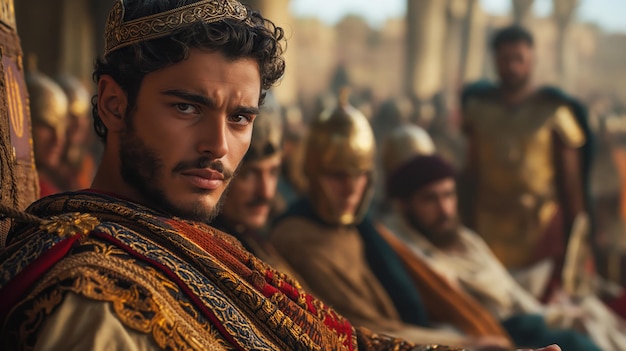
The opening chapter of 2 Samuel, When He Came to David begins with sorrow instead of celebration. Although David had been anointed to become king years earlier, he did not rejoice over Saul’s death. Instead, he mourned the loss of Israel’s king, Jonathan his beloved friend, and the soldiers who had fallen in battle. This chapter reveals a heart that honors God above personal ambition and demonstrates the humility that God desires in every leader.
Obedience • God’s Covenant • Judgment • Faith • Fasting • Battle • Repentance • Redemption Plan • Jesus Christ
📖 2 Samuel 1:1–2 (NIV)
“1 After the death of Saul, David returned from striking down the Amalekites and stayed in Ziklag two days. 2 On the third day a man arrived from Saul’s camp with his clothes torn and dust on his head. When he came to David, he fell to the ground to pay him honor.”
“3 “Where have you come from?” David asked him.
He answered, “I have escaped from the Israelite camp.”
The messenger reported that Israel had fled before the Philistines and that Saul and Jonathan were dead. Believing he would receive a reward, he claimed that he had finished Saul’s life at the king’s own request and presented Saul’s crown and armlet to David.
Instead of celebrating, David and his men tore their clothes, wept, mourned, and fasted until evening for Saul, Jonathan, the army of Israel, and the people of God who had fallen in battle.
When David questioned the messenger, he reminded him that Saul was still the Lord’s anointed. By his own testimony the Amalekite admitted to killing the king, and David ordered justice to be carried out.
David then composed one of Scripture’s most moving songs of mourning, honoring Saul and Jonathan and teaching future generations to remember their courage rather than celebrate their downfall.
Even in victory, David chose honor over revenge.
“4 “What happened?” David asked. “Tell me.”
“The men fled from the battle,” he replied. “Many of them fell and died. And Saul and his son Jonathan are dead.”
“5 Then David said to the young man who brought him the report, “How do you know that Saul and his son Jonathan are dead?”
“6 “I happened to be on Mount Gilboa,” the young man said, “and there was Saul, leaning on his spear, with the chariots and their drivers in hot pursuit.
He understood that Saul had once been chosen and anointed by God.
David refused to celebrate another person’s downfall, even when it appeared to benefit his own future.
His actions remind us that spiritual maturity is revealed by how we respond when those who oppose us fall.
God calls His people to honor His authority while leaving judgment in His hands.
📖 2 Samuel 1:7-14 (NIV)
“7 When he turned around and saw me, he called out to me, and I said, ‘What can I do?’
“8 “He asked me, ‘Who are you?’
“‘An Amalekite,’ I answered.
“9 “Then he said to me, ‘Stand here by me and kill me! I’m in the throes of death, but I’m still alive.’
“10 “So I stood beside him and killed him, because I knew that after he had fallen he could not survive. And I took the crown that was on his head and the band on his arm and have brought them here to my lord.”
“11 Then David and all the men with him took hold of their clothes and tore them. 12 They mourned and wept and fasted till evening for Saul and his son Jonathan, and for the army of the Lord and for the nation of Israel, because they had fallen by the sword.”
“13 David said to the young man who brought him the report, “Where are you from?”
“I am the son of a foreigner, an Amalekite,” he answered.
“14 David asked him, “Why weren’t you afraid to lift your hand to destroy the Lord’s anointed?”
David’s response surprises many readers.
They wept.
Then fasted.
He lamented.
David loved Jonathan deeply and respected Saul’s position as king. His grief revealed genuine compassion rather than political calculation.
Faith does not remove sorrow.
Faith teaches us how to grieve with hope while trusting God’s greater purpose.
📖 2 Samuel 1:15-22 (NIV)
“15 Then David called one of his men and said, “Go, strike him down!” So he struck him down, and he died. 16 For David had said to him, “Your blood be on your own head. Your own mouth testified against you when you said, ‘I killed the Lord’s anointed.’”
“17 David took up this lament concerning Saul and his son Jonathan, 18 and he ordered that the people of Judah be taught this lament of the bow (it is written in the Book of Jashar):”
“19
“A gazelle[a] lies slain on your heights, Israel.
How the mighty have fallen!”
“20
“Tell it not in Gath,
proclaim it not in the streets of Ashkelon,
lest the daughters of the Philistines be glad,
lest the daughters of the uncircumcised rejoice.”
“21
“Mountains of Gilboa,
may you have neither dew nor rain,
may no showers fall on your terraced fields.[b]
For there the shield of the mighty was despised,
the shield of Saul—no longer rubbed with oil.”
“22
“From the blood of the slain,
from the flesh of the mighty,
the bow of Jonathan did not turn back,
the sword of Saul did not return unsatisfied.”
Instead, he faced judgment.
Whether his story was entirely true or partly fabricated, he claimed responsibility for killing the Lord’s anointed.
David understood an important principle:
No one has the right to seize what belongs to God.
God alone establishes leaders.
God alone removes leaders.
Holy Spirit of God alone judges every heart.
📖 2 Samuel 1:23-27 (NIV)
“23
Saul and Jonathan—
in life they were loved and admired,
and in death they were not parted.
They were swifter than eagles,
they were stronger than lions.”
“24
“Daughters of Israel,
weep for Saul,
who clothed you in scarlet and finery,
who adorned your garments with ornaments of gold.”
“25
“How the mighty have fallen in battle!
Jonathan lies slain on your heights.”
“26
I grieve for you, Jonathan my brother;
you were very dear to me.
Your love for me was wonderful,
more wonderful than that of women.”
“27
“How the mighty have fallen!
The weapons of war have perished!”
David commanded that Judah learn this song of mourning.
His words teach future generations that honoring those who have fallen is greater than boasting over victory.
The mighty may fall, but God’s covenant continues.
Saul’s death did not end God’s promises.
God’s covenant with Israel continued.
His plan for David continued.
His promise of an eternal King continued.
Human leaders rise and fall, but God’s purposes never fail.
Every event moves history closer to the fulfillment of His redemption plan.
This chapter reminds believers that:
Obedience honors God above personal gain.
True leaders refuse to rejoice over another person’s downfall.
Faith responds with humility, compassion, and wisdom.
Judgment belongs to God alone.
God’s covenant stands firm through every generation.
Even seasons of sorrow remain under God’s sovereign control.
David teaches us that humility often prepares us for greater responsibility than victory ever could.
David mourned the death of Israel’s king.
Jesus came as the eternal King who willingly gave His own life for His people.
David honored the Lord’s anointed.
Jesus is God’s Anointed One—the Messiah who conquered sin and death through His sacrifice on the cross.
David’s lament pointed toward earthly loss.
Christ’s resurrection points toward eternal hope.
The kingdom Saul lost, David inherited, and Jesus fulfilled forever.
Every chapter of 2 Samuel continues revealing God’s faithful covenant and His perfect redemption plan through Jesus Christ, the King of Kings and Lord of Lords.