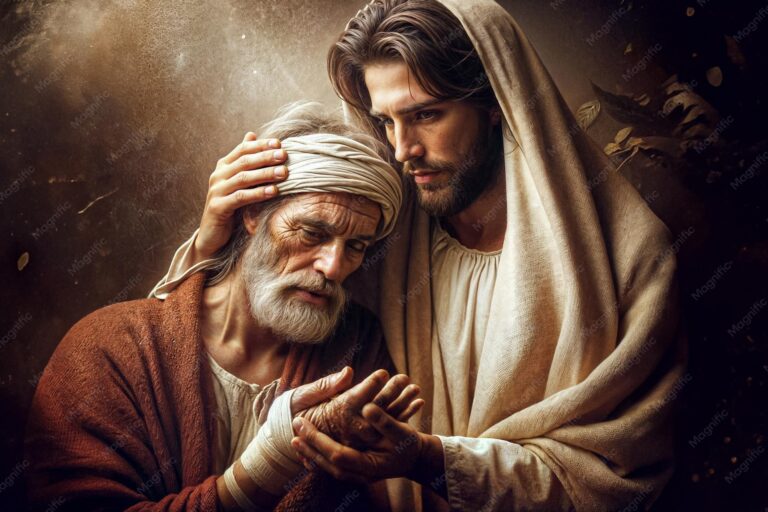
Mark begins with movement. The good news of Jesus Christ does not arrive quietly—it begins with prophecy, repentance, baptism, the Holy Spirit, temptation, healing, teaching, and deliverance. John prepares the way, and Jesus enters the world with authority. The Father declares His pleasure in His Son, while The Holy Spirit descends upon Him. From that moment, Jesus begins the work of God’s Redemption Plan.
Obedience, God’s Covenant, Healing, Judgment, Grace, Blessings, God Was Pleased, Redemption Plan, Jesus Christ
📖 Mark 1:1-3 (NIV)
“1 The beginning of the good news about Jesus the Messiah,[a] the Son of God,[b] 2 as it is written in Isaiah the prophet:
“I will send my messenger ahead of you,
who will prepare your way”[c]—
“3
“a voice of one calling in the wilderness,
‘Prepare the way for the Lord,
make straight paths for him.’”[d]”
Mark shows us that God’s promises were already moving toward fulfillment before Jesus began His ministry.
John the Baptist came as the messenger preparing the way, calling people to repentance and forgiveness.
Then Jesus was baptized, the heavens opened, the Holy Spirit descended upon Him, and the Father declared,
“You are my Son, whom I love; with you I am well pleased.”
Jesus immediately faced temptation in the wilderness, showing that obedience to God would remain at the center of His mission.
He then called ordinary fishermen to follow Him and began teaching with authority.
Demons recognized Him, the sick were healed, and people from everywhere came searching for Him.
Yet Jesus did not allow the crowds to become His purpose.
He withdrew to pray and continued traveling to preach.
His mission was greater than one town, one healing, or one group of people.
He had come to proclaim the kingdom of God and ultimately fulfill God’s Redemption Plan through Jesus Christ.
📖 Mark 1:4-8 (NIV)
“4 And so John the Baptist appeared in the wilderness, preaching a baptism of repentance for the forgiveness of sins. 5 The whole Judean countryside and all the people of Jerusalem went out to him. Confessing their sins, they were baptized by him in the Jordan River. 6 John wore clothing made of camel’s hair, with a leather belt around his waist, and he ate locusts and wild honey. 7 And this was his message: “After me comes the one more powerful than I, the straps of whose sandals I am not worthy to stoop down and untie. 8 I baptize you with[e] water, but he will baptize you with[f] the Holy Spirit.”
The Holy Spirit appears immediately as Jesus begins His earthly ministry.
This moment reveals the unity of the Father, Son, and Holy Spirit and marks the beginning of Jesus’ public ministry.
The Spirit then sends Jesus into the wilderness, where He faces Satan’s temptation.
Jesus does not abandon God’s purpose when tested.
He remains obedient.
Lesson: God’s calling does not mean there will be no testing. Sometimes obedience leads directly into difficult places. But God remains present, and His purpose does not change.
📖 Mark 1:9-13 (NIV)
“9 At that time Jesus came from Nazareth in Galilee and was baptized by John in the Jordan. 10 Just as Jesus was coming up out of the water, he saw heaven being torn open and the Spirit descending on him like a dove. 11 And a voice came from heaven: “You are my Son, whom I love; with you I am well pleased.”
“12 At once the Spirit sent him out into the wilderness, 13 and he was in the wilderness forty days, being tempted[g] by Satan. He was with the wild animals, and angels attended him.”
John understood that he was not the Messiah.
He pointed beyond himself to Jesus, declaring that the One coming after him was greater and would baptize with the Holy Spirit.
Lesson: God’s servants are not called to make themselves the center of the story. John prepared people to see Jesus. Our lives should ultimately point people toward Christ.
📖 Mark 1:14-18 (NIV)
“14 After John was put in prison, Jesus went into Galilee, proclaiming the good news of God. 15 “The time has come,” he said. “The kingdom of God has come near. Repent and believe the good news!”
“16 As Jesus walked beside the Sea of Galilee, he saw Simon and his brother Andrew casting a net into the lake, for they were fishermen. 17 “Come, follow me,” Jesus said, “and I will send you out to fish for people.” 18 At once they left their nets and followed him.”
Jesus walks beside the Sea of Galilee and calls Simon and Andrew.
They leave their nets and follow Him.
Their response demonstrates obedience.
They did not have every answer before they followed.
They responded to Jesus’ call.
Lesson: God can use ordinary people for extraordinary purposes. Following Jesus begins with obedience, even when we do not yet understand everything that lies ahead.
📖 Mark 1:19-23 (NIV)
“19 When he had gone a little farther, he saw James son of Zebedee and his brother John in a boat, preparing their nets. 20 Without delay he called them, and they left their father Zebedee in the boat with the hired men and followed him.”
“21 They went to Capernaum, and when the Sabbath came, Jesus went into the synagogue and began to teach. 22 The people were amazed at his teaching, because he taught them as one who had authority, not as the teachers of the law. 23 Just then a man in their synagogue who was possessed by an impure spirit cried out, “
Mark quickly shows the authority of Jesus.
The crowds recognize that something different is happening.
Jesus is not simply another teacher.
His authority reaches into areas that humanity cannot overcome on its own.
Lesson: Jesus has authority over things that are beyond human control. His miracles are not merely demonstrations of power; they reveal who He is and point people toward God’s greater plan.
📖 Mark 1:24-28 (NIV)
“24 “What do you want with us, Jesus of Nazareth? Have you come to destroy us? I know who you are—the Holy One of God!”
“25 “Be quiet!” said Jesus sternly. “Come out of him!” 26 The impure spirit shook the man violently and came out of him with a shriek.”
“27 The people were all so amazed that they asked each other, “What is this? A new teaching—and with authority! He even gives orders to impure spirits and they obey him.” 28 News about him spread quickly over the whole region of Galilee.”
After a night of healing and deliverance, Jesus gets up early and goes to a solitary place to pray.
Yet Jesus does not simply stay where the crowds are.
He says they must go elsewhere so He can preach there also.
Lesson: Prayer keeps our priorities aligned with God. Jesus did not allow popularity, demands, or crowds to determine His mission. He knew why He had come.
📖 Mark 1:29-33 (NIV)
“29 As soon as they left the synagogue, they went with James and John to the home of Simon and Andrew. 30 Simon’s mother-in-law was in bed with a fever, and they immediately told Jesus about her. 31 So he went to her, took her hand and helped her up. The fever left her and she began to wait on them.”
“32 That evening after sunset the people brought to Jesus all the sick and demon-possessed. 33 The whole town gathered at the door, “
Jesus responds, “I am willing.”
He reaches out and touches him, and the man is cleansed.
This is more than a physical healing.
The man was living with a condition that separated him from normal community life.
Jesus did not turn away. He reached toward him.
Lesson: God’s grace reaches people where they are. Jesus demonstrates mercy while also showing the authority of God to restore what is broken.
📖 Mark 1:34-38 (NIV)
“34 and Jesus healed many who had various diseases. He also drove out many demons, but he would not let the demons speak because they knew who he was.”
“35 Very early in the morning, while it was still dark, Jesus got up, left the house and went off to a solitary place, where he prayed. 36 Simon and his companions went to look for him, 37 and when they found him, they exclaimed: “Everyone is looking for you!”
“38 Jesus replied, “Let us go somewhere else—to the nearby villages—so I can preach there also. That is why I have come.”
One of the most important moments in Mark 1 comes before Jesus performs His miracles: the Father declares His love and pleasure in His Son.
He does not need the approval of the crowds to know who He is.
Lesson: Our worth should not be built on human approval. Jesus knew He belonged to the Father, and His mission came from God. The foundation came before the work.
📖 Mark 1:39-45 (NIV)
“39 So he traveled throughout Galilee, preaching in their synagogues and driving out demons.”
“40 A man with leprosy[h] came to him and begged him on his knees, “If you are willing, you can make me clean.”
“41 Jesus was indignant.[i] He reached out his hand and touched the man. “I am willing,” he said. “Be clean!” 42 Immediately the leprosy left him and he was cleansed.”
“43 Jesus sent him away at once with a strong warning: 44 “See that you don’t tell this to anyone. But go, show yourself to the priest and offer the sacrifices that Moses commanded for your cleansing, as a testimony to them.” 45 Instead he went out and began to talk freely, spreading the news. As a result, Jesus could no longer enter a town openly but stayed outside in lonely places. Yet the people still came to him from everywhere.”
Mark does not hide the reality of evil.
The chapter shows that darkness is real, but it also shows something greater: darkness recognizes the authority of Jesus Christ.
Jesus does not compromise with evil.
He commands it.
Lesson: God’s Redemption Plan is not merely about making life easier. It is about overcoming sin, darkness, death, and separation from God. Jesus enters the battle with authority.
Throughout Scripture, God makes promises and fulfills them in His time.
Mark begins by connecting Jesus to what God had already spoken through the prophets. John comes first to prepare the way, exactly as Scripture foretold.
Then Jesus arrives.
The Covenant is moving forward.
The Father identifies Jesus as His beloved Son.
The Holy Spirit descends upon Him.
Jesus begins proclaiming that the kingdom of God has come near.
Nothing happening in Mark 1 is accidental.
God is continuing the story He began long before Jesus walked along the Sea of Galilee.
God’s Covenant stands because God stands behind His promises.
Mark 1 teaches us that following Jesus requires obedience.
It teaches us that faith may be tested, but God remains faithful.
It teaches us that mercy can reach the broken and that Jesus has authority over darkness and sickness.
Jesus also teaches us that blessings are not always about receiving what we want.
Sometimes the greatest blessing is being called to follow God’s purpose.
Jesus did not come simply to make people comfortable.
He came to save.
Mark 1 introduces us to Jesus not simply as a teacher or miracle worker, but as the Messiah, the Son of God.
John prepares the way for Him.
The Holy Spirit comes upon Him.
The Father declares His pleasure in Him.
Satan tempts Him.
Demons recognize His authority.
The sick are healed.
The broken are restored.
A crowd can come from everywhere.
And Jesus continues forward.
Every part points toward something greater: God’s Redemption Plan through Jesus Christ.
Jesus came to proclaim the kingdom, call people to repentance, restore the broken, defeat darkness, and ultimately give His life for the salvation of humanity.