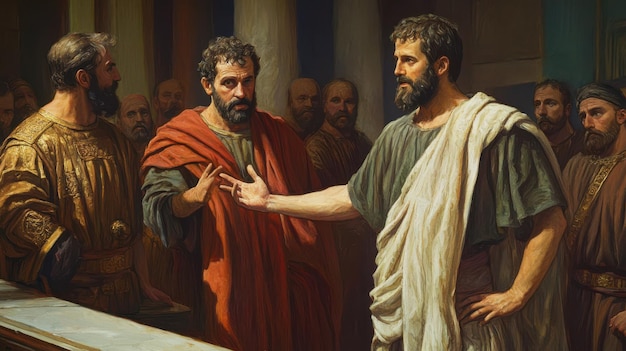
Chapter 15 is the heart of Paul’s message Taken Your Stand about the resurrection and the promise of eternal life. Everything rests on one essential truth: Jesus Christ died for our sins, was buried, and was raised from the dead. Paul explains that if Christ has not been raised, faith has no foundation. But Christ has indeed been raised, and His victory changes how we understand death, how we live today, and what we can hope for tomorrow.
This chapter also brings the story of Adam and Jesus Christ together. Through Adam came death; through Jesus Christ comes the promise of life. Paul takes us from the first earthly body to the future spiritual body, from mortality to immortality, and from the sting of death to victory through our Lord Jesus Christ.
Obedience, God’s Covenant, Faith, Resurrection, Death, Sleep, Imperishable, Raised, Victory, Adam, Spiritual Body, Redemption Plan, Jesus Christ
📖 1 Corinthians 15:1 (NIV)
“15 Now, brothers and sisters, I want to remind you of the gospel I preached to you, which you received and on which you have taken your stand.“
Paul reminds the Corinthians of the Gospel they received and on which they have taken their stand.
Jesus Christ died for our sins according to Scripture, was buried, and was raised on the third day.
He appeared to Peter, the Twelve, more than five hundred believers, James, the apostles, and finally Paul himself.
The resurrection was not presented as an idea or a symbol, but as the foundation of their faith.
Paul then challenges those who question whether the dead will be raised.
If there is no resurrection, Christ has not been raised, and faith is meaningless.
But Christ has indeed been raised, the firstfruits of those who have fallen asleep.
Through Adam came death, but through Jesus Christ comes the promise that those who belong to Him will be made alive.
Paul explains that our earthly bodies are perishable, but God has promised something greater.
The body is sown in weakness and raised in power, sown perishable and raised imperishable.
At the last trumpet, believers will be changed, and death will be swallowed up in victory.
Paul concludes by encouraging believers to stand firm and give themselves fully to the work of the Lord, knowing their labor is not in vain.
📖 1 Corinthians 15:1-4 (NIV)
“15 Now, brothers and sisters, I want to remind you of the gospel I preached to you, which you received and on which you have taken your stand. 2 By this gospel you are saved, if you hold firmly to the word I preached to you. Otherwise, you have believed in vain.”
“3 For what I received I passed on to you as of first importance[a]: that Christ died for our sins according to the Scriptures, 4 that he was buried, that he was raised on the third day according to the Scriptures,“
Paul begins by reminding the Corinthians of the Gospel he preached.
They received it, believed it, and took their stand on it.
He encourages them to hold firmly to that message because it is through this Gospel that they are saved.
Faith is more than hearing a message once.
It is allowing God’s truth to become the foundation of how we live.
We will face questions, difficulties, and moments when our understanding is challenged.
That is why we need to keep returning to the truth of God’s Word.
We do not build our faith on popularity, personal opinions, or what others want us to believe.
We build on Jesus Christ and the Gospel.
Our stand is not that we are perfect.
It is that we believe in the One who saves us.
When we hold firmly to Jesus Christ, we have a foundation that can carry us through this life and give us hope beyond it.
📖 1 Corinthians 15:5-8 (NIV)
“5 and that he appeared to Cephas,[b] and then to the Twelve. 6 After that, he appeared to more than five hundred of the brothers and sisters at the same time, most of whom are still living, though some have fallen asleep. 7 Then he appeared to James, then to all the apostles, 8 and last of all he appeared to me also, as to one abnormally born.”
Paul identifies the message of first importance: Christ died for our sins according to the Scriptures, was buried, and was raised on the third day.
He also appeared to Peter and the Twelve.
These events are at the center of God’s Redemption Plan. Jesus did not come simply to teach people how to live.
He came to give His life for humanity and make forgiveness and reconciliation with God possible.
The cross reminds us of the seriousness of sin, but the resurrection reminds us that sin and death do not have the final word.
Jesus Christ willingly gave His life, and God raised Him from the dead.
Our salvation does not begin with what we accomplish.
It begins with what Jesus Christ accomplished for us.
We respond through faith, trusting His sacrifice and believing that He lives.
📖 1 Corinthians 15:9-12 (NIV)
“9 For I am the least of the apostles and do not even deserve to be called an apostle, because I persecuted the church of God. 10 But by the grace of God I am what I am, and his grace to me was not without effect. No, I worked harder than all of them—yet not I, but the grace of God that was with me. 11 Whether, then, it is I or they, this is what we preach, and this is what you believed.”
“12 But if it is preached that Christ has been raised from the dead, how can some of you say that there is no resurrection of the dead?”
Paul lists those who saw the risen Jesus.
He mentions more than five hundred believers who saw Him at one time, many of whom were still living when Paul wrote.
Paul’s point is that the resurrection was not a private belief based on one person’s experience.
Many people had witnessed the risen Christ, and their testimony became part of the message preached throughout the early church.
Paul describes himself as one who was like a person born at the wrong time.
He knew his past and understood that he had once opposed the church.
This teaches us that our past does not have to determine our future.
God can work through people who have made mistakes, experienced failure, or traveled in the wrong direction.
The resurrection gives us more than a historical message.
It gives us a living Savior in whom we can place our faith.
📖 1 Corinthians 15:13-16 (NIV)
“13 If there is no resurrection of the dead, then not even Christ has been raised. 14 And if Christ has not been raised, our preaching is useless and so is your faith. 15 More than that, we are then found to be false witnesses about God, for we have testified about God that he raised Christ from the dead. But he did not raise him if in fact the dead are not raised. 16 For if the dead are not raised, then Christ has not been raised either.”
Paul openly acknowledges that he persecuted the church and considers himself the least of the apostles.
Yet he recognizes that God’s grace made him what he became.
He did not use grace as an excuse to remain unchanged.
He worked diligently, but he understood that the strength behind his work came from God.
This is an important lesson for anyone who feels that past mistakes have made them unworthy of serving God.
He understood the difference between what he had done and what God’s grace could accomplish through him.
We should not confuse humility with giving up.
When we recognize our shortcomings, we can turn toward God rather than hide from Him.
God’s grace does not make our efforts meaningless.
It gives us a reason to live differently, serve faithfully, and keep growing through Jesus Christ.
📖 1 Corinthians 15:17-20 (NIV)
“17 And if Christ has not been raised, your faith is futile; you are still in your sins. 18 Then those also who have fallen asleep in Christ are lost. 19 If only for this life we have hope in Christ, we are of all people most to be pitied.”
“20 But Christ has indeed been raised from the dead, the : of those who have fallen asleep.”
Paul challenges those who claim that there is no resurrection of the dead.
He explains the consequences of that belief.
If Christ has not been raised, preaching is useless, faith is empty, and believers remain in their sins.
Paul also explains that those who have died believing in Christ would have no future hope if resurrection were not real.
This is why the resurrection cannot be treated as a small detail of Christianity.
It is central to everything believers proclaim.
Our hope is not limited to having a better day, a more comfortable life, or temporary success.
The Gospel promises something greater: life beyond death through Jesus Christ.
If our faith were only for this world, it would be incomplete.
But because Christ lives, we have a reason to believe that death is not the end of God’s promise.
📖 1 Corinthians 15:21-24 (NIV)
“21 For since death came through a man, the resurrection of the dead comes also through a man. 22 For as in Adam all die, so in Christ all will be made alive. 23 But each in turn: Christ, the firstfruits; then, when he comes, those who belong to him. 24 Then the end will come, when he hands over the kingdom to God the Father after he has destroyed all dominion, authority and power.“
Paul declares that Christ has indeed been raised from the dead, the firstfruits of those who have fallen asleep.
The firstfruits point toward what is still to come.
Jesus’ resurrection is the beginning and assurance of the resurrection hope promised to those who belong to Him.
Paul connects Adam and Jesus Christ.
Adam represents humanity’s entrance into death, while Christ represents God’s answer through resurrection.
Paul also describes Christ reigning until every enemy is placed under His feet.
The last enemy to be destroyed is death.
This shows us the direction of God’s Redemption Plan.
Death entered the human story, but God has not abandoned humanity to it.
Jesus Christ reigns, and His victory will be complete.
The Son’s work brings the kingdom to its appointed fulfillment, so that God may be all in all.
Our hope rests not in human power but in God’s authority and the victory of His Son.
📖 1 Corinthians 15:25-28 (NIV)
“25 For he must reign until he has put all his enemies under his feet. 26 The last enemy to be destroyed is death. 27 For he “has put everything under his feet.”[c] Now when it says that “everything” has been put under him, it is clear that this does not include God himself, who put everything under Christ. 28 When he has done this, then the Son himself will be made subject to him who put everything under him, so that God may be all in all.”
Paul asks why believers would endure danger and hardship for the Gospel if there were no resurrection.
He describes the risks he faces and the seriousness of his commitment.
If death were the end, people might conclude that nothing matters beyond immediate pleasure.
But Paul teaches that resurrection changes how we live today.
He also warns that bad company corrupts good character and calls believers to come back to their senses and stop sinning.
Our choices matter because life has meaning beyond what we see.
We should consider the people who influence us, the habits we develop, and the direction in which our decisions lead us.
Belief in eternal life should not make us careless about today.
It should make us more responsible, more faithful, and more willing to live in a way that honors God.
📖 1 Corinthians 15:29-32 (NIV)
“29 Now if there is no resurrection, what will those do who are baptized for the dead? If the dead are not raised at all, why are people baptized for them? 30 And as for us, why do we endanger ourselves every hour? 31 I face death every day—yes, just as surely as I boast about you in Christ Jesus our Lord. 32 If I fought wild beasts in Ephesus with no more than human hopes, what have I gained? If the dead are not raised,
“Let us eat and drink,
for tomorrow we die.”[d]”
He uses the example of a seed.
What is planted does not look like the plant that eventually grows from it. God gives each seed the body He has determined.
He then explains that different forms of life have different kinds of bodies and that earthly and heavenly bodies have different kinds of splendor.
The lesson is that we should not limit God’s power by what we currently understand about the human body.
The Creator who gives life to the seed is able to bring about the resurrection.
We do not need to know every detail of how God will accomplish this promise before we can trust Him.
We can recognize that our present understanding is limited while God’s power is not.
The resurrection is not humanity creating a new life for itself.
It is God fulfilling His promise in a way only He can.
📖 1 Corinthians 15:33-36 (NIV)
“33 Do not be misled: “Bad company corrupts good character.”[e] 34 Come back to your senses as you ought, and stop sinning; for there are some who are ignorant of God—I say this to your shame.”
“35 But someone will ask, “How are the dead raised? With what kind of body will they come?” 36 How foolish! What you sow does not come to life unless it dies.“
Paul explains the difference between the body that is buried and the body that is raised.
It is sown perishable but raised imperishable.
It is sown in dishonor but raised in glory.
And it is sown in weakness but raised in power.
He also describes the difference between a natural body and a spiritual body.
Our earthly bodies experience aging, weakness, illness, and death.
These are realities of human life.
But Paul points toward a future that is not limited by the weaknesses of our present bodies.
God promises a transformation beyond our present condition.
This gives hope to those who experience physical limitations and reminds us that our worth is not measured by strength, appearance, or health.
Our future rests in God’s promise, not in what our earthly bodies can accomplish.
📖 1 Corinthians 15:37- 40 (NIV)
37 When you sow, you do not plant the body that will be, but just a seed, perhaps of wheat or of something else. 38 But God gives it a body as he has determined, and to each kind of seed he gives its own body. 39 Not all flesh is the same: People have one kind of flesh, animals have another, birds another and fish another. 40 There are also heavenly bodies and there are earthly bodies; but the splendor of the heavenly bodies is one kind, and the splendor of the earthly bodies is another.
Paul returns to Adam, the first man, who became a living being.
He contrasts him with Jesus Christ, the last Adam, who became a life-giving spirit.
The first man came from the dust of the earth.
Jesus Christ came from heaven.
This connects the beginning of the Bible with the promise of resurrection.
Humanity’s story began with Adam, but God’s Redemption Plan reaches its fulfillment through Jesus Christ.
We cannot return to the beginning and undo everything that has happened.
We cannot remove the consequences of sin through our own efforts.
But God has provided a way forward through His Son.
Jesus is not simply another example for humanity to follow.
He is the One through whom God gives the promise of new life.
📖 1 Corinthians 15:41-44 (NIV)
“41 The sun has one kind of splendor, the moon another and the stars another; and star differs from star in splendor.”
“42 So will it be with the resurrection of the dead. The body that is sown is perishable, it is raised imperishable; 43 it is sown in dishonor, it is raised in glory; it is sown in weakness, it is raised in power; 44 it is sown a natural body, it is raised a spiritual body.”
Paul explains that flesh and blood cannot inherit the kingdom of God, nor can the perishable inherit the imperishable.
He is teaching that our present earthly condition is not suited to the eternal life God promises.
Something must change.
The mortal must be transformed so that it can receive what is imperishable.
This is important because eternal life is not simply an extension of our current human existence.
We often focus on what we can see and touch.
Paul directs our attention toward what God has promised but what we cannot yet fully experience.
Our future does not depend on preserving our earthly condition forever.
It depends on God’s power to transform us through the victory of Jesus Christ.
📖 1 Corinthians 15:45-49 (NIV)
“45 So it is written: “The first man Adam became a living being”[f]; the last Adam, a life-giving spirit. 46 The spiritual did not come first, but the natural, and after that the spiritual. 47 The first man was of the dust of the earth; the second man is of heaven. 48 As was the earthly man, so are those who are of the earth; and as is the heavenly man, so also are those who are of heaven. 49 And just as we have borne the image of the earthly man, so shall we[g] bear the image of the heavenly man.”
Paul reveals a mystery: not everyone will sleep, but all will be changed.
At the last trumpet, the dead will be raised imperishable, and those who remain will also be changed.
The perishable must put on the imperishable, and the mortal must put on immortality.
This is a promise that reaches beyond what human beings can accomplish.
We cannot make ourselves immortal, and we cannot overcome death through our own strength.
God will accomplish what He has promised in His appointed time.
Whether a believer has died or remains alive when this takes place, the promise is transformation.
The message gives us reason to live with hope and readiness. We do not know the exact time, but we can stand firm in what God has revealed.
📖 1 Corinthians 15:50-53 (NIV)
“50 I declare to you, brothers and sisters, that flesh and blood cannot inherit the kingdom of God, nor does the perishable inherit the imperishable. 51 Listen, I tell you a mystery: We will not all sleep, but we will all be changed— 52 in a flash, in the twinkling of an eye, at the last trumpet. For the trumpet will sound, the dead will be raised imperishable, and we will be changed. 53 For the perishable must clothe itself with the imperishable, and the mortal with immortality. “
Paul celebrates the fulfillment of God’s promise: death has been swallowed up in victory.
He asks where death’s victory and sting have gone.
He then explains that the sting of death is sin and that the power of sin is the law.
Sin brought separation and death into humanity’s story.
God’s law reveals sin, but it does not give humanity the power to overcome sin through its own efforts.
This is why we need Jesus Christ.
His sacrifice addresses our sin, and His resurrection establishes the hope that death will not have the final word.
Paul does not pretend that death is painless or that grief is unimportant.
He points us toward the greater promise that God will ultimately defeat death.
For believers, this means we can face life’s greatest uncertainty with hope because Jesus Christ has already been raised.
📖 1 Corinthians 15:54-57 (NIV)
“54 When the perishable has been clothed with the imperishable, and the mortal with immortality, then the saying that is written will come true: “Death has been swallowed up in victory.”[h]
“55
“Where, O death, is your victory?
Where, O death, is your sting?”[i]”
“56 The sting of death is sin, and the power of sin is the law. 57 But thanks be to God! He gives us the victory through our Lord Jesus Christ.”
Paul gives thanks to God because He gives us the victory through our Lord Jesus Christ.
Notice where the victory comes from.
It is not earned through human perfection, personal strength, or the number of good things we accomplish.
It is a gift from God through Jesus Christ.
This does not mean our choices are unimportant.
It means our choices should be shaped by gratitude for what God has done.
We have a reason to turn away from sin, pursue what is good, and place our trust in Christ.
When we understand this, our faith becomes more than a belief about what happens after death.
It becomes a reason to live with purpose today, knowing that God’s promise reaches beyond this life.
📖 1 Corinthians 15:58 (NIV)
58 Therefore, my dear brothers and sisters, stand firm. Let nothing move you. Always give yourselves fully to the work of the Lord, because you know that your labor in the Lord is not in vain.
Paul concludes with a direct encouragement: stand firm, let nothing move you, and always give yourselves fully to the work of the Lord.
Everything in this chapter leads to this final instruction.
Because Jesus Christ has been raised, because death will be defeated, and because God promises eternal life, believers have a reason to remain faithful.
Our efforts may not always produce immediate results.
People may not recognize our kindness, understand our faith, or appreciate the work we do.
But God sees what is done in faith and love.
We should not confuse standing firm with refusing to learn or grow.
It means remaining rooted in the truth of Jesus Christ while continuing to mature in our understanding and actions.
The resurrection gives our lives purpose.
We can serve, encourage, forgive, and keep doing what is good because our hope is greater than the temporary struggles of this world.
God’s Covenant carries a promise that reaches from the beginning of humanity to the future resurrection.
Through Adam came death, revealing the consequences of sin.
Through Jesus Christ came the answer: forgiveness, reconciliation, and the promise of eternal life.
God did not leave humanity without hope.
He sent His Son, who died for our sins and was raised on the third day according to Scripture.
Jesus is the firstfruits of those who have fallen asleep, and His resurrection points toward the future God has promised.
The Covenant stands because God’s promises do not depend on human perfection.
They depend on His faithfulness.
We are called to believe, remain faithful, and hold firmly to the Gospel.
Death is an enemy, but it is not the final chapter.
God has promised victory through our Lord Jesus Christ.
This chapter teaches us to look beyond what we can see today.
Our earthly lives are temporary, and our bodies experience weakness and mortality.
But God promises something greater through the resurrection.
We learn that faith needs a foundation, and that foundation is Jesus Christ.
We should know what we believe, understand why we believe it, and allow that belief to shape our choices.
And we also learn that our past does not have to define us.
Paul’s life reminds us that God’s grace can change a person and give new purpose to someone who once walked in the wrong direction.
Most importantly, we should not live as though this life is all there is.
Our decisions, our treatment of others, and our service to God matter.
We can stand firm, keep growing, and continue doing good because our labor in the Lord is not in vain.
The story of humanity begins with Adam, but God’s Redemption Plan leads us to Jesus Christ.
Adam came from the dust of the earth, and through humanity came death. Jesus came from heaven, gave
His life for our sins, and rose again to open the way to eternal life.
The cross and resurrection are not separate messages.
The cross shows the sacrifice Jesus made, and the resurrection shows God’s victory over death.
Without the resurrection, the Gospel would have no foundation.
Because Jesus lives, believers have hope beyond the grave.
Paul’s final words encourage us to stand firm.
We do not have to understand every detail of the future to trust God’s promise.
We can live faithfully today, knowing that our future rests in Jesus Christ.
Our earthly bodies are temporary, but God’s promise is imperishable.
Our strength is limited, but His power is not.
Death entered humanity’s story, but Jesus Christ brings the promise of victory.
Death does not have the final word.
Jesus Christ does.
Through Him, God gives us the victory and the hope of eternal life.
All Glory Belongs to God.
Amen.