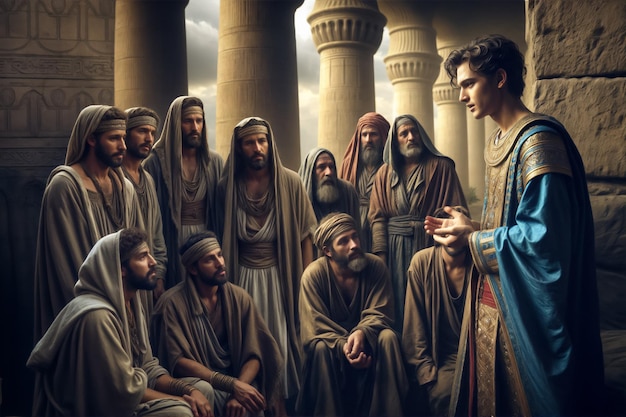
Sons of Egypt: Your Father Is Ill
As Jacob’s life draws near its end, Sons of Egypt, God provides one final opportunity for blessing, remembrance, and covenant assurance. When Joseph hears that his father is ill, he brings his sons, Ephraim and Manasseh, before him. What follows is far more than a family visit—it is a powerful confirmation that God’s promises continue from generation to generation. Though Jacob’s eyes are failing, his faith remains strong. The God who preserved Joseph now prepares the future of Israel through covenant blessing and divine purpose.
God’s Blessings, Ephraim, Manasseh, Family Covenant, Failing Eyes, Unexpected Joy, Future Generations, God’s Faithfulness
📖 Genesis 48:1 (NIV)
“48 Some time later Joseph was told, “Your father is ill.” So he took his two sons Manasseh and Ephraim along with him.”
As Jacob’s life drew near its end, Joseph received word that his father was ill. He immediately brought his two sons, Ephraim and Manasseh, to visit him. What followed was far more than a family gathering. It became a powerful moment of covenant blessing, adoption, and prophecy. The God who had guided Abraham, Isaac, and Jacob was now extending His promises to another generation. Though Jacob’s eyes were failing, his spiritual vision remained clear as he looked ahead to God’s unfolding plan.
📖 Genesis 48:2-4 (NIV)
“2When Jacob was told, “Your son Joseph has come to you,” Israel rallied his strength and sat up on the bed.”
“3 Jacob said to Joseph, “God Almighty[a] appeared to me at Luz in the land of Canaan, and there he blessed me 4 and said to me, ‘I am going to make you fruitful and increase your numbers. I will make you a community of peoples, and I will give this land as an everlasting possession to your descendants after you.’
📖 Genesis 48:4 (NIV)
“4 and said to me, ‘I am going to make you fruitful and increase your numbers. I will make you a community of peoples, and I will give this land as an everlasting possession to your descendants after you.’”
After Joseph arrived, Jacob gathered his strength and sat up in bed.
His thoughts immediately turned to God’s covenant promises.
He recalled how God Almighty had appeared to him at Luz (Bethel) and promised:
“I am going to make you fruitful and increase your numbers.”
Even in his final days, Jacob’s confidence rested not in his accomplishments but in God’s faithfulness.
The covenant that began with Abraham was still moving forward exactly as God had promised.
📖 Genesis 48:5–6 (NIV)
5 “Now then, your two sons born to you in Egypt before I came to you here will be reckoned as mine; Ephraim and Manasseh will be mine, just as Reuben and Simeon are mine. 6 Any children born to you after them will be yours; in the territory they inherit they will be reckoned under the names of their brothers. “
Jacob made an extraordinary declaration.
He adopted Joseph’s two sons as his own:
“Ephraim and Manasseh will be mine.”
This elevated them to the status of tribal heirs within Israel.
God’s blessings were now extending beyond Jacob’s sons to the next generation.
What began as a family promise was becoming a growing nation just as God had foretold.
📖 Genesis 48:8–11 (NIV)
“8 When Israel saw the sons of Joseph, he asked, “Who are these?”
9 “They are the sons God has given me here,” Joseph said to his father.”
“Then Israel said, “Bring them to me so I may bless them.”
“10 Now Israel’s eyes were failing because of old age, and he could hardly see. So Joseph brought his sons close to him, and his father kissed them and embraced them.”
“11 Israel said to Joseph, “I never expected to see your face again, and now God has allowed me to see your children too.”
When Joseph brought his sons forward, Jacob embraced them and said:
“I never expected to see your face again, and now God has allowed me to see your children too.”
Years earlier Jacob believed Joseph was dead.
The grief had nearly consumed him.
Yet God’s plan was greater than Jacob could see.
Not only did God restore Joseph to him, but He also allowed him to witness the next generation of blessing.
God often gives far more than we expect when His timing is fulfilled.
📖 Genesis 48:12–16 (NIV)
“12 Then Joseph removed them from Israel’s knees and bowed down with his face to the ground. 13 And Joseph took both of them, Ephraim on his right toward Israel’s left hand and Manasseh on his left toward Israel’s right hand, and brought them close to him. 14 But Israel reached out his right hand and put it on Ephraim’s head, though he was the younger, and crossing his arms, he put his left hand on Manasseh’s head, even though Manasseh was the firstborn.”
“15 Then he blessed Joseph and said,
“May the God before whom my fathers
Abraham and Isaac walked faithfully,
the God who has been my shepherd
all my life to this day,”
“16
the Angel who has delivered me from all harm
—may he bless these boys.
May they be called by my name
and the names of my fathers Abraham and Isaac,
and may they increase greatly
on the earth.”
Jacob’s physical eyesight was weak.
He could hardly see.
Yet his spiritual understanding remained strong.
As Joseph positioned Manasseh, the firstborn, before Jacob’s right hand, Jacob deliberately crossed his arms.
His right hand rested on Ephraim, the younger son.
Then he prayed:
“May the God who has been my shepherd all my life to this day…”
Jacob recognized that every blessing in his life had come from God’s guidance and protection.
The same God who delivered him from harm would now bless these boys.
📖 Genesis 48:17–20 (NIV)
“17 When Joseph saw his father placing his right hand on Ephraim’s head he was displeased; so he took hold of his father’s hand to move it from Ephraim’s head to Manasseh’s head. 18 Joseph said to him, “No, my father, this one is the firstborn; put your right hand on his head.”
“19 But his father refused and said, “I know, my son, I know. He too will become a people, and he too will become great. Nevertheless, his younger brother will be greater than he, and his descendants will become a group of nations.” 20 He blessed them that day and said,
“In your[c] name will Israel pronounce this blessing:
‘May God make you like Ephraim and Manasseh.’”
So he put Ephraim ahead of Manasseh.
Joseph attempted to correct what appeared to be a mistake.
The right-hand blessing belonged to the firstborn.
But Jacob knew exactly what he was doing.
He answered:
“I know, my son, I know.”
God had revealed that Ephraim would become greater than Manasseh.
Once again, God’s purposes overruled human expectations.
Just as God chose Isaac over Ishmael and Jacob over Esau, He now placed Ephraim ahead of Manasseh.
God’s plans are never limited by human customs.
📖 Genesis 48:21–22 (NIV)
“21 Then Israel said to Joseph, “I am about to die, but God will be with you[d] and take you[e] back to the land of your[f] fathers. 22 And to you I give one more ridge of land[g] than to your brothers, the ridge I took from the Amorites with my sword and my bow.”
Jacob knew his death was approaching.
Yet his final words were filled with confidence:
“God will be with you and take you back to the land of your fathers.”
Though Israel lived in Egypt, Jacob knew Egypt was not their final home.
God’s covenant land still awaited His people.
Jacob died trusting that God would continue fulfilling every promise He had made.
His faith looked beyond his own lifetime and toward God’s future work.
Genesis 48 is a chapter about legacy.
Jacob’s strength was fading, but God’s promises were not.
His eyes were weak, but his faith remained strong.
His life was ending, yet God’s covenant was advancing into another generation.
The God who blessed Abraham, Isaac, Jacob, Joseph, Ephraim, and Manasseh remained faithful to every promise He made.
God’s covenant promises extend from generation to generation.
Physical weakness does not diminish spiritual insight.
God often gives blessings beyond what we expect.
The Lord’s plans are greater than human traditions.
Faith looks beyond present circumstances to future promises.
God’s faithfulness does not end when one generation passes away.
The next generation is an important part of God’s work.
God’s blessings continue unfolding according to His perfect plan.
Jacob once believed he would never see Joseph again. Yet God not only restored Joseph to him but also allowed him to bless Joseph’s sons. Standing at the end of his journey, Jacob could see the faithfulness of God stretching across multiple generations.
Genesis 48 reminds us that God’s promises are bigger than one lifetime. His covenant continues from generation to generation, and His plans move forward long after we are gone. Though Jacob’s eyes were failing, his faith clearly saw what mattered most—God would remain faithful to His people, and His blessings would continue through the generations to come.