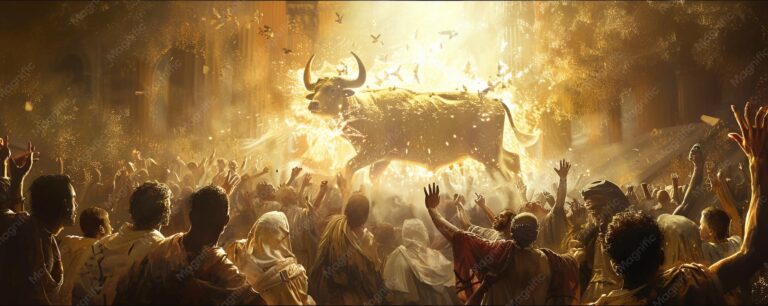
While Moses was on Mount Sinai receiving God’s covenant instructions, Sin Following the Calf, the people grew impatient and allowed fear, doubt, and disobedience to guide their actions. In a moment of spiritual weakness, they exchanged the worship of the living God for a golden calf made by human hands. Exodus 32 reveals the dangers of idolatry, the consequences of sin, and the importance of covenant faithfulness. Yet even amid judgment, God’s redemption plan continued through mercy, intercession, and His unwavering commitment to His people.
Obedience, God’s Covenant, Redemption Plan, Protection, Punishment, Idolatry, Gold, Corruption, Broken Tablets, Atonement
📖 Exodus 32:1 (NIV)
“32 When the people saw that Moses was so long in coming down from the mountain, they gathered around Aaron and said, “Come, make us gods[a] who will go before us. As for this fellow Moses who brought us up out of Egypt, we don’t know what has happened to him.”
📖 Exodus 32:2-3 (NIV)
“2 Aaron answered them, “Take off the gold earrings that your wives, your sons and your daughters are wearing, and bring them to me.” 3 So all the people took off their earrings and brought them to Aaron.”
While Moses remained on Mount Sinai receiving God’s covenant instructions, the people grew impatient. Instead of trusting the God who had delivered them from Egypt, they demanded something they could see and touch. What followed became one of the greatest failures in Israel’s history. A people who had witnessed miracles, crossed the Red Sea, eaten bread from heaven, and stood before God’s mountain quickly turned to idolatry. Exodus 32 reveals the danger of impatience, the seriousness of sin, and the mercy of God even when His people fail.
📖 Exodus 32:4-6 (NIV)
” 4 He took what they handed him and made it into an idol cast in the shape of a calf, fashioning it with a tool. Then they said, “These are your gods,[b] Israel, who brought you up out of Egypt.”
“5 When Aaron saw this, he built an altar in front of the calf and announced, “Tomorrow there will be a festival to the Lord.” 6 So the next day the people rose early and sacrificed burnt offerings and presented fellowship offerings. Afterward they sat down to eat and drink and got up to indulge in revelry.”
When Moses delayed in returning from the mountain, the people became restless.
They approached Aaron and demanded:
“Come, make us gods who will go before us.”
Aaron collected their gold earrings and fashioned a calf with a tool.
The people declared:
“These are your gods, Israel, who brought you up out of Egypt.”
The tragedy was not simply the creation of an idol.
They credited the work of God to something made by human hands.
The gold that had been given as provision from Egypt was transformed into an object of false worship.
What God had given for blessing was misused through disobedience.
📖 Exodus 32:7–10 (NIV)
“7 Then the Lord said to Moses, “Go down, because your people, whom you brought up out of Egypt, have become corrupt. 8 They have been quick to turn away from what I commanded them and have made themselves an idol cast in the shape of a calf. They have bowed down to it and sacrificed to it and have said, ‘These are your gods, Israel, who brought you up out of Egypt.’
“9 “I have seen these people,” the Lord said to Moses, “and they are a stiff-necked people. 10 Now leave me alone so that my anger may burn against them and that I may destroy them. Then I will make you into a great nation.”
The Lord informed Moses that the people had become corrupt.
They had quickly turned away from God’s commands.
The covenant had barely been established, yet they were already violating the first commandments.
God described them as:
“A stiff-necked people.”
Their problem was not lack of evidence.
Their problem was a lack of trust and obedience.
They exchanged God’s truth for something they created themselves.
📖 Exodus 32:11–14 (NIV)
“11 But Moses sought the favor of the Lord his God. “Lord,” he said, “why should your anger burn against your people, whom you brought out of Egypt with great power and a mighty hand? 12 Why should the Egyptians say, ‘It was with evil intent that he brought them out, to kill them in the mountains and to wipe them off the face of the earth’? Turn from your fierce anger; relent and do not bring disaster on your people. 13 Remember your servants Abraham, Isaac and Israel, to whom you swore by your own self: ‘I will make your descendants as numerous as the stars in the sky and I will give your descendants all this land I promised them, and it will be their inheritance forever.’” 14 Then the Lord relented and did not bring on his people the disaster he had threatened.”
Rather than accepting God’s offer to start over with him, Moses pleaded for mercy.
He reminded God of:
His covenant with Abraham, Isaac, and Jacob.
His promises to Israel.
His reputation among the nations.
Moses stood in the gap for the people.
He appealed to God’s covenant faithfulness.
Because of Moses’ intercession, the Lord withheld the complete destruction that had been threatened.
The redemption plan would continue forward.
📖 Exodus 32:15–20 (NIV)
“15 Moses turned and went down the mountain with the two tablets of the covenant law in his hands. They were inscribed on both sides, front and back. 16 The tablets were the work of God; the writing was the writing of God, engraved on the tablets.
17 When Joshua heard the noise of the people shouting, he said to Moses, “There is the sound of war in the camp.”
“18 Moses replied:
“It is not the sound of victory,
it is not the sound of defeat;
it is the sound of singing that I hear.”
“19 When Moses approached the camp and saw the calf and the dancing, his anger burned and he threw the tablets out of his hands, breaking them to pieces at the foot of the mountain. 20 And he took the calf the people had made and burned it in the fire; then he ground it to powder, scattered it on the water and made the Israelites drink it.”
Moses descended the mountain carrying the tablets of the covenant law.
These tablets were:
“The work of God.”
When he entered the camp and saw the calf and the dancing, righteous anger filled him.
He threw the tablets to the ground and shattered them.
The broken tablets symbolized what Israel had already done spiritually.
Before they broke stone tablets, they had broken covenant faithfulness.
Moses then destroyed the calf, ground it into powder, scattered it on water, and made the people drink it.
The idol they trusted was reduced to dust.
📖 Exodus 32:21–24 (NIV)
“21 He said to Aaron, “What did these people do to you, that you led them into such great sin?”
“22 “Do not be angry, my lord,” Aaron answered. “You know how prone these people are to evil. 23 They said to me, ‘Make us gods who will go before us. As for this fellow Moses who brought us up out of Egypt, we don’t know what has happened to him.’ 24 So I told them, ‘Whoever has any gold jewelry, take it off.’ Then they gave me the gold, and I threw it into the fire, and out came this calf!”
Moses confronted Aaron.
Instead of accepting responsibility, Aaron shifted blame to the people.
Then he gave one of Scripture’s most remarkable excuses:
“I threw it into the fire, and out came this calf!”
Aaron attempted to minimize his role.
But leadership carries responsibility.
His failure allowed the people to drift into greater sin.
📖 Exodus 32:25–29 (NIV)
“25 Moses saw that the people were running wild and that Aaron had let them get out of control and so become a laughingstock to their enemies. 26 So he stood at the entrance to the camp and said, “Whoever is for the Lord, come to me.” And all the Levites rallied to him.
“27 Then he said to them, “This is what the Lord, the God of Israel, says: ‘Each man strap a sword to his side. Go back and forth through the camp from one end to the other, each killing his brother and friend and neighbor.’” 28 The Levites did as Moses commanded, and that day about three thousand of the people died. 29 Then Moses said, “You have been set apart to the Lord today, for you were against your own sons and brothers, and he has blessed you this day.”
The camp had descended into chaos.
Moses stood at the entrance and declared:
“Whoever is for the Lord, come to me.”
The Levites responded.
They chose obedience over popularity.
Faithfulness over compromise.
As judgment fell, about three thousand people died.
The consequences were severe because the sin was serious.
God was teaching Israel that covenant obedience mattered.
📖 Exodus 32:30–34 (NIV)
“30 The next day Moses said to the people, “You have committed a great sin. But now I will go up to the Lord; perhaps I can make atonement for your sin.”
“31 So Moses went back to the Lord and said, “Oh, what a great sin these people have committed! They have made themselves gods of gold. 32 But now, please forgive their sin—but if not, then blot me out of the book you have written.”
“33 The Lord replied to Moses, “Whoever has sinned against me I will blot out of my book. 34 Now go, lead the people to the place I spoke of, and my angel will go before you. However, when the time comes for me to punish, I will punish them for their sin.”
The following day Moses again approached God on behalf of the people.
He confessed:
“What a great sin these people have committed!”
Moses even offered himself in their place.
His willingness to sacrifice himself points forward to a greater Mediator who would one day stand between God and sinful humanity.
Although forgiveness was granted, consequences remained.
God’s covenant would continue, but sin still carried accountability.
📖 Exodus 32:35 (NIV)
“35 And the Lord struck the people with a plague because of what they did with the calf Aaron had made.”
The chapter closes with judgment.
The Lord struck the people with a plague because of their participation in the worship of the calf.
The lesson was unmistakable.
God is merciful.
God is patient.
But God does not ignore sin.
Despite Israel’s failure, God’s redemption plan did not end.
The covenant promises remained secure.
Moses interceded.
God showed mercy.
The people were disciplined, but they were not abandoned.
Throughout Exodus, God repeatedly demonstrates that His faithfulness is greater than human failure.
His covenant survives because it rests upon His character, not man’s perfection.
Impatience often leads people into poor decisions.
Idolatry begins when we place something above God.
God’s blessings should never become objects of worship.
Sin can spread quickly when leadership fails.
True leaders take responsibility rather than making excuses.
God’s covenant includes both mercy and accountability.
Intercession matters.
Forgiveness does not always remove consequences.
God’s redemption plan continues despite human failure.
Obedience remains the pathway to blessing and protection.
Exodus 32 serves as a sobering reminder that even people who have witnessed God’s miracles can drift away when they stop trusting Him. Israel exchanged the glory of the God who delivered them from Egypt for a golden calf made with human hands. Their impatience led to corruption, their disobedience led to judgment, and their sin shattered the covenant symbolized by the broken tablets.
Yet the chapter also reveals God’s mercy. Through Moses’ intercession, the Lord preserved His people and continued His redemption plan. The lesson remains timeless: sin brings consequences, but God’s covenant faithfulness continues to call His people back to obedience, repentance, and trust in Him alone.