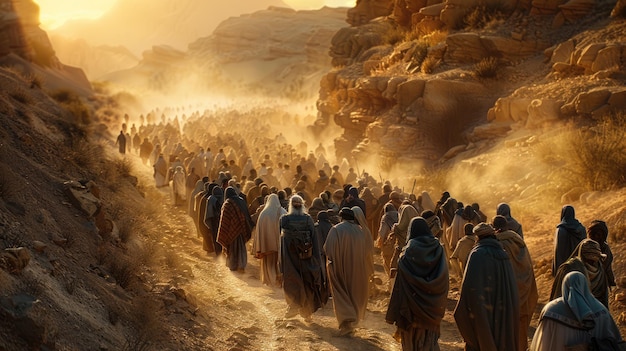
After the miracle of the Red Sea, Road to Elim Israel began a new journey of learning to trust the God who had redeemed them. The wilderness quickly revealed their fears, doubts, and dependence on daily provision. When bitter water tested their faith, God provided healing. When hunger stirred complaints, He promised bread from heaven. Along the road to Elim, the Lord showed that His covenant faithfulness did not end with deliverance from slavery. He would guide, provide, protect, and sustain His people every step of the way.
God’s Covenant, Redemption, Provision, Trust, Obedience, Testing, Healing, Grace, Daily Dependence
📖 Exodus 15:22
“15:22 Then Moses led Israel from the Red Sea and they went into the Desert of Shur. For three days they traveled in the desert without finding water.”
Only days after witnessing God’s mighty deliverance at the Red Sea, the Israelites found themselves facing new challenges in the wilderness. Their journey from Egypt was not just about leaving slavery behind—it was about learning to trust the God who had redeemed them.
When water became scarce, they grumbled. When food seemed uncertain, they complained. Yet despite their fears and doubts, God continued to provide. He turned bitter water sweet, led them to refreshing springs, and promised bread from heaven.
The road to Elim became a lesson that God’s redemption does not end with deliverance—it continues through His daily provision and care.
📖 Exodus 15:23–25
“23 When they came to Marah, they could not drink its water because it was bitter. (That is why the place is called Marah.[f]) 24 So the people grumbled against Moses, saying, “What are we to drink?”
“25 Then Moses cried out to the Lord, and the Lord showed him a piece of wood. He threw it into the water, and the water became fit to drink.”
There the Lord issued a ruling and instruction for them and put them to the test.
Three days after crossing the Red Sea, the Israelites entered the Desert of Shur.
Water was desperately needed.
When they finally found water at Marah, they discovered it was bitter and unfit to drink.
Disappointment quickly turned into complaints.
“What are we to drink?”
The people grumbled against Moses rather than seeking the Lord.
Moses, however, cried out to God.
The Lord showed him a piece of wood, and when it was thrown into the water, the water became fit to drink.
What seemed impossible became possible through God’s intervention.
The God who parted the sea could also provide water in the desert.
📖 Exodus 15:26
“26 He said, “If you listen carefully to the Lord your God and do what is right in his eyes, if you pay attention to his commands and keep all his decrees, I will not bring on you any of the diseases I brought on the Egyptians, for I am the Lord, who heals you.”
At Marah, God gave the people an important lesson.
He said:
“I am the Lord, who heals you.”
The issue was never simply water.
God was teaching His people that obedience and trust would be essential for the journey ahead.
The Lord had redeemed them from Egypt, but now He was shaping them into a people who would follow Him.
His covenant promises included not only deliverance but also healing, guidance, and protection.
📖 Exodus 15:27
“27 Then they came to Elim, where there were twelve springs and seventy palm trees, and they camped there near the water.”
After Marah came Elim.
What a contrast.
Instead of bitter water, they found:
Twelve springs
Seventy palm trees
Abundant water
Rest and refreshment
God led them from testing into blessing.
Elim served as a reminder that difficult seasons are often followed by seasons of provision.
The same God who allowed the test also prepared the oasis.
📖 Exodus 16:1–3
“16 The whole Israelite community set out from Elim and came to the Desert of Sin, which is between Elim and Sinai, on the fifteenth day of the second month after they had come out of Egypt. 2 In the desert the whole community grumbled against Moses and Aaron. 3 The Israelites said to them, “If only we had died by the Lord’s hand in Egypt! There we sat around pots of meat and ate all the food we wanted, but you have brought us out into this desert to starve this entire assembly to death.”
As the journey continued, another challenge arose.
Food supplies became scarce.
Again the people grumbled.
They looked back toward Egypt and remembered the food they once had.
Fear caused them to forget the slavery they had endured.
They accused Moses and Aaron of leading them into the wilderness to die.
Their complaints revealed a struggle many believers face:
Trusting God for tomorrow.
The people had witnessed miracles, yet they still doubted God’s ability to provide.
📖 Exodus 16:4–5
“4 Then the Lord said to Moses, “I will rain down bread from heaven for you. The people are to go out each day and gather enough for that day. In this way I will test them and see whether they will follow my instructions. 5 On the sixth day they are to prepare what they bring in, and that is to be twice as much as they gather on the other days.”
Rather than responding in anger, God responded with grace.
The Lord declared:
“I will rain down bread from heaven for you.”
Every day the people would gather exactly what they needed.
No more.
No less.
On the sixth day they would gather twice as much in preparation for the Sabbath.
God was not only feeding His people.
He was teaching them dependence.
Each morning required faith.
Each day required trust.
The provision would come directly from Him.
📖 Exodus 16:6–12
“6 So Moses and Aaron said to all the Israelites, “In the evening you will know that it was the Lord who brought you out of Egypt, 7 and in the morning you will see the glory of the Lord, because he has heard your grumbling against him. Who are we, that you should grumble against us?” 8 Moses also said, “You will know that it was the Lord when he gives you meat to eat in the evening and all the bread you want in the morning, because he has heard your grumbling against him. Who are we? You are not grumbling against us, but against the Lord.”
“9 Then Moses told Aaron, “Say to the entire Israelite community, ‘Come before the Lord, for he has heard your grumbling.’”
“10 While Aaron was speaking to the whole Israelite community, they looked toward the desert, and there was the glory of the Lord appearing in the cloud.”
“11 The Lord said to Moses, 12 “I have heard the grumbling of the Israelites. Tell them, ‘At twilight you will eat meat, and in the morning you will be filled with bread. Then you will know that I am the Lord your God.’”
Moses reminded the people that their complaints were not truly against him or Aaron.
Their grumbling was against the Lord.
Yet God still listened.
The glory of the Lord appeared in the cloud.
Then God promised:
“At twilight you will eat meat, and in the morning you will be filled with bread.”
God heard their fears.
God understood their needs.
God responded with provision.
Through every miracle He was revealing the same truth:
“Then you will know that I am the Lord your God.”
The journey from Egypt was not merely about escaping slavery.
It was about learning to trust the One who saves.
At Marah, God provided water.
At Elim, He provided rest.
In the wilderness, He provided bread.
Each step revealed His covenant faithfulness.
The Lord who redeemed Israel would also sustain Israel.
God’s redemption includes daily provision.
Difficult seasons often prepare us for future blessings.
Complaining reveals a lack of trust.
God hears our fears even when we express them poorly.
Obedience and faith go hand in hand.
God often provides one day at a time.
The Lord is our healer, provider, and protector.
God’s covenant promises extend beyond deliverance into daily care.
The road from Egypt to the Promised Land was filled with lessons about trust. At Marah, God turned bitter water sweet. At Elim, He provided springs and shade. In the wilderness, He promised bread from heaven.
Again and again, Israel discovered that redemption was not a single event—it was an ongoing journey with a faithful God. Though they struggled with fear and doubt, God’s covenant remained secure. He provided water when they were thirsty, bread when they were hungry, and hope when they were uncertain.
The same God who delivered them from slavery would faithfully sustain them every step of the way.