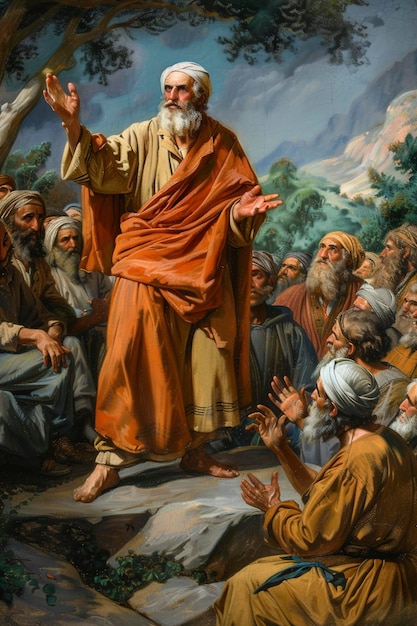
Paul teaches us that extraordinary experiences do not make a person greater than others. Nothing To Be Gained, Visions, revelations, accomplishments, and spiritual authority are not reasons for pride. What matters is how we respond to God’s grace. Through Paul’s weakness, we discover that God’s power is greater than human strength, and that true love seeks the spiritual well-being of others.
Obedience, God’s Covenant, Faith, Boast, Grace, Satan, Vision, Weakness, Fool, Wisdom, Power, Redemption Plan, Jesus Christ.
📖 2 Corinthians 12:1 (NIV)
“12 I must go on boasting. Although there is nothing to be gained, I will go on to visions and revelations from the Lord.”
Paul continues explaining why he has been forced to defend his ministry.
He describes a remarkable experience from fourteen years earlier, when a man in Christ was caught up to the third heaven and heard things that could not be expressed.
Paul does not use this experience to elevate himself. Instead, he turns attention to his weaknesses.
He then describes a thorn in his flesh, a source of suffering that he pleaded with the Lord to remove three times.
The Lord’s answer was that His grace was sufficient and His power was made perfect in weakness.
Paul learned that his limitations did not prevent Christ from working through him.
Paul also reminds the Corinthians that he served them without seeking their possessions.
His concern was that they grow stronger in faith and turn away from the sins and disorder that threatened their relationship with God.
The chapter brings together humility, grace, perseverance, love, and repentance.
Paul shows us that spiritual strength is not measured by how impressive we appear, but by how faithfully we depend on Jesus Christ.
📖 2 Corinthians 12:1-4 (NIV)
“12 I must go on boasting. Although there is nothing to be gained, I will go on to visions and revelations from the Lord. 2 I know a man in Christ who fourteen years ago was caught up to the third heaven. Whether it was in the body or out of the body I do not know—God knows. 3 And I know that this man—whether in the body or apart from the body I do not know, but God knows— 4 was caught up to paradise and heard inexpressible things, things that no one is permitted to tell.”
Paul reluctantly speaks about visions and revelations from the Lord.
He describes a man in Christ who, fourteen years earlier, was caught up to the third heaven and paradise.
Paul does not claim to know whether this happened in the body or outside the body.
The experience was extraordinary, but Paul does not use it to claim superiority.
He also makes clear that the things heard were inexpressible and not permitted to be shared.
This teaches us that not every spiritual experience is meant to become a public accomplishment.
God’s work is not a competition, and personal experiences should never become a reason to look down on others.
Faith is not measured by how many extraordinary experiences we can describe.
We should remain humble, recognize that some things belong to God alone, and keep our attention on His Word.
Our relationship with Jesus Christ matters more than the attention we receive from others.
📖 2 Corinthians 12:5-8 (NIV)
“5 I will boast about a man like that, but I will not boast about myself, except about my weaknesses. 6 Even if I should choose to boast, I would not be a fool, because I would be speaking the truth. But I refrain, so no one will think more of me than is warranted by what I do or say, 7 or because of these surpassingly great revelations. Therefore, in order to keep me from becoming conceited, I was given a thorn in my flesh, a messenger of Satan, to torment me. 8 Three times I pleaded with the Lord to take it away from me.”
Paul explains that he will boast about his weaknesses rather than elevate himself through extraordinary experiences.
He does not want people to think more highly of him than his words and actions deserve.
He then describes a thorn in his flesh, which he calls a messenger of Satan sent to torment him.
It may have been a physical, personal, or other persistent affliction, but we should not claim certainty where Scripture does not provide it.
Paul recognizes that even after receiving remarkable revelations, he still needs humility.
His weakness keeps him from becoming conceited.
None of us is beyond the need for humility.
Success, knowledge, recognition, or spiritual experiences can tempt us to believe we are more important than others.
Our weaknesses remind us that we remain dependent on God.
We do not have to understand every hardship to continue trusting Him.
📖 2 Corinthians 12:9-12 (NIV)
“9 But he said to me, “My grace is sufficient for you, for my power is made perfect in weakness.” Therefore I will boast all the more gladly about my weaknesses, so that Christ’s power may rest on me. 10 That is why, for Christ’s sake, I delight in weaknesses, in insults, in hardships, in persecutions, in difficulties. For when I am weak, then I am strong.”
“11 I have made a fool of myself, but you drove me to it. I ought to have been commended by you, for I am not in the least inferior to the “super-apostles,”[a] even though I am nothing. 12 I persevered in demonstrating among you the marks of a true apostle, including signs, wonders and miracles.”
Paul pleads with the Lord three times to remove his thorn.
The answer he receives is one of the most important teachings in this chapter:
“My grace is sufficient for you, for my power is made perfect in weakness.”
Paul does not say that his suffering disappeared. Instead, he discovers that Christ’s power can sustain him even when the hardship remains.
He can face insults, difficulties, persecution, and hardship without believing that his weakness makes him useless.
His confidence rests in Christ, not in his own ability.
Sometimes we ask God to change our circumstances, but the answer may come through the grace that helps us endure them.
This does not mean suffering is good or that we should ignore situations where help is needed.
It means hardship does not have to separate us from hope.
When our strength reaches its limits, Christ’s grace remains sufficient.
📖 2 Corinthians 12:13-16 (NIV)
“13 How were you inferior to the other churches, except that I was never a burden to you? Forgive me this wrong!”
“14 Now I am ready to visit you for the third time, and I will not be a burden to you, because what I want is not your possessions but you. After all, children should not have to save up for their parents, but parents for their children. 15 So I will very gladly spend for you everything I have and expend myself as well. If I love you more, will you love me less? 16 Be that as it may, I have not been a burden to you. Yet, crafty fellow that I am, I caught you by trickery!”
The Corinthians should have recognized the work he had done among them, but instead he found himself compared with those claiming to be superior.
He reminds them that the signs of a true apostle were demonstrated through perseverance, signs, wonders, and miracles.
He also points out that he never made himself a financial burden to them.
His purpose is not to demand admiration.
He wants the Corinthians to recognize that his ministry was genuine and that his work among them was for their benefit.
A person’s spiritual value should not be determined by popularity or self-promotion.
Faithful service is demonstrated through truth, perseverance, integrity, and a desire to strengthen others.
We should look for the fruit of genuine service rather than simply accepting someone’s claims about themselves.
📖 2 Corinthians 12:17-21 (NIV)
“17 Did I exploit you through any of the men I sent to you? 18 I urged Titus to go to you and I sent our brother with him. Titus did not exploit you, did he? Did we not walk in the same footsteps by the same Spirit?”
“19 Have you been thinking all along that we have been defending ourselves to you? We have been speaking in the sight of God as those in Christ; and everything we do, dear friends, is for your strengthening. 20 For I am afraid that when I come I may not find you as I want you to be, and you may not find me as you want me to be. I fear that there may be discord, jealousy, fits of rage, selfish ambition, slander, gossip, arrogance and disorder. 21 I am afraid that when I come again my God will humble me before you, and I will be grieved over many who have sinned earlier and have not repented of the impurity, sexual sin and debauchery in which they have indulged.”
Paul prepares for his third visit to Corinth and explains that he does not want their possessions.
He wants them.
Like a parent who provides for children, Paul is willing to spend himself for their spiritual well-being.
He says he will gladly give everything and expend himself for them, even if his love is not returned in the same measure.
He reminds them that Titus and his companion followed the same Spirit and the same pattern of conduct.
Genuine love is not built around what we can take from others.
It seeks their well-being.
This is an important lesson for families, friendships, churches, and leadership.
We should give with sincerity, serve without manipulation, and never use faith as an excuse to take advantage of another person.
God’s grace remains greater than human weakness.
Paul’s experience reminds us that God’s promises are not dependent on our strength, our possessions, or our ability to impress others.
Throughout Scripture, God calls people to humility, obedience, and faith.
His Redemption Plan is not something humanity can accomplish through pride or personal achievement.
It is fulfilled through Jesus Christ, who gave Himself for us.
The Lord’s answer to Paul reminds us that His grace is sufficient.
Even when we face circumstances we cannot change, we can continue to trust His faithfulness.
God’s purpose remains greater than our limitations.
This chapter teaches us to examine what we consider strength.
Are we seeking recognition, or are we seeking to serve?
Do we use our knowledge to build others up, or to make ourselves appear important?
Paul shows us that spiritual maturity requires humility.
We may experience hardship, unanswered prayers, and personal limitations, but these things do not determine our worth before God.
We also learn that love must be sincere.
Paul wanted the Corinthians to grow in faith, not become dependent on him or give him their possessions.
His concern was their relationship with God.
We are not asked to be perfect.
We are asked to keep learning, turn away from sin, seek forgiveness, and trust the grace of Jesus Christ.
Paul’s words about grace and weakness point us directly toward Jesus Christ.
Jesus did not come to gain worldly recognition or possessions.
He came to serve, to sacrifice, and to fulfill God’s Redemption Plan.
Through His crucifixion and resurrection, Jesus opened the way for humanity to receive forgiveness and eternal life.
His power is not measured by worldly standards, and His grace reaches people who recognize their need for Him.
Paul learned that God’s grace was sufficient even when his thorn remained.
We can carry that lesson into our own lives.
We may not always understand why hardship comes, why a prayer is answered differently than we hoped, or why our strength sometimes fails.
But we can continue to trust the One whose strength never fails.
The final warning Paul gives the Corinthians also matters.
Faith must lead us toward repentance and away from the sins that damage our lives and relationships.
Grace is not permission to continue in wrongdoing; it is God’s gift that leads us toward a new life in Christ.
Our journey is built through humility, faith, obedience, and the willingness to keep growing.
We do not have to boast about ourselves.
We can boast in the Lord, whose grace is sufficient and whose love leads us toward eternal life.
All Glory Belongs To God.
Amen.