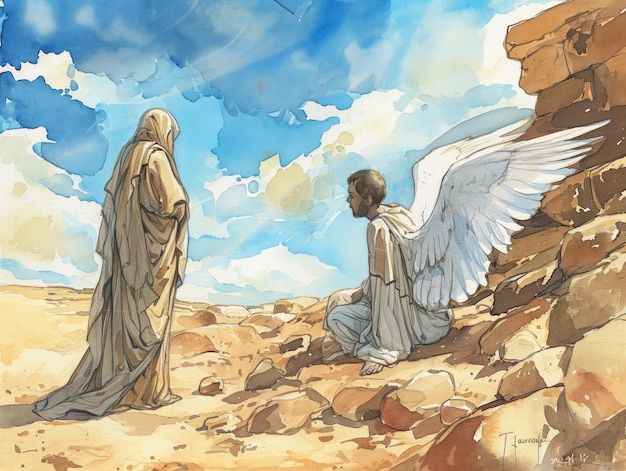
After conflict and hardship Lords Angel Sent, grew within Abram’s household, Hagar fled into the wilderness carrying pain, rejection, and uncertainty. What began through human impatience and attempts to fulfill God’s promise had created division and emotional struggle. Yet in the desert, the angel of the Lord found Hagar and reminded her that she was not forgotten. God spoke promise over her son Ishmael and revealed Himself as the One who hears and sees suffering. Genesis shows that even during hardship, pride, and broken relationships, God remains aware of human pain and need.
God’s Promise, Submission, Ishmael, and the God Who Sees
📖 Genesis 16:7
“7 The angel of the Lord found Hagar near a spring in the desert; it was the spring that is beside the road to Shur”
After conflict and mistreatment within Abram’s household, Hagar fled into the wilderness.
She carried:
pain
rejection
uncertainty
emotional exhaustion
What began as a human attempt to fulfill God’s promise had created division and hardship.
Yet even in the desert, God saw Hagar’s suffering.
📖 Genesis 16:7–8
“Genesis says:
“The angel of the Lord found Hagar near a spring in the desert.”
This moment is important because Hagar was not forgotten.
God sought her out during a time of fear and loneliness.
The angel asked:
“Where have you come from, and where are you going?”
The question revealed both:
concern
and invitation for reflection.
Hagar answered:
“I’m running away from my mistress Sarai.”
Her situation had become emotionally difficult.
Genesis shows how conflict, pride, jealousy, and broken relationships can push people toward isolation and escape.
Yet even while fleeing, Hagar encountered God’s presence.
📖 Genesis 16:9
“9 Then the angel of the Lord told her, “Go back to your mistress and submit to her.”
The angel told Hagar:
“Go back to your mistress and submit to her.”
Submission here did not erase hardship, but it revealed trust in God’s larger plan.
Sometimes obedience requires humility during difficult seasons.
Genesis repeatedly shows that God’s direction may involve:
patience
endurance
trust beyond current emotions.
📖 Genesis 16:10
“10 The angel added, “I will increase your descendants so much that they will be too numerous to count.”
The angel declared:
“I will increase your descendants so much that they will be too numerous to count.”
Even though the situation began through human impatience and struggle, God still spoke future promise over Hagar and her child.
This reveals:
God’s awareness
His sovereignty
and His ability to work through imperfect human situations.
📖 Genesis 16:11
1 The angel of the Lord also said to her:
“You are now pregnant
and you will give birth to a son.
You shall name him Ishmael,[a]
for the Lord has heard of your misery.
The angel said:
“You shall name him Ishmael, for the Lord has heard of your misery.”
The name Ishmael means:
“God hears.”
This moment reveals God’s compassion toward those who feel:
unseen
rejected
forgotten
mistreated
God heard Hagar’s suffering in the wilderness.
📖 Genesis 16:12
“12He will be a wild donkey of a man;
his hand will be against everyone
and everyone’s hand against him,
and he will live in hostility
toward[b] all his brothers.”
The angel described Ishmael’s future:”
“He will be a wild donkey of a man.”
Ishmael’s descendants would become:
numerous
strong
independent
influential leaders and peoples
Yet conflict and struggle would also surround parts of his future.
Genesis shows that human decisions can create long-lasting effects across generations.
📖 Genesis 16:13
13 She gave this name to the Lord who spoke to her: “You are the God who sees me,” for she said, “I have now seen[c] the One who sees me.” 14 That is why the well was called Beer Lahai Roi[d]; it is still there, between Kadeshand Bered.”
Hagar responded:
“You are the God who sees me.”
This became one of the most personal moments in Genesis.
Hagar realized:
God saw her pain
God understood her suffering
God had not abandoned her
Even in isolation and hardship, she was not invisible before God.
The well became known as:
Beer Lahai Roi
meaning:
“the well of the Living One who sees me.”
The location became a reminder that God sees people even during:
suffering
loneliness
rejection
wandering seasons of life.
📖 Genesis 16:15–16
“15 So Hagar bore Abram a son, and Abram gave the name Ishmael to the son she had borne. 16 Abram was eighty-six years old when Hagar bore him Ishmael.”
Hagar gave birth to Ishmael, and Abram named the child exactly as instructed.
Though the situation began through:
impatience
emotional struggle
human effort
God still remained active within the unfolding story.
Genesis continues showing that God’s plans move forward even through imperfect circumstances.
This part of Genesis reminds us:
God sees suffering and hardship
pride and jealousy create division
obedience sometimes requires humility
God can work through imperfect situations
God hears the cries of those in pain
Hagar fled into the wilderness carrying pain, rejection, and uncertainty, yet God met her there through His angel.
The naming of Ishmael became a reminder that God hears and sees those who suffer.
Even within a situation shaped by impatience and human weakness, God still spoke promise, future, and purpose.
Genesis reveals that no one is invisible before God, and His plans can continue unfolding even through hardship, pride, and broken circumstances.