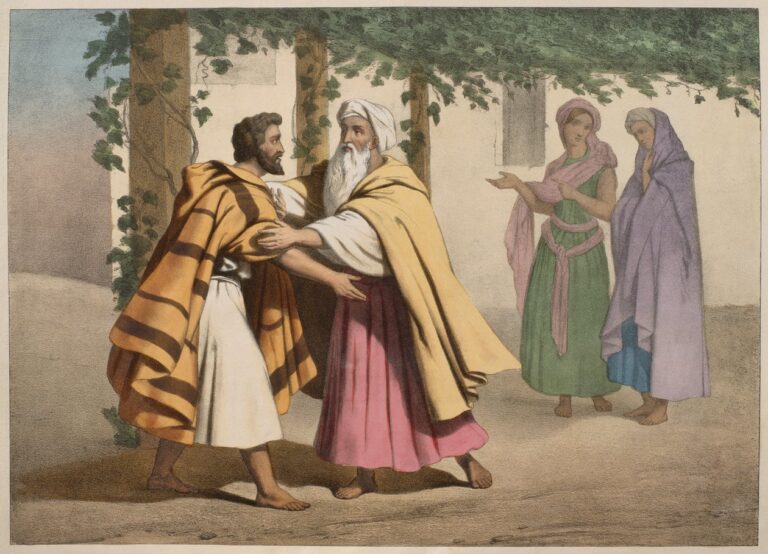
Jacob had spent many years serving Laban, Laban Loses His Grip, building his household, raising his children, and faithfully tending flocks that greatly increased under God’s blessing. What began as a temporary stay had become a long season of obligations, challenges, and dependence upon another man’s authority. Yet God was preparing a new chapter. As Jacob sought to return to his homeland, Laban struggled to maintain control. This passage reveals how God’s favor continued to prosper Jacob while gradually loosening the grip others held over his future.
Deception, Homeland, Family, Livestock, Prosperity, and God’s Blessing
📖 Genesis 30:25
“25 After Rachel gave birth to Joseph, Jacob said to Laban, “Send me on my way so I can go back to my own homeland. “
📖 Genesis 30:26
26 Give me my wives and children, for whom I have served you, and I will be on my way. You know how much work I’ve done for you.”
After Rachel gave birth to Joseph, Jacob began thinking about the future.
For many years he had served Laban faithfully.
Now he desired to return to:
his homeland
his family inheritance
the land God had promised
Jacob requested permission to leave and take:
his wives
his children
his household
The season of serving Laban was drawing to a close.
📖 Genesis 30:27–30
“27 But Laban said to him, “If I have found favor in your eyes, please stay. I have learned by divination that the Lord has blessed me because of you.” 28 He added, “Name your wages, and I will pay them.”29 Jacob said to him, “You know how I have worked for you and how your livestock has fared under my care. 30 The little you had before I came has increased greatly, and the Lord has blessed you wherever I have been. But now, when may I do something for my own household?”
Laban did not want Jacob to leave.
He openly admitted that God’s blessing had rested upon his household because of Jacob’s presence.
Before Jacob arrived, Laban possessed far less.
Through Jacob’s faithful work:
flocks multiplied
wealth increased
prosperity expanded
Even Laban understood that God’s favor was working through Jacob.
Yet despite benefiting from Jacob’s labor, Laban still sought ways to maintain control.
📖 Genesis 30:31–34
31 “What shall I give you?” he asked.
“Don’t give me anything,” Jacob replied. “But if you will do this one thing for me, I will go on tending your flocks and watching over them: 32 Let me go through all your flocks today and remove from them every speckled or spotted sheep, every dark-colored lamb and every spotted or speckled goat. They will be my wages. 33 And my honesty will testify for me in the future, whenever you check on the wages you have paid me. Any goat in my possession that is not speckled or spotted, or any lamb that is not dark-colored, will be considered stolen.”
34 “Agreed,” said Laban. “Let it be as you have said.”
Jacob proposed a simple arrangement.
Instead of demanding immediate payment, he requested certain animals from the flocks as his wages.
The agreement involved:
speckled sheep
spotted goats
dark-colored lambs
Jacob’s plan was straightforward.
His honesty would prove whether he had dealt fairly with Laban.
Laban quickly agreed.
However, his actions soon revealed that he had no intention of making things easy for Jacob.
📖 Genesis 30:35–36
35 That same day he removed all the male goats that were streaked or spotted, and all the speckled or spotted female goats (all that had white on them) and all the dark-colored lambs, and he placed them in the care of his sons. 36 Then he put a three-day journey between himself and Jacob, while Jacob continued to tend the rest of Laban’s flocks.
On the very day the agreement was made, Laban removed many of the animals that would have belonged to Jacob.
He placed them under the care of his own sons and created distance between the two flocks.
Once again, deception appeared.
Laban continued trying to maintain control by manipulating circumstances to his advantage.
His pattern of behavior had not changed.
📖 Genesis 30:37–43
37 Jacob, however, took fresh-cut branches from poplar, almond and plane trees and made white stripes on them by peeling the bark and exposing the white inner wood of the branches. 38 Then he placed the peeled branches in all the watering troughs, so that they would be directly in front of the flocks when they came to drink. When the flocks were in heat and came to drink, 39 they mated in front of the branches. And they bore young that were streaked or speckled or spotted. 40 Jacob set apart the young of the flock by themselves, but made the rest face the streaked and dark-colored animals that belonged to Laban. Thus he made separate flocks for himself and did not put them with Laban’s animals.
41 Whenever the stronger females were in heat, Jacob would place the branches in the troughs in front of the animals so they would mate near the branches, 42 but if the animals were weak, he would not place them there. So the weak animals went to Laban and the strong ones to Jacob. 43 In this way the man grew exceedingly prosperous and came to own large flocks, and female and male servants, and camels and donkeys.
Despite Laban’s efforts, Jacob’s flocks continued to grow.
The stronger animals increasingly became part of Jacob’s herds.
Over time:
his flocks multiplied
his servants increased
his wealth expanded
his household prospered
The chapter concludes with Jacob becoming exceedingly prosperous.
The true source of his success was not human strategy alone.
God’s blessing continued resting upon him.
For years Laban controlled:
Jacob’s labor
Jacob’s future
Jacob’s opportunities
He repeatedly adjusted circumstances for his own benefit.
Yet God’s blessing could not be contained.
The more Laban attempted to maintain control, the more God’s favor elevated Jacob.
What Laban thought he possessed was gradually slipping away.
His grip on Jacob’s future was weakening.
One of the central lessons of this chapter is that God’s blessing is not limited by human opposition.
Jacob faced:
deception
manipulation
unfair treatment
changing circumstances
Yet God continued providing for him.
The Lord’s covenant promises remained active.
Human schemes could not stop divine purposes.
This chapter marks a turning point.
Jacob is no longer the young man who arrived in Harran with nothing.
He now possesses:
wives
children
servants
livestock
growing wealth
God has transformed his circumstances.
The time is approaching when Jacob will return to the land promised to Abraham and Isaac.
The covenant family continues moving forward.
This part of Genesis reminds us:
God’s blessing cannot be controlled by others
deception eventually loses its power
faithful labor often produces lasting rewards
God prospers His people according to His purposes
opposition cannot stop God’s covenant plans
seasons of waiting often prepare us for future responsibilities
God remains faithful through difficult circumstances
God’s favor is stronger than human manipulation
Jacob spent years serving under Laban’s authority, enduring deception, changing agreements, and attempts to limit his success. Yet throughout every challenge, God remained faithful. The Lord blessed Jacob’s work, increased his household, and steadily expanded his influence. While Laban sought to maintain control, God’s covenant promises continued moving forward.
Genesis 30 reminds us that human manipulation cannot overcome divine blessing. When God chooses to prosper His purposes, no amount of opposition can prevent His plans from unfolding. God’s favor remained upon Jacob, and the path home was beginning to open before him.
I think this chapter is really about God gradually breaking Laban’s control while preparing Jacob to return home as a covenant leader rather than a servant. That’s the thread that ties the whole chapter together.