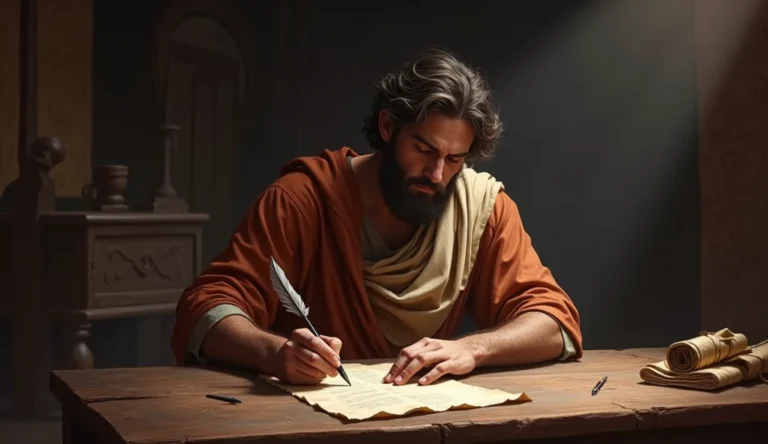
Romans 1 begins by revealing that the Gospel Of God was not a new idea. It had been promised through the prophets and Scripture and was fulfilled through Jesus Christ. Paul explains that the Gospel brings salvation to everyone who believes, but faith is also connected to obedience. Romans then warns what happens when people reject God’s truth, exchange it for lies, and continue practicing evil.
Obedience, God’s Covenant, Mercy, Grace, Faith, Gossips, Evil, Slanderers, Redemption Plan, Jesus Christ
📖 Romans 1:1 (NIV)
“1 Paul, a servant of Christ Jesus, called to be an apostle and set apart for the gospel of God— “
Paul introduces himself as a servant of Jesus Christ and explains that he was called to proclaim the Gospel of God.
This Gospel had been promised beforehand through the prophets and concerns God’s Son, Jesus Christ.
The resurrection confirms who Jesus is and establishes Him as Lord.
Through Him, Paul received grace and apostleship to call the Gentiles to the obedience that comes from faith.
Paul then tells the believers in Rome that he is not ashamed of the Gospel because it is the power of God that brings salvation to everyone who believes.
The Gospel reveals the righteousness of God, and the righteous live by faith.
But Romans 1 also shows the other direction a person can take.
People can know about God and still refuse to honor Him.
They can exchange God’s truth for a lie and worship created things instead of the Creator.
When truth is rejected, the heart and mind can become increasingly controlled by sinful desires.
Paul lists many destructive behaviors, including envy, deceit, malice, gossip, slander, arrogance, and a lack of mercy.
The warning becomes even stronger when people not only practice these things but approve of others who practice them.
Romans 1 therefore places two paths before us: the Gospel that leads to salvation through faith and the rejection of God’s truth that leads deeper into sin.
📖 Romans 1:1-4 (NIV)
“1 Paul, a servant of Christ Jesus, called to be an apostle and set apart for the gospel of God— 2 the gospel he promised beforehand through his prophets in the Holy Scriptures 3 regarding his Son, who as to his earthly life[a] was a descendant of David, 4 and who through the Spirit of holiness was appointed the Son of God in power[b] by his resurrection from the dead: Jesus Christ our Lord. “
Paul begins by showing that the Gospel did not appear without preparation.
God had promised it beforehand through His prophets in the Holy Scriptures.
The coming of Jesus Christ was connected to a story that had already been unfolding through generations.
This is important because God’s Redemption Plan did not begin when Jesus was born.
The promises, prophecies, Covenant, and Scriptures were already pointing forward.
Jesus Christ is the fulfillment of what God had promised.
The Gospel allows us to look backward and see that God’s Covenant was moving toward a purpose all along.
📖 Romans 1:5-8 (NIV)
“5 Through him we received grace and apostleship to call all the Gentiles to the obedience that comes from[c] faith for his name’s sake. 6 And you also are among those Gentiles who are called to belong to Jesus Christ.”
“7 To all in Rome who are loved by God and called to be his holy people:
Grace and peace to you from God our Father and from the Lord Jesus Christ.”
“8 First, I thank my God through Jesus Christ for all of you, because your faith is being reported all over the world.?
Paul identifies Jesus as God’s Son, descended from David according to His earthly life and revealed in power through His resurrection from the dead.
Everything Paul is about to teach begins with Jesus Christ.
The Gospel is not simply a list of religious instructions.
It is the announcement of what God has done through His Son.
Jesus died.
Jesus was raised.
He is the Lord.
And through Him, grace was given.
When we understand Jesus as the center of the Gospel, obedience is no longer about trying to earn salvation.
It becomes a response to the One who has already given grace.
📖 Romans 1:9-12 (NIV)
” 9 God, whom I serve in my spirit in preaching the gospel of his Son, is my witness how constantly I remember you 10 in my prayers at all times; and I pray that now at last by God’s will the way may be opened for me to come to you.”
“11 I long to see you so that I may impart to you some spiritual gift to make you strong— 12 that is, that you and I may be mutually encouraged by each other’s faith. “
Paul connects faith and obedience.
He received grace and apostleship to call the Gentiles to “the obedience that comes from faith.”
Faith is not merely agreeing that something is true.
Faith begins changing the direction of a person’s life.
Believing God should affect how we think, how we speak, how we treat others, and how we respond when God reveals something in our lives that needs to change.
Grace does not make obedience unnecessary.
Grace gives us the reason to obey.
Faith trusts God enough to follow Him.
📖 Romans 1:13-16 (NIV)
“13 I do not want you to be unaware, brothers and sisters,[d] that I planned many times to come to you (but have been prevented from doing so until now) in order that I might have a harvest among you, just as I have had among the other Gentiles.”
“14 I am obligated both to Greeks and non-Greeks, both to the wise and the foolish. 15 That is why I am so eager to preach the gospel also to you who are in Rome.”
“16 For I am not ashamed of the gospel, because it is the power of God that brings salvation to everyone who believes: first to the Jew, then to the Gentile. “
Paul says he is obligated to Greeks and non-Greeks, to the wise and the foolish.
His desire is to preach the Gospel in Rome because the message is not limited to one group.
The Gospel is God’s invitation to everyone who believes.
Paul does not describe salvation as something reserved for people who have already become perfect.
He is proclaiming salvation to people who need God’s grace.
This becomes an important part of Romans: humanity needs salvation because humanity cannot overcome sin through human strength alone.
The Gospel reaches across cultures, backgrounds, education, status, and history.
Jesus Christ is the Savior.
📖 Romans 1:17-20 (NIV)
“17 For in the gospel the righteousness of God is revealed—a righteousness that is by faith from first to last,[e] just as it is written: “The righteous will live by faith.”[f]”
“18 The wrath of God is being revealed from heaven against all the godlessness and wickedness of people, who suppress the truth by their wickedness, 19 since what may be known about God is plain to them, because God has made it plain to them. 20 For since the creation of the world God’s invisible qualities—his eternal power and divine nature—have been clearly seen, being understood from what has been made, so that people are without excuse.”
Paul declares that he is not ashamed of the Gospel because it is the power of God that brings salvation to everyone who believes.
That statement gives the Gospel its proper place.
It is not simply Paul’s personal philosophy.
It is not merely human wisdom.
And It is God’s power working toward salvation.
The Gospel reveals God’s righteousness, and Paul connects it with the words, “The righteous will live by faith.”
Faith becomes the foundation.
Grace becomes the gift.
Jesus Christ becomes the center.
Salvation becomes the purpose.
📖 Romans 1:21-23 (NIV)
“21 For although they knew God, they neither glorified him as God nor gave thanks to him, but their thinking became futile and their foolish hearts were darkened. 22 Although they claimed to be wise, they became fools 23 and exchanged the glory of the immortal God for images made to look like a mortal human being and birds and animals and reptiles.”
Paul explains that God’s invisible qualities, eternal power, and divine nature can be understood through what God has made.
Creation points beyond itself.
The world is not God.
Created things should not replace the Creator.
Romans shows how easily humanity can look at what God created and give it the place that belongs to God Himself.
This is more than an ancient problem.
People can still allow possessions, success, reputation, pleasure, power, or human approval to become more important than the Creator.
The question is simple:
Who receives the glory?
📖 Romans 1:24-26 (NIV)
“24 Therefore God gave them over in the sinful desires of their hearts to sexual impurity for the degrading of their bodies with one another. 25 They exchanged the truth about God for a lie, and worshiped and served created things rather than the Creator—who is forever praised. Amen.”
“26 Because of this, God gave them over to shameful lusts. Even their women exchanged natural sexual relations for unnatural ones. “
Paul describes a tragic exchange.
People knew God but did not glorify Him or give thanks.
Their thinking became futile, and they exchanged the glory of the immortal God for created images.
Later, Paul says they exchanged the truth about God for a lie.
Sin often begins with an exchange.
Truth is exchanged for convenience.
Obedience is exchanged for desire.
God’s wisdom is exchanged for human reasoning.
The Creator is exchanged for creation.
Romans warns that what begins in the heart can eventually shape the entire direction of a person’s life.
📖 Romans 1:27-29 (NIV)
“27 In the same way the men also abandoned natural relations with women and were inflamed with lust for one another. Men committed shameful acts with other men, and received in themselves the due penalty for their error.”
“28 Furthermore, just as they did not think it worthwhile to retain the knowledge of God, so God gave them over to a depraved mind, so that they do what ought not to be done. 29 They have become filled with every kind of wickedness, evil, greed and depravity. They are full of envy, murder, strife, deceit and malice. They are gossips, “
Paul gives a long list of behaviors that reveal what happens when people reject God’s truth: wickedness, greed, envy, murder, strife, deceit, malice, gossip, slander, arrogance, boasting, disobedience, lack of love, and lack of mercy.
These behaviors are destructive because they damage relationships and move people farther away from God’s character.
Notice that Paul does not mention only dramatic sins.
Gossip matters.
Slander matters.
Envy matters.
Pride matters.
Lack of mercy matters.
The passage reminds us that sin can become a pattern that we stop recognizing as destructive.
The believer should therefore examine the heart, not merely point at the sins of others.
📖 Romans 1:30-32 (NIV)
“30 slanderers, God-haters, insolent, arrogant and boastful; they invent ways of doing evil; they disobey their parents; 31 they have no understanding, no fidelity, no love, no mercy. 32 Although they know God’s righteous decree that those who do such things deserve death, they not only continue to do these very things but also approve of those who practice them.”
Romans 1 ends with a serious warning: people can know God’s righteous decree and still continue practicing the very things they know are wrong.
Even more seriously, they can approve of others who practice them.
Knowing the truth creates responsibility.
The Gospel calls us toward a different life.
We are not saved because we have become perfect.
We are saved by God’s grace through faith in Jesus Christ.
But genuine faith should not make us comfortable with evil.
It should make us willing to change.
And It should make us willing to repent.
It should make us willing to show mercy.
And It should make us willing to speak truth instead of gossip, love instead of hatred, humility instead of pride, and obedience instead of rebellion.
The question is not simply, “What do other people practice?”
The question is also, “What am I allowing to become a practice in my own life?”
Romans begins by reminding us that the Gospel was promised beforehand through God’s prophets and the Holy Scriptures.
That means Jesus Christ did not appear outside God’s Covenant story.
God’s promises continued forward.
The prophets pointed forward.
And the Scriptures pointed forward.
The Messiah came.
Jesus died.
Jesus was raised.
And the Gospel was carried into the world.
Human beings can reject God’s truth, exchange it for lies, and turn toward created things, but their choices do not destroy God’s Covenant.
God’s Covenant stands because God remains faithful.
Romans 1 teaches us to examine what we believe, what we practice, and what we approve.
Faith should produce obedience.
Grace should produce gratitude.
Mercy should produce mercy toward others.
Knowing God should lead us toward honoring God.
We should be careful about gossip, slander, envy, pride, greed, deceit, and every other practice that can slowly take control of the heart.
The passage also teaches us not to make ourselves the judge of everyone else while ignoring our own need for God’s grace.
We are imperfect people living temporary lives.
The Gospel gives us a way forward.
Believe.
Repent.
Receive God’s grace.
Follow Jesus Christ.
And allow faith to change how we live.
Romans 1 begins with the Gospel of God and ends with a warning about what happens when humanity rejects God’s truth.
Between those two points is the reason Jesus Christ matters so much.
Humanity has a problem.
Sin is real.
Truth can be rejected.
Hearts can become darkened.
People can exchange the Creator for creation.
But God did not leave humanity without hope.
The Gospel had been promised.
Jesus Christ came.
He died.
He was raised from the dead.
Grace was given.
Faith became the response.
Salvation became available.
Romans will continue developing this message, but the foundation is already established:
The Gospel is the power of God for salvation to everyone who believes.
And every step of that Gospel leads us back to Jesus Christ.