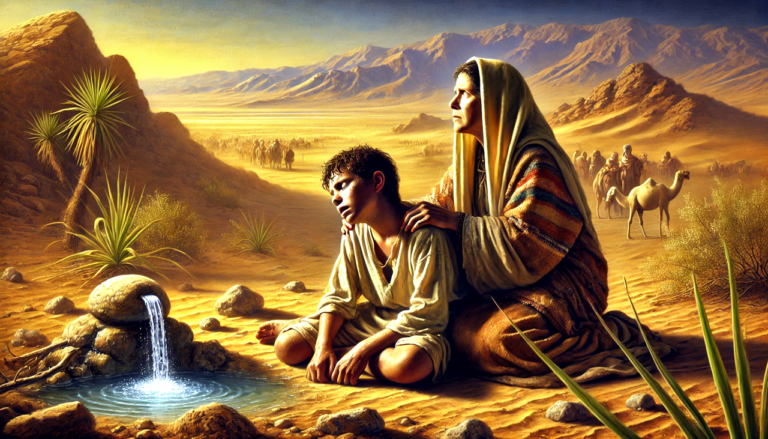
After being sent away, Gods Promise to Hagar, into the wilderness with her son Ishmael, Hagar faced fear, loneliness, and despair as their water ran out in the desert. Believing death was near, she wept helplessly beneath the weight of uncertainty and loss. Yet God heard the cries of the boy and spoke hope into the wilderness, promising that Ishmael would become a great nation. Genesis reveals that even during rejection, hardship, and isolation, God still sees suffering, provides what is needed, and continues fulfilling His promises through future generations.
Despair, Trust, Obedience, Future Hope, and God Hearing the Cry of the Broken
📖 Genesis 21:14
“14 Early the next morning Abraham took some food and a skin of water and gave them to Hagar. He set them on her shoulders and then sent her off with the boy. She went on her way and wandered in the Desert of Beersheba.”
📖 Genesis 21:14
“14 Early the next morning Abraham took some food and a skin of water and gave them to Hagar. He set them on her shoulders and then sent her off with the boy. She went on her way and wandered in the Desert of Beersheba.”
Early in the morning, Abraham gave Hagar food and water and sent her away with Ishmael into the wilderness of Beersheba.
This moment carried:
heartbreak
uncertainty
loneliness
and fear about the future.
Hagar and Ishmael were now wandering through the desert with limited supplies and no clear destination.
The separation marked a painful turning point for both mother and son.
📖 Genesis 21:15–16
“15 When the water in the skin was gone, she put the boy under one of the bushes. 16 Then she went off and sat down about a bowshot away, for she thought, “I cannot watch the boy die.” And as she sat there, she[c] began to sob.”
When the water was gone, Hagar placed Ishmael beneath a bush and moved away because she could not bear to watch him die.
Genesis says:
“She began to sob.”
This reveals complete despair:
exhaustion
hopelessness
emotional collapse
fear of losing her child.
The wilderness became a place of desperation and sorrow.
📖 Genesis 21:17-18
“17 God heard the boy crying, and the angel of God called to Hagar from heaven and said to her, “What is the matter, Hagar? Do not be afraid; God has heard the boy crying as he lies there. 18 Lift the boy up and take him by the hand, for I will make him into a great nation.”
“Genesis says:
“God heard the boy crying.”
The angel of God called to Hagar from heaven:
“Do not be afraid.”
Even in isolation and despair:
God heard
God saw
God responded.
Hagar and Ishmael were not abandoned or forgotten.
This moment powerfully reveals God’s compassion toward people in suffering and hardship.
The angel said:
“Lift the boy up and take him by the hand, for I will make him into a great nation.”
God shifted the situation from:
despair
to:
future promise.
What appeared hopeless in the wilderness still carried purpose in God’s plan.
Ishmael’s future was not ending in the desert.
God still intended:
growth
leadership
descendants
and nation building through him.
📖 Genesis 21:19
“9 Then God opened her eyes and she saw a well of water. So she went and filled the skin with water and gave the boy a drink.”
Genesis says:
“God opened her eyes and she saw a well of water.”
The well represented:
provision
survival
hope
renewed strength.
God provided exactly what was needed at the right moment.
Sometimes fear and despair can blind people to the help and provision already nearby until God brings clarity.
Hagar’s story reflects trust during uncertainty.
Though:
wandering
grieving
and fearful
she continued moving forward and caring for Ishmael.
The wilderness often becomes a place where:
dependence upon God deepens
survival requires faith
and trust grows through hardship.
📖 Genesis 21:20
“20 God was with the boy as he grew up. He lived in the desert and became an archer. 21 While he was living in the Desert of Paran, his mother got a wife for him from Egypt.”
Genesis declares:
“God was with the boy as he grew up.”
This is one of the strongest statements in the passage.
Even outside Abraham’s household, God remained with Ishmael.
He grew:
strong
capable
skilled
independent.
The boy who nearly died in the wilderness would become part of a future nation.
📖 Genesis 21:21
Ishmael lived in the Desert of Paran and became an archer.
Hagar later found a wife for him from Egypt.
Life continued forward.
The wilderness was not the end of the story.
God’s promises still moved ahead through future generations.
One major theme in this chapter is that:
hardship does not cancel God’s promises
rejection does not erase future purpose
wilderness seasons are not permanent endings.
God can still bring:
provision
direction
growth
and future blessing after moments of great despair.
This part of Genesis reminds us:
God hears cries of pain and fear
despair does not mean abandonment
God provides in difficult seasons
wilderness experiences can shape future strength
God’s promises continue even through hardship
Hagar and Ishmael’s journey into the wilderness appeared filled with hopelessness, fear, and despair after separation from Abraham’s household.
Yet God heard their cries, provided water, restored hope, and reaffirmed a future promise over Ishmael’s life.
Genesis reminds us that even in lonely and painful seasons, God still sees, hears, provides, and continues building futures and nations through those who trust Him during hardship