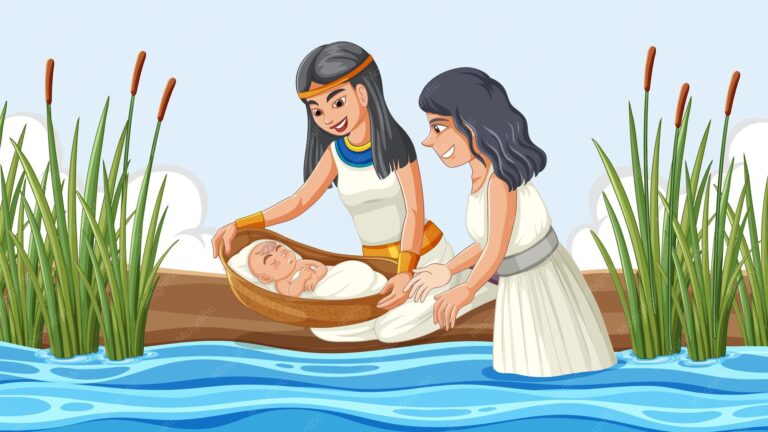
During one of the darkest periods in Israel’s history, Gods Leader Is Born when Pharaoh ordered Hebrew baby boys to be killed, God was quietly preparing the deliverer who would lead His people to freedom. Moses was born under a sentence of death, yet God’s protection surrounded him from the very beginning. Through unexpected circumstances, wilderness preparation, and divine timing, God guided every step of his journey. While Israel cried out under slavery, God’s covenant remained secure, and His redemption plan was already unfolding.
God’s Covenant, Moses, Deliverance, Midian, Zipporah, Gershom, God’s Timing, God’s Compassion, Redemption Begins
📖 Exodus 2:1–2 (NIV)
“2 Now a man of the tribe of Levi married a Levite woman, 2 and she became pregnant and gave birth to a son. When she saw that he was a fine child, she hid him for three months.”
📖 Exodus 2:3-4 (NIV)
“3 But when she could hide him no longer, she got a papyrus basket[a] for him and coated it with tar and pitch. Then she placed the child in it and put it among the reeds along the bank of the Nile. 4 His sister stood at a distance to see what would happen to him.”
As Pharaoh’s decree threatened every Hebrew baby boy, God was already at work preparing the leader who would one day confront Egypt and lead Israel to freedom. Moses’ story begins during a time of fear, oppression, and uncertainty. Yet behind every event—from a basket in the Nile to a well in Midian—God’s hand was guiding His covenant plan. What appeared to be a series of ordinary events was actually the beginning of God’s redemption of His people.
📖 Exodus 2:5–10 (NIV)
“5 Then Pharaoh’s daughter went down to the Nile to bathe, and her attendants were walking along the riverbank. She saw the basket among the reeds and sent her female slave to get it. 6 She opened it and saw the baby. He was crying, and she felt sorry for him. “This is one of the Hebrew babies,” she said.”
“7 Then his sister asked Pharaoh’s daughter, “Shall I go and get one of the Hebrew women to nurse the baby for you?”
“8 “Yes, go,” she answered. So the girl went and got the baby’s mother. 9 Pharaoh’s daughter said to her, “Take this baby and nurse him for me, and I will pay you.” So the woman took the baby and nursed him. 10 When the child grew older, she took him to Pharaoh’s daughter and he became her son. She named him Moses,[b] saying, “I drew him out of the water.”
A Levite woman gave birth to a son and saw that he was a special child.
To protect him from Pharaoh’s command, she hid him for three months.
When she could hide him no longer, she placed him in a basket among the reeds of the Nile and entrusted him to God’s care.
What appeared to be a desperate act became a divine appointment.
Pharaoh’s daughter discovered the child, had compassion on him, and adopted him as her own son.
Even more remarkable, Moses’ own mother was paid to nurse and care for him.
God protected the very child Pharaoh wanted destroyed.
Moses’ name reflected his rescue:
“I drew him out of the water.”
The future deliverer of Israel was preserved by God’s providence.
📖 Exodus 2:11–15 (NIV)
“11 One day, after Moses had grown up, he went out to where his own people were and watched them at their hard labor. He saw an Egyptian beating a Hebrew, one of his own people. 12 Looking this way and that and seeing no one, he killed the Egyptian and hid him in the sand. 13 The next day he went out and saw two Hebrews fighting. He asked the one in the wrong, “Why are you hitting your fellow Hebrew?”
“14 The man said, “Who made you ruler and judge over us? Are you thinking of killing me as you killed the Egyptian?” Then Moses was afraid and thought, “What I did must have become known.”
“15 When Pharaoh heard of this, he tried to kill Moses, but Moses fled from Pharaoh and went to live in Midian, where he sat down by a well.”
As Moses grew older, he became aware of the suffering of his people.
Seeing an Egyptian beating a Hebrew slave, Moses acted in anger and killed the Egyptian.
The next day he discovered that his actions had become known.
When Pharaoh learned what happened, Moses was forced to flee Egypt.
Although Moses desired justice, he attempted to accomplish God’s work through human strength rather than God’s timing.
The man who would one day lead a nation first had to learn dependence upon God.
Sometimes God’s preparation includes discipline through failure and disappointment.
📖 Exodus 2:16–22 (NIV)
“16 Now a priest of Midian had seven daughters, and they came to draw water and fill the troughs to water their father’s flock. 17 Some shepherds came along and drove them away, but Moses got up and came to their rescue and watered their flock.”
“18 When the girls returned to Reuel their father, he asked them, “Why have you returned so early today?”
“19 They answered, “An Egyptian rescued us from the shepherds. He even drew water for us and watered the flock.”
“20 “And where is he?” Reuel asked his daughters. “Why did you leave him? Invite him to have something to eat.”
“21 Moses agreed to stay with the man, who gave his daughter Zipporah to Moses in marriage. 22 Zipporah gave birth to a son, and Moses named him Gershom,[c] saying, “I have become a foreigner in a foreign land.”
Moses fled into the wilderness and arrived in Midian.
There he encountered the daughters of a priest who were being mistreated by shepherds.
Once again Moses stepped forward to help those in need.
The daughters returned home and told their father about the man who had rescued them.
Soon Moses was welcomed into the household and married Zipporah.
Their son was named Gershom, meaning:
“I have become a foreigner in a foreign land.”
The prince of Egypt had become a shepherd in Midian.
Yet God was not finished with him.
The wilderness would become God’s classroom where Moses would learn humility, patience, and obedience.
📖 Exodus 2:23–25 (NIV)
“23 During that long period, the king of Egypt died. The Israelites groaned in their slavery and cried out, and their cry for help because of their slavery went up to God. 24 God heard their groaning and he remembered his covenant with Abraham, with Isaac and with Jacob. 25 So God looked on the Israelites and was concerned about them.”
While Moses lived in Midian, Israel remained in slavery.
The people groaned under their burdens and cried out for help.
Their cries reached heaven.
Scripture gives one of the most comforting statements in Exodus:
“God heard their groaning and he remembered his covenant with Abraham, with Isaac and with Jacob.”
God had not forgotten His promises.
He had not abandoned His people.
He had not overlooked their suffering.
The covenant made generations earlier was still in effect.
And God was preparing to act.
This chapter reveals that God’s covenant cannot be stopped by kings, slavery, fear, or human failure.
Pharaoh attempted to destroy Hebrew boys.
God preserved Moses.
Moses failed and fled.
God continued preparing him.
Israel suffered in bondage.
God remembered His covenant.
Everything was moving according to God’s perfect plan, even when no one could yet see it.
God often prepares leaders during difficult seasons.
Human opposition cannot stop God’s purposes.
God’s timing is better than human impatience.
Failure does not disqualify someone from God’s plan.
God often develops character before assigning responsibility.
The wilderness can become a place of preparation.
God hears the cries of His people.
God’s covenant promises remain secure across generations.
Exodus 2 shows that God’s deliverer did not emerge through power, wealth, or position. Moses began as a helpless child hidden in a basket, became a fugitive in the wilderness, and lived as a shepherd in a foreign land. Yet every step was part of God’s preparation.
While Israel groaned in slavery, God was already raising up the man who would lead them out. When the people cried for help, God heard them and remembered His covenant. The path to Midian was not a detour—it was part of God’s redemption plan. The leader was born, the preparation had begun, and God’s deliverance was drawing near