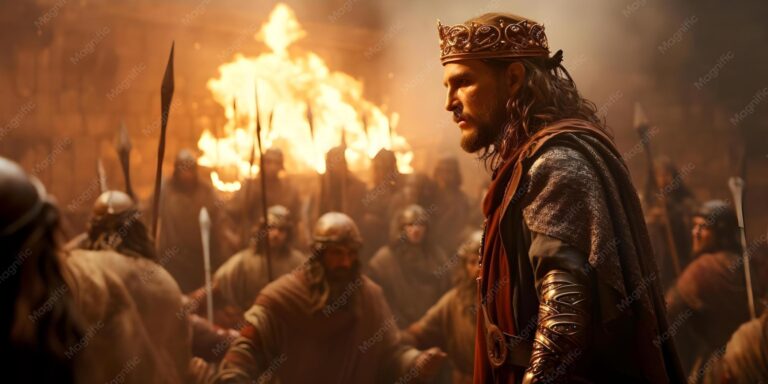
The Famine For Three Successive Years brought Israel to a place where David had to seek the Lord for answers. God revealed that the suffering was connected to Saul’s actions against the Gibeonites and a broken oath Israel had made. This chapter reminds us that actions have consequences, promises matter to God, and justice cannot simply be ignored. Yet even in judgment, mercy, faithfulness, prayer, restoration, and protection remain part of God’s greater plan.
Obedience, God’s Covenant, Faith, Mercy, Grace, Judgment, Consequences, Justice, Famine, Redemption Plan, Jesus Christ
📖 2 Samuel 21:1 (NIV)
“21 During the reign of David, there was a famine for three successive years; so David sought the face of the Lord. The Lord said, “It is on account of Saul and his blood-stained house; it is because he put the Gibeonites to death.”
Second Samuel 21 begins with three successive years of famine.
David did not simply accept the circumstances; he sought the face of the Lord.
God revealed that the famine was connected to Saul’s bloodshed against the Gibeonites, whom Israel had promised to protect.
The chapter deals with difficult subjects: judgment, death, consequences, justice, and the effects of sin reaching beyond the person who committed it.
Yet it also shows David remembering his covenant with Jonathan by sparing Mephibosheth.
David eventually gathered the bones of Saul and Jonathan and gave them a proper burial.
Then the chapter turns toward battle.
David became exhausted, and his men protected him from an enemy who sought his life.
His warriors continued fighting and defeated the descendants of the giants.
The chapter closes with Israel’s enemies falling before David and his men.
It is a story of judgment and mercy, weakness and strength, consequences and faithfulness.
Above all, it reminds us that God sees what happened in the past, responds to injustice, remembers promises, and continues His purposes even through difficult circumstances.
📖 2 Samuel 21:2-4 (NIV)
“2 The king summoned the Gibeonites and spoke to them. (Now the Gibeonites were not a part of Israel but were survivors of the Amorites; the Israelites had sworn to spare them, but Saul in his zeal for Israel and Judah had tried to annihilate them.) 3 David asked the Gibeonites, “What shall I do for you? How shall I make atonement so that you will bless the Lord’s inheritance?”
“4 The Gibeonites answered him, “We have no right to demand silver or gold from Saul or his family, nor do we have the right to put anyone in Israel to death.”
“What do you want me to do for you?” David asked.
The famine lasted three successive years.
David could have looked only at the circumstances—the lack of food, the suffering of the people, and the continuing hardship. Instead, he sought the face of the Lord.
That decision is important.
David understood that Israel needed more than human reasoning.
They needed God’s answer.
Seeking God does not mean every hardship is caused by a specific personal sin.
Scripture teaches us to be careful about making that assumption.
But this chapter clearly identifies a particular cause for this particular famine.
The lesson is simple: when we face difficulty, we should not only ask, “How do we fix this?” We should also ask, “Lord, what do You want us to understand?”
Faith begins by turning toward God rather than away from Him.
📖 2 Samuel 21:5-8 (NIV)
“5 David replied, “Indeed women have been kept from us, as usual whenever[b] I set out. The men’s bodies are holy even on missions that are not holy. How much more so today!” 6 So the priest gave him the consecrated bread, since there was no bread there except the bread of the Presence that had been removed from before the Lord and replaced by hot bread on the day it was taken away.”
“7 Now one of Saul’s servants was there that day, detained before the Lord; he was Doeg the Edomite, Saul’s chief shepherd.”
“8 David asked Ahimelek, “Don’t you have a spear or a sword here? I haven’t brought my sword or any other weapon, because the king’s mission was urgent.”
Saul’s actions had consequences long after his death.
The Gibeonites had been given protection through Israel’s oath, yet Saul had attempted to destroy them.
The famine demonstrates the seriousness with which God regarded that broken obligation.
This is a powerful warning about obedience.
What we do may affect more people than ourselves.
Decisions made in anger, pride, fear, or misplaced zeal can create consequences that continue long after the original decision has been made.
At the same time, this passage should not be used to conclude that every hardship someone experiences is punishment for something they personally did.
The Bible contains many examples of righteous people suffering.
The teaching here is that God sees injustice, remembers promises, and takes faithfulness seriously.
All choices matter.
The words matter.
Our promises matter.
And obedience matters.
📖 2 Samuel 21:9-13 (NIV)
“9 He handed them over to the Gibeonites, who killed them and exposed their bodies on a hill before the Lord. All seven of them fell together; they were put to deathduring the first days of the harvest, just as the barley harvest was beginning.”
“10 Rizpah daughter of Aiah took sackcloth and spread it out for herself on a rock. From the beginning of the harvest till the rain poured down from the heavens on the bodies, she did not let the birds touch them by day or the wild animals by night. 11 When David was told what Aiah’s daughter Rizpah, Saul’s concubine, had done, 12 he went and took the bones of Saul and his son Jonathan from the citizens of Jabesh Gilead. (They had stolen their bodies from the public square at Beth Shan, where the Philistines had hung them after they struck Saul down on Gilboa.) 13 David brought the bones of Saul and his son Jonathan from there, and the bones of those who had been killed and exposed were gathered up.”
David spared Mephibosheth because of the oath between David and Jonathan before the Lord.
This detail is easy to overlook, but it is one of the most important lessons in the chapter.
David had made a covenant with Jonathan, and years later that covenant still mattered.
Even while dealing with the consequences of Saul’s actions, David remembered his own promise.
Throughout Scripture, God repeatedly reveals Himself as faithful. Humanity may forget.
People may break promises. Kingdoms may change. Generations may pass. But God remains faithful.
The Bible’s redemption story depends upon this truth.
God’s promises are not temporary ideas.
They are part of His character.
And when we eventually arrive at Jesus Christ, we see the greatest expression of God’s faithfulness: the promise of redemption fulfilled through Christ.
📖 2 Samuel 21:14-16 (NIV)
“14 They buried the bones of Saul and his son Jonathan in the tomb of Saul’s father Kish, at Zela in Benjamin, and did everything the king commanded. After that, God answered prayer in behalf of the land.”
“15 Once again there was a battle between the Philistines and Israel. David went down with his men to fight against the Philistines, and he became exhausted.16 And Ishbi-Benob, one of the descendants of Rapha, whose bronze spearhead weighed three hundred shekels[b] and who was armed with a new sword, said he would kill David.”
This chapter contains severe judgment, but it also contains mercy.
David spared Mephibosheth. He remembered Jonathan’s covenant rather than treating every descendant of Saul identically.
That distinction matters.
The chapter reminds us that justice and mercy are not enemies in God’s plan.
God is righteous, but He is also merciful.
Rizpah’s actions also reveal something about the human response to death.
Her grief became an act of remembrance.
David then gathered the bones of Saul and Jonathan and buried them properly.
Even in a chapter filled with difficult judgment, dignity was restored.
This helps us understand something about God’s character: judgment does not mean God has stopped caring.
His justice is not cruelty.
His mercy is not the denial of justice.
God sees both the wrong and the people affected by it.
📖 2 Samuel 20:17-19 (NIV)
“17 But Abishai son of Zeruiah came to David’s rescue; he struck the Philistine down and killed him. Then David’s men swore to him, saying, “Never again will you go out with us to battle, so that the lamp of Israel will not be extinguished.”
“18 In the course of time, there was another battle with the Philistines, at Gob. At that time Sibbekai the Hushathite killed Saph, one of the descendants of Rapha.”
“19 In another battle with the Philistines at Gob, Elhanan son of Jair[c] the Bethlehemite killed the brother of[d] Goliath the Gittite, who had a spear with a shaft like a weaver’s rod.”
David had been a mighty warrior, a king, and a leader of Israel. Yet during battle, he became exhausted.
That detail is significant because Scripture does not portray David as invincible.
He needed others.
Abishai came to his rescue when Ishbi-Benob attempted to kill him.
Afterward, David’s men recognized that the king needed protection and determined that he should no longer go into battle with them.
There is wisdom in recognizing human limitations.
Sometimes strength means allowing someone else to stand beside you.
God often works through people to protect, encourage, and strengthen one another.
David had spent years protecting Israel, but eventually Israel’s warriors had to protect David.
None of us is strong enough to stand alone forever.
God can use others as part of His provision.
📖 2 Samuel 21:20-22 (NIV)
“20 In still another battle, which took place at Gath, there was a huge man with six fingers on each hand and six toes on each foot—twenty-four in all. He also was descended from Rapha. 21 When he taunted Israel, Jonathan son of Shimeah, David’s brother, killed him.”
“22 These four were descendants of Rapha in Gath, and they fell at the hands of David and his men.”
This the final portion of the chapter describes several battles with the Philistines and the defeat of powerful descendants of Rapha.
An emphasis is not simply on individual warriors.
The chapter repeatedly points toward David and his men.
David was not fighting alone.
God had placed people around him who were willing to stand, fight, protect, and remain faithful.
This is another important lesson for us.
God does not always accomplish His purposes through one person acting alone.
He builds communities, families, teams, and faithful servants who work together.
Faith does not always mean sitting still and waiting.
Sometimes faith means standing up, doing what God has placed before us, and trusting Him with the outcome.
The battle may be difficult, but God can provide the people and strength necessary to continue.
This chapter reminds us that God does not forget His covenant.
David remembered his oath to Jonathan, and God remembered Israel’s obligation to the Gibeonites.
God’s faithfulness is bigger than human failure.
His promises continue through generations, pointing toward the ultimate covenant fulfilled through Jesus Christ.
What God promises, He does not forget.
Seek God when circumstances become difficult.
Take obedience seriously.
Remember that actions have consequences, but do not assume every hardship is personal punishment.
Show mercy where God gives opportunity.
Recognize your limitations and allow others to help.
Most importantly, trust that God remains faithful even when His purposes are difficult for us to understand.
The deepest answer to humanity’s sin is not found in human strength, judgment, or sacrifice. It is found in Jesus Christ.
This chapter shows the seriousness of sin, the consequences of broken faithfulness, the need for justice, and humanity’s inability to repair everything on its own.
The redemption plan moves toward Christ, where justice and mercy meet.
Jesus becomes the fulfillment of God’s promise—the One through whom forgiveness, reconciliation, grace, and salvation are offered.
Every story keeps pointing us toward Him.