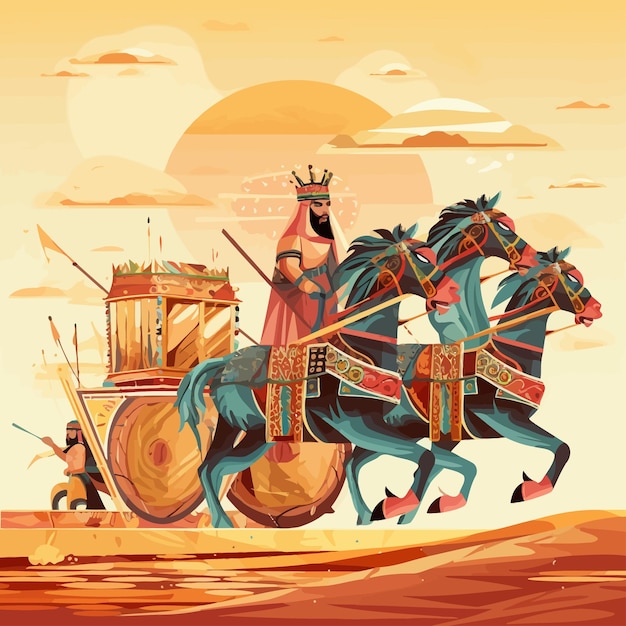
The famine was still severe, yet God’s covenant family was about to take a step that seemed both risky and necessary. Chariot to Goshen, Jacob left the land of Canaan and traveled toward Egypt with his children, grandchildren, flocks, and possessions. Before the journey, God spoke to him, promising, “Do not be afraid to go down to Egypt… I will go down with you.” The chapter becomes a testimony of obedience, family restoration, and God’s faithfulness to imperfect people across generations.
God’s Covenant, Obedience, God’s Blessings, Family Restoration, Life After Sin, Children, Imperfect People Used by God, Pharaoh, Goshen
📖 Genesis 46:1 (NIV)
“46 So Israel set out with all that was his, and when he reached Beersheba, he offered sacrifices to the God of his father Isaac.”
📖 Genesis 46:2-6 (NIV)
2 And God spoke to Israel in a vision at night and said, “Jacob! Jacob!”
“Here I am,” he replied.
3 “I am God, the God of your father,” he said. “Do not be afraid to go down to Egypt, for I will make you into a great nation there. 4 I will go down to Egypt with you, and I will surely bring you back again. And Joseph’s own hand will close your eyes.”
5 Then Jacob left Beersheba, and Israel’s sons took their father Jacob and their children and their wives in the carts that Pharaoh had sent to transport him. 6 So Jacob and all his offspring went to Egypt, taking with them their livestock and the possessions they had acquired in Canaan.
There are moments when God’s people must move forward even when they cannot see what lies ahead. Jacob had spent much of his life in Canaan, the land promised to Abraham and Isaac. Now, during a severe famine, God was leading him to Egypt. It may have seemed like leaving the Promised Land was moving away from God’s plan, but the Lord assured Jacob that His covenant remained secure. Genesis 46 reminds us that God’s presence, not a location, is the source of our security. When God leads, obedience opens the door to blessing.
📖 Genesis 46:7 (NIV)
“7 Jacob brought with him to Egypt his sons and grandsons and his daughters and granddaughters—all his offspring.”.
Before leaving for Egypt, Israel stopped at Beersheba and offered sacrifices to God.
There, God spoke to him in a vision:
“Do not be afraid to go down to Egypt, for I will make you into a great nation there.”
God knew Jacob’s concerns.
Egypt was foreign territory.
The covenant land was behind him.
The future was uncertain.
Yet God gave three powerful promises:
I will make you into a great nation.
I will go down with you.
I will surely bring you back again.
Then came one of the most tender promises in Scripture:
“Joseph’s own hand will close your eyes.”
God assured Jacob that his final years would include peace, restoration, and reunion.
📖 Genesis 46:25–27 (NIV)
“25 These were the sons born to Jacob by Bilhah, whom Laban had given to his daughter Rachel—seven in all.”
“26 All those who went to Egypt with Jacob—those who were his direct descendants, not counting his sons’ wives—numbered sixty-six persons. 27 With the two sons[f] who had been born to Joseph in Egypt, the members of Jacob’s family, which went to Egypt, were seventy[g] in all.”
Jacob gathered his children, grandchildren, livestock, and possessions and journeyed toward Egypt.
The chapter records the names of those who traveled with him.
These names tell an important story.
This family was far from perfect.
Among them were men who had lied, deceived, acted selfishly, and made serious mistakes.
Yet God did not abandon His covenant.
Instead, He continued building a nation through imperfect people.
The list serves as a reminder that God’s promises are not sustained by human perfection but by God’s faithfulness.
Generation after generation, the covenant continued moving forward.
📖 Genesis 46:28–30 (NIV)
“28 Now Jacob sent Judah ahead of him to Joseph to get directions to Goshen. When they arrived in the region of Goshen, 29 Joseph had his chariot made ready and went to Goshen to meet his father Israel. As soon as Joseph appeared before him, he threw his arms around his father[h] and wept for a long time.”
“30 Israel said to Joseph, “Now I am ready to die, since I have seen for myself that you are still alive.”
Judah went ahead to prepare the way to Goshen.
Then came the long-awaited reunion.
Joseph prepared his chariot and traveled to meet his father.
As soon as Joseph saw Israel, he embraced him and wept for a long time.
Israel responded:
“Now I am ready to die, since I have seen for myself that you are still alive.”
The son Jacob believed dead was standing before him.
God had fulfilled what once seemed impossible.
One of the remarkable themes in this chapter is restoration after failure.
The family standing together in Goshen was the same family that had once been torn apart by jealousy, favoritism, deception, and betrayal.
Joseph had been sold.
Jacob had mourned.
The brothers had carried guilt.
Yet God’s grace continued working through their brokenness.
The story did not end with their sins.
God’s mercy wrote a new chapter.
The reunion in Goshen demonstrates that God’s purposes are greater than human failures.
📖 Genesis 46:31–34 (NIV)
“31 Then Joseph said to his brothers and to his father’s household, “I will go up and speak to Pharaoh and will say to him, ‘My brothers and my father’s household, who were living in the land of Canaan, have come to me. 32 The men are shepherds; they tend livestock, and they have brought along their flocks and herds and everything they own.’ 33 When Pharaoh calls you in and asks, ‘What is your occupation?’ 34 you should answer, ‘Your servants have tended livestock from our boyhood on, just as our fathers did.’ Then you will be allowed to settle in the region of Goshen, for all shepherds are detestable to the Egyptians.”
Joseph wisely prepared his family for their meeting with Pharaoh.
He instructed them to answer honestly:
“Your servants have tended livestock from our boyhood on, just as our fathers did.”
Their occupation would allow them to settle in Goshen.
While Egyptians looked down upon shepherds, God used this distinction to protect Israel’s family.
Goshen would become a place where the covenant family could grow, multiply, and remain separate.
What appeared to be a disadvantage became part of God’s provision.
Once again, God’s wisdom was working behind the scenes.
This chapter is not merely about moving to Egypt.
It is about God’s covenant continuing exactly as He promised.
God preserved the future nation of Israel.
Every mile traveled toward Goshen was another step toward the fulfillment of God’s promises.
The Lord was preparing a family to become a nation.
God’s presence goes with us wherever He leads.
Obedience often requires trusting God in unfamiliar places.
God’s covenant is not dependent on human perfection.
Family restoration is possible through God’s grace.
God uses imperfect people to accomplish His purposes.
The Lord often turns disadvantages into blessings.
God’s promises remain secure through every generation.
Faith means following God’s direction even when the future is unclear.
The journey to Goshen was more than a relocation. It was a testimony to God’s faithfulness. Jacob left Canaan with confidence because God promised to go with him. Joseph’s chariot carried more than a son—it carried evidence that God’s promises never fail. The family that once seemed broken beyond repair was reunited, restored, and protected.
Genesis 46 reminds us that when God leads us into unfamiliar territory, we do not travel alone. His covenant goes before us, His presence goes with us, and His promises remain secure. Just as Joseph’s hand would one day close Jacob’s eyes, God would faithfully complete the work He had begun in the covenant family