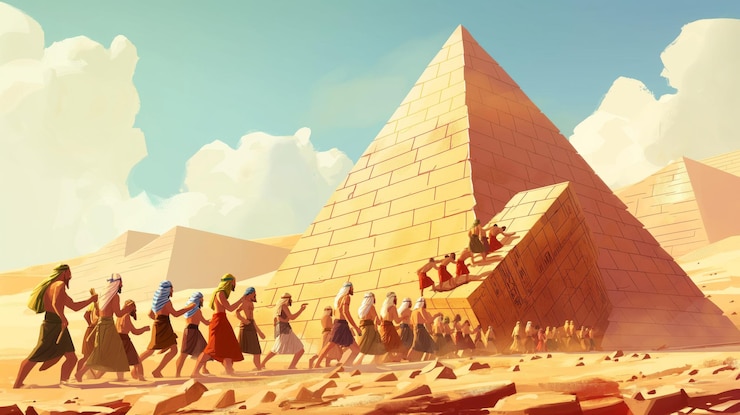
For generations, the Israelites cried out for deliverance, Bricks No Straw, and God began moving His redemption plan forward through Moses and Aaron. Yet their first act of obedience seemed to make life worse instead of better. Pharaoh responded with pride, anger, and harsher demands, forcing the people to gather their own straw while maintaining the same brick quota. In the middle of suffering and confusion, God remained in control. What looked like defeat was actually the beginning of His mighty deliverance.
God’s Covenant, Obedience, God’s Control, Self-Denial, Pharaoh’s Pride, False Idols, Increased Burdens, Faith During Trials
📖 Exodus 5:1 (NIV)
“5 Afterward Moses and Aaron went to Pharaoh and said, “This is what the Lord, the God of Israel, says: ‘Let my people go, so that they may hold a festival to me in the wilderness.’”
📖 Exodus 5:2–3 (NIV)
“2 Pharaoh said, “Who is the Lord, that I should obey him and let Israel go? I do not know the Lord and I will not let Israel go.”
“3 Then they said, “The God of the Hebrews has met with us. Now let us take a three-day journey into the wilderness to offer sacrifices to the Lord our God, or he may strike us with plaguesor with the sword.”
One of the most difficult moments in the life of faith occurs when obedience seems to make circumstances worse instead of better. Moses and Aaron faithfully delivered God’s message to Pharaoh, expecting the process of redemption to begin. Instead, Pharaoh hardened his heart and increased the suffering of Israel. The people were forced to gather their own straw while maintaining the same brick quota, facing punishment when they failed. Yet even in this hardship, God’s covenant plan remained firmly in motion. What appeared to be a setback was actually the beginning of God’s confrontation with Pharaoh’s pride, power, and false gods.
📖 Exodus 5:4–6 (NIV)
“4 But the king of Egypt said, “Moses and Aaron, why are you taking the people away from their labor? Get back to your work!” 5 Then Pharaoh said, “Look, the people of the land are now numerous, and you are stopping them from working.”
6 That same day Pharaoh gave this order to the slave driversand overseers in charge of the people:”
Moses and Aaron appeared before Pharaoh with a simple command from God:
“Let my people go, so that they may hold a festival to me in the wilderness.”
Pharaoh’s response revealed the true battle taking place:
“Who is the Lord, that I should obey him?”
This was not merely a political dispute.
It was a challenge against the authority of the living God.
Pharaoh viewed himself as supreme and saw no reason to submit to anyone higher than himself.
His pride and self-importance blinded him to the truth.
📖 Exodus 5:7–11 (NIV)
“7 “You are no longer to supply the people with straw for making bricks; let them go and gather their own straw. 8 But require them to make the same number of bricks as before; don’t reduce the quota. They are lazy; that is why they are crying out, ‘Let us go and sacrifice to our God.’ 9 Make the work harder for the people so that they keep working and pay no attention to lies.”
“10 Then the slave drivers and the overseers went out and said to the people, “This is what Pharaoh says: ‘I will not give you any more straw.”
“11 Go and get your own straw wherever you can find it, but your work will not be reduced at all.’”
Pharaoh decided to make life even harder for the Israelites.
He ordered that straw would no longer be provided for brickmaking.
The people would have to gather it themselves.
Yet the daily quota would remain unchanged.
“You will not be given any straw, yet you must produce your full quota of bricks.”
The burden became impossible.
The people scattered across Egypt searching for stubble while trying to maintain production.
When they failed, they were beaten and punished.
Oppression revealed Pharaoh’s true character.
The more God moved toward redemption, the more Pharaoh resisted.
📖 Exodus 5:12–18 (NIV)
“12 So the people scattered all over Egypt to gather stubble to use for straw. 13 The slave drivers kept pressing them, saying, “Complete the work required of you for each day, just as when you had straw.” 14 And Pharaoh’s slave drivers beat the Israelite overseers they had appointed, demanding, “Why haven’t you met your quota of bricks yesterday or today, as before?”
“15 Then the Israelite overseers went and appealed to Pharaoh: “Why have you treated your servants this way? 16 Your servants are given no straw, yet we are told, ‘Make bricks!’ Your servants are being beaten, but the fault is with your own people.”
“17 Pharaoh said, “Lazy, that’s what you are—lazy! That is why you keep saying, ‘Let us go and sacrifice to the Lord.’ 18 Now get to work. You will not be given any straw, yet you must produce your full quota of bricks.”
The Israelite overseers appealed directly to Pharaoh for mercy.
Instead of compassion, they received accusations.
“Lazy, that’s what you are—lazy!”
Pharaoh viewed worship as a waste of time.
His heart was centered on power, productivity, and control.
The gods of Egypt offered him a sense of superiority, but they were powerless idols.
The Lord was about to demonstrate that no ruler, no kingdom, and no false god could stand against His covenant purposes.
📖 Exodus 5:19–21 (NIV)
“19 The Israelite overseers realized they were in trouble when they were told, “You are not to reduce the number of bricks required of you for each day.” 20 When they left Pharaoh, they found Moses and Aaron waiting to meet them, 21 and they said, “May the Lord look on you and judge you! You have made us obnoxious to Pharaoh and his officials and have put a sword in their hand to kill us.”
The Israelite overseers blamed Moses and Aaron for their increased suffering.
From their perspective, obedience had only made life worse.
They told Moses:
“You have made us obnoxious to Pharaoh and his officials.”
Fear and discouragement often cause people to lose sight of God’s larger plan.
The Israelites could not yet see what God was doing behind the scenes.
They saw only greater hardship.
God saw future deliverance.
📖 Exodus 5:22–23 (NIV)
“22 Moses returned to the Lord and said, “Why, Lord, why have you brought trouble on this people? Is this why you sent me?23 Ever since I went to Pharaoh to speak in your name, he has brought trouble on this people, and you have not rescued your people at all.”
Even Moses struggled.
He returned to the Lord and asked:
“Why, Lord, why have you brought trouble on this people?”
Moses expected immediate results.
Instead, he encountered resistance.
This moment reminds us that even faithful servants can wrestle with disappointment and confusion.
Moses obeyed, yet circumstances became more difficult.
But God’s promises had not failed.
The story was not over.
Throughout this chapter, God’s covenant never changes.
Pharaoh resisted.
The workload increased.
The people complained.
Moses questioned.
Yet God remained in control.
Nothing Pharaoh did could stop God’s redemption plan.
The increased oppression was not evidence of God’s absence.
It was evidence that the conflict between God’s kingdom and Pharaoh’s pride had begun.
Obedience does not always produce immediate relief.
God’s plan often unfolds through difficult seasons.
Pride resists God’s authority.
False idols promise power but cannot save.
God remains faithful even when circumstances worsen.
Faith must continue when answers are not yet visible.
Human opposition cannot stop God’s covenant promises.
God is always working even when His people cannot see it.
Exodus 5 reminds us that God’s redemption often begins with confrontation. Moses obeyed, but Pharaoh responded with greater oppression. The Israelites faced impossible demands, gathering straw while maintaining the same quota of bricks. Discouragement spread among the people, and even Moses questioned what God was doing.
Yet God had not abandoned His people. Pharaoh’s pride, self-importance, and false gods would soon be exposed. What looked like a setback was actually the opening stage of God’s mighty deliverance. When life becomes harder after obedience, believers can take comfort in knowing that God remains in control and His covenant promises never fail