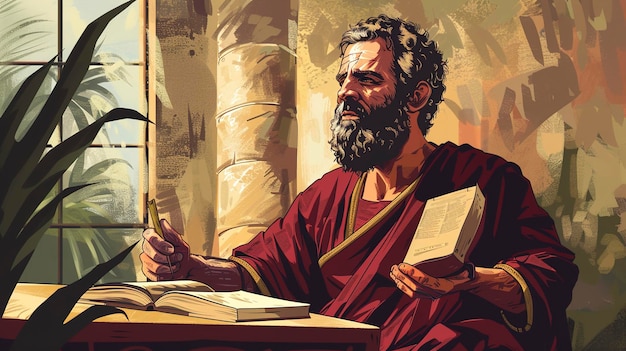
The Book of Titus reminds believers that genuine faith is demonstrated not only by what we believe but also by how we live. Through practical instruction and the transforming grace of God, Paul teaches that sound doctrine produces godly character, faithful leadership, and lives devoted to good works—all for the glory of Christ.
Growing in sound doctrine, faithful leadership, and godly living through the grace of Jesus Christ.
The Book of Titus is one of Paul’s three Pastoral Epistles, along with 1 Timothy and 2 Timothy. Written to Titus, a trusted coworker, the letter provides practical instruction for organizing churches, appointing qualified elders, teaching sound doctrine, and encouraging believers to live lives that honor God.
Although brief, Titus contains profound teaching about God’s grace, salvation, Christian leadership, and the daily conduct of those who belong to Christ.
The central message is clear:
Right belief should produce right living.
The Apostle Paul likely wrote Titus around A.D. 63–65, following his first Roman imprisonment.
After evangelizing the island of Crete, Paul left Titus behind to strengthen the churches and complete the work that remained unfinished. False teachers had begun influencing believers, creating confusion through distorted doctrine and ungodly living.
Paul instructed Titus to establish faithful leadership, confront false teaching, and teach believers how God’s grace transforms every area of life.
The churches were young, but God’s work among them was only beginning.
The apostle chosen by Jesus Christ to proclaim the Gospel throughout the Gentile world. Paul writes with pastoral wisdom, encouraging Titus to strengthen the churches through sound doctrine and faithful leadership.
A trusted Gentile believer and one of Paul’s closest companions. Titus faithfully served alongside Paul and was entrusted with organizing the churches on Crete.
Paul outlines the qualifications for elders, emphasizing integrity, self-control, sound teaching, and godly character. Their leadership would protect the churches from false doctrine.
Paul warns against individuals who were misleading believers through empty talk, deception, and legalism. Titus is instructed to confront error with truth.
Men, women, older believers, younger believers, servants, and families are all instructed to demonstrate lives transformed by God’s grace.
A large island in the Mediterranean Sea where Titus was serving. Crete was known in the ancient world for moral corruption and dishonesty, making it a challenging place for the young churches to grow.
Paul later planned to spend the winter in Nicopolis and instructed Titus to join him there after completing his ministry on Crete.
God’s grace brings salvation.
Sound doctrine produces godly living.
Faith is demonstrated through good works.
Qualified spiritual leadership strengthens the church.
Believers must reject false teaching.
The Gospel transforms every generation.
Christian character reflects the work of Christ.
Good works flow from salvation—they do not earn it.
Unity and humility strengthen God’s people.
God’s covenant continues through His redeemed Church.
The Book of Titus demonstrates that God’s redemption plan does not end with salvation—it continues through transformation.
Because of Christ’s sacrifice, believers are forgiven, renewed, and empowered by the Holy Spirit to live differently.
Paul explains that salvation is entirely the work of God’s grace, not human effort. Those redeemed by Christ become eager to do what is good, reflecting His character before the world.
Titus shows that God’s redemption plan changes both our eternal destiny and our daily lives.
Jesus Christ is revealed throughout Titus as:
Our great God and Savior.
The source of God’s grace.
The One who gave Himself to redeem us.
The purifier of His own people.
The foundation of sound doctrine.
The Savior who brings hope.
The One whose return believers eagerly await.
Titus continually points readers to Christ, whose grace teaches believers how to live holy lives while looking forward to His glorious appearing.
As you study Titus, you will discover:
Why church leadership matters.
The qualifications of faithful spiritual leaders.
How sound doctrine protects God’s people.
Why grace changes the way believers live.
The relationship between faith and good works.
How every generation has a role within the church.
Why humility and unity are essential.
How God’s redemption plan transforms everyday life.
The hope believers have in Jesus Christ’s return.
How God’s grace equips us to live lives that honor Him.
The Book of Titus reminds us that the Gospel is more than a message to believe—it is a life to live. God’s grace not only forgives our sins but also transforms our hearts, shaping us into people who reflect the character of Jesus Christ.
As you journey through Titus, you will see how sound doctrine, faithful leadership, and practical obedience work together to strengthen God’s people. Every chapter reveals another step in God’s Redemption Plan, showing that those who have been redeemed by Christ are called to live with integrity, humility, and love while eagerly awaiting His glorious return.
The journey through Titus is an invitation to grow in the knowledge of Jesus Christ, to stand firm in the truth of God’s Word, and to demonstrate through daily living the transforming power of His amazing grace.