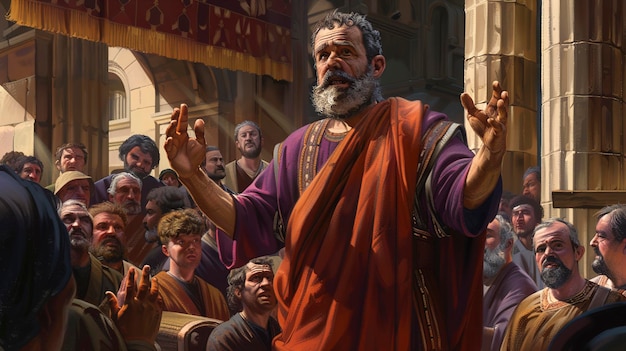
Romans 9 begins with Paul’s deep anguish over his own people and then reaches the Anguish In My Heart and God’s Covenant promises. Paul explains that God’s Word has not failed, even when people respond differently to His promises. Mercy belongs to God, righteousness cannot be earned through works, and the chapter ultimately points to Jesus Christ—the One who fulfills God’s promises and becomes the foundation of faith.
Obedience, God’s Covenant, Blessing, Grace, Wrath, Truth, Judgment, Faith, Believe, Promises, Redemption Plan, Jesus Christ
📖 Romans 9:1 (NIV)
“9 I speak the truth in Christ—I am not lying, my conscience confirms it through the Holy Spirit— “
Paul begins Romans 9 with extraordinary sorrow.
He loves his fellow Israelites so deeply that he wishes he could bear their separation from Christ for their sake.
Israel had received adoption, God’s glory, the covenants, the Law, worship, promises, and the patriarchs.
Most importantly, the Messiah came through their human ancestry.
Yet Paul makes a critical statement: God’s Word has not failed.
Physical ancestry alone does not determine who belongs to God’s promise.
Paul points back to Isaac and the promise God made to Abraham and Sarah.
God’s purposes have always involved His promise and His calling.
Paul then discusses Jacob and Esau, God’s mercy, Pharaoh, and the Potter and the clay.
These difficult passages remind humanity that God is the Creator and remains sovereign.
The chapter then reaches the Gentiles.
Those who did not pursue righteousness obtained righteousness through faith, while many in Israel pursued righteousness through the Law but stumbled because they pursued it through works rather than faith.
Romans 9 ends by pointing directly to Jesus Christ—the stone placed in Zion.
The one who believes in Him will never be put to shame.
He speaks the truth in Christ and says his conscience confirms it through the Holy Spirit: he has great sorrow and continual anguish in his heart for his fellow Israelites.
This reveals that truth and love belong together.
Paul does not speak about people he disagrees with as though they have no value.
He cares deeply about their relationship with God.
His sorrow reminds us that salvation is not merely a theological subject.
Real people are involved.
Paul understands the blessings his people received, yet he also recognizes that possessing God’s Law and promises does not automatically produce faith.
His anguish becomes part of his mission.
He wants people to know the truth about Jesus Christ.
📖 Romans 9:5-8 (NIV)
“5 Theirs are the patriarchs, and from them is traced the human ancestry of the Messiah, who is God over all, forever praised![a] Amen.”
“6 It is not as though God’s word had failed. For not all who are descended from Israel are Israel. 7 Nor because they are his descendants are they all Abraham’s children. On the contrary, “It is through Isaac that your offspring will be reckoned.”[b] 8 In other words, it is not the children by physical descent who are God’s children, but it is the children of the promise who are regarded as Abraham’s offspring.”
Paul lists the extraordinary privileges given to Israel: adoption, glory, covenants, the Law, worship, promises, patriarchs, and the human ancestry of the Messiah.
This history matters.
God did not abandon His Covenant.
The coming of Jesus Christ did not mean God’s previous promises had failed.
Instead, Christ stands within the story God had been building throughout Scripture.
Romans 9 teaches us to look backward before we look forward.
Abraham, Isaac, Jacob, Moses, the prophets, and the promises all belong to the same continuing story.
God’s Covenant has a direction.
It moves toward His Redemption Plan.
And at the center of that plan is Jesus Christ.
📖 Romans 9:9-12 (NIV)
“9 For this was how the promise was stated: “At the appointed time I will return, and Sarah will have a son.”[c]”
“10 Not only that, but Rebekah’s children were conceived at the same time by our father Isaac. 11 Yet, before the twins were born or had done anything good or bad—in order that God’s purpose in election might stand: 12 not by works but by him who calls—she was told, “The older will serve the younger.”[d] “
Paul asks us to consider a difficult question: If some people did not believe, did God’s Word fail?
His answer is no.
God’s Word has not failed.
Paul explains that not everyone descended physically from Israel is automatically counted as the children of promise.
The distinction goes back to God’s promise concerning Isaac.
This teaches us that God’s Covenant is not simply about physical ancestry.
God’s promise has always involved God’s purpose and calling.
Human response does not make God’s Word true or false.
God remains faithful.
Even when people reject what God has offered, His promises remain.
That is important for believers today.
Our circumstances do not determine whether God’s promises are true.
God’s faithfulness does.
📖 Romans 9:13-16 (NIV)
“13 Just as it is written: “Jacob I loved, but Esau I hated.”[e]”
“14 What then shall we say? Is God unjust? Not at all! 15 For he says to Moses,
“I will have mercy on whom I have mercy,
and I will have compassion on whom I have compassion.”[f]”
“16 It does not, therefore, depend on human desire or effort, but on God’s mercy. “
Paul discusses God’s mercy and compassion and points to God’s words to Moses: He will have mercy on whom He has mercy and compassion on whom He has compassion.
This passage reminds us that God is not controlled by human demands.
We cannot put God on trial and demand that He operate according to our understanding.
Paul uses the Potter and the clay to emphasize the Creator’s authority over His creation.
There are mysteries here that human beings cannot completely explain.
Romans 9 calls us to humility.
We can study God’s Word.
We can ask questions.
And we can seek understanding.
But we should remember who God is and who we are.
The Creator sees the entire picture.
We see only a portion.
📖 Romans 9:17-20 (NIV)
“17 For Scripture says to Pharaoh: “I raised you up for this very purpose, that I might display my power in you and that my name might be proclaimed in all the earth.”[g] 18 Therefore God has mercy on whom he wants to have mercy, and he hardens whom he wants to harden.”
“19 One of you will say to me: “Then why does God still blame us? For who is able to resist his will?” 20 But who are you, a human being, to talk back to God? “Shall what is formed say to the one who formed it, ‘Why did you make me like this?’”[h]”
Romans 9 also speaks about God’s wrath, His power, and His patience.
This reminds us that God’s judgment is real.
Yet Paul also emphasizes God’s patience.
God’s judgment should never be separated from His mercy.
Throughout Scripture, God repeatedly gives people opportunities to respond, repent, believe, and turn toward Him.
His patience demonstrates that judgment is not something to treat casually.
It also shows why the Redemption Plan matters.
Humanity needs more than knowledge of God’s Law.
Humanity needs God’s mercy.
And God’s mercy ultimately leads us toward Jesus Christ.
📖 Romans 9:21-24 (NIV)
“21 Does not the potter have the right to make out of the same lump of clay some pottery for special purposes and some for common use?”
“22 What if God, although choosing to show his wrath and make his power known, bore with great patience the objects of his wrath—prepared for destruction? 23 What if he did this to make the riches of his glory known to the objects of his mercy, whom he prepared in advance for glory— 24 even us, whom he also called, not only from the Jews but also from the Gentiles? “
Paul then turns toward the Gentiles.
Hosea had spoken of people who were not previously called God’s people becoming God’s people and children of the living God.
This demonstrates the expanding reach of God’s Redemption Plan.
The Gospel was never meant to remain limited to one ethnic group.
The promise reaches beyond Israel.
The Gentiles are called.
God’s mercy reaches people who were once considered outside the covenant community.
This does not erase Israel’s place in God’s story.
Instead, it shows the growing reach of God’s purpose.
God’s plan is bigger than human boundaries.
Jesus Christ becomes the bridge through which the promise reaches the nations.
📖 Romans 9:25-28 (NIV)
“25 As he says in Hosea:
“I will call them ‘my people’ who are not my people;
and I will call her ‘my loved one’ who is not my loved one,”[i]”
“26 and,
“In the very place where it was said to them,
‘You are not my people,’
there they will be called ‘children of the living God.’”[j]”
“27 Isaiah cries out concerning Israel:
“Though the number of the Israelites be like the sand by the sea,
only the remnant will be saved.”
“28
For the Lord will carry out
his sentence on earth with speed and finality.”[k]”
Romans 9 reaches an important contrast.
Meanwhile, many in Israel pursued the Law as though righteousness could be achieved through works and did not attain the goal.
Paul explains why.
They stumbled because they pursued righteousness not by faith but as though it could be established through works.
This connects Romans 9 directly to the earlier chapters.
Romans 3 taught that righteousness comes through faith.
Romans 4 showed Abraham believing God’s promise.
Then Romans 5 showed justification through faith.
Romans 6 showed the believer living a new life.
Romans 7 showed the struggle with sin and the Law.
And Romans 8 showed life through the Spirit.
Now Romans 9 reminds us that faith cannot be replaced by human achievement.
📖 Romans 9:29-33 (NIV)
“29 It is just as Isaiah said previously:
“Unless the Lord Almighty
had left us descendants,
we would have become like Sodom,
we would have been like Gomorrah.”[l]”
“30 What then shall we say? That the Gentiles, who did not pursue righteousness, have obtained it, a righteousness that is by faith; 31 but the people of Israel, who pursued the law as the way of righteousness, have not attained their goal. 32 Why not? Because they pursued it not by faith but as if it were by works. They stumbled over the stumbling stone. 33 As it is written:
“See, I lay in Zion a stone that causes people to stumble
and a rock that makes them fall,
and the one who believes in him will never be put to shame.”[m]”
Jesus Christ becomes the dividing point.
Some stumble over Him.
Others believe in Him.
The issue is not whether God kept His promises.
The issue is how people respond to the One God sent.
Jesus is not simply another teacher in the story.
He is the Messiah promised throughout God’s Covenant.
He is the foundation of God’s Redemption Plan.
And Paul gives the believer a powerful promise:
The one who believes in Him will never be put to shame.
Faith in Jesus Christ is not a temporary decision disconnected from the rest of Scripture.
It is the response to the promise God has been unfolding throughout history.
Romans 9 makes clear that God’s Covenant remains firm even when human beings respond differently to it.
God’s Word has not failed.
His promises did not disappear.
God’s mercy remains His to give.
His purpose continues.
The history of Israel, the patriarchs, the Law, the prophets, and the promises all lead forward toward the Messiah.
Jesus Christ stands at the center of that Covenant story.
The Gentiles being brought into God’s people does not mean God’s Covenant story has failed.
It demonstrates the expanding reach of God’s Redemption Plan.
God remains faithful to His promises.
Romans 9 teaches us humility, faith, and perseverance.
We may not understand every mystery surrounding God’s sovereignty, mercy, judgment, and human responsibility.
But we can understand what Paul makes clear: God’s Word has not failed.
We should not depend upon ancestry, religious identity, human achievement, or outward works as though they can replace faith.
Righteousness cannot be earned by checking every box.
The chapter points us toward believing God’s promise.
It also reminds us that we should care about people who have not yet embraced the truth.
Paul’s anguish was not hatred.
It was love expressed through a desire for others to know God.
Faith should produce both humility before God and compassion toward people.
Romans 9 takes us deep into the history of God’s Covenant and brings us directly to Jesus Christ.
The promises began generations before Paul.
Abraham received the promise.
Isaac carried the promised line.
Jacob became part of the continuing Covenant story.
The Law revealed God’s holy standard.
The prophets spoke about what was coming.
The Messiah came through Israel’s human ancestry.
And Jesus Christ became the stone upon which humanity must respond.
Some stumbled.
Others believed.
But God’s Redemption Plan continued.
Romans 9 does not leave us wondering whether God’s Word has failed.
It points us to the promise:
“The one who believes in Him will never be put to shame.”
Our temporary life contains questions we cannot answer completely.
But God’s promise remains.
God’s Covenant stands.
His mercy matters.
His truth remains.
And Jesus Christ remains at the center of the story.