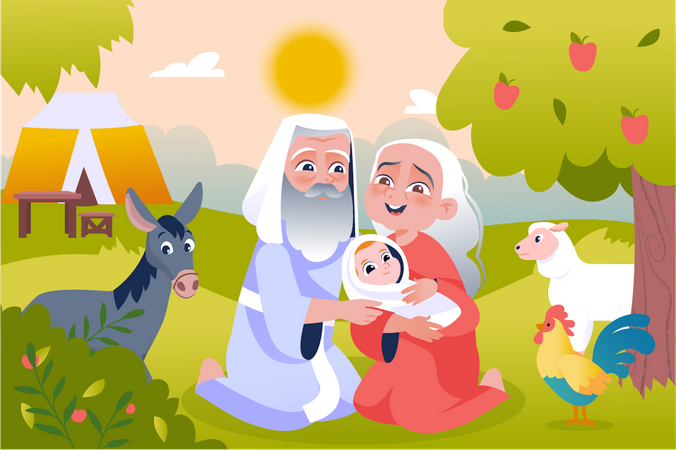
After years of waiting, A Son Is Born, doubt, and impossible circumstances, God fulfilled His promise to Abraham and Sarah with the birth of Isaac. The child’s arrival brought laughter, joy, and a new beginning during their old age, proving that God’s timing and promises never fail. Yet even within celebration, jealousy, fear, and tension entered the household as conflict grew between Sarah, Hagar, and their sons. Genesis reveals that God continues building nations and fulfilling His covenant purposes through imperfect families, obedience, faith, and the unfolding journey of future generations.
Promise Fulfilled, New Beginnings, Jealousy, Obedience, and Nation Building
📖 Genesis 21:1
“21 Now the Lord was gracious to Sarah as he had said, and the Lord did for Sarah what he had promised. “
After years of waiting, uncertainty, and impossible circumstances, God fulfilled His promise to Abraham and Sarah.
📖 Genesis 21:2–4
“2-2 Sarah became pregnant and bore a son to Abraham in his old age, at the very time God had promised him. 3 Abraham gave the name Isaac[a] to the son Sarah bore him. 4 When his son Isaac was eight days old, Abraham circumcised him, as God commanded him”
Genesis says:
“The Lord did for Sarah what he had promised.”
Sarah conceived and gave birth to Isaac exactly:
“at the very time God had promised.”
This moment marked:
fulfillment
new beginnings
covenant continuation
and evidence of God’s faithfulness.
What once seemed impossible had now become reality.
📖 Genesis 21:5
“5 Abraham was a hundred years old when his son Isaac was born to him.”
Genesis explains:
“Abraham was a hundred years old when his son Isaac was born.”
Isaac’s birth revealed that God’s promises are not limited by:
age
weakness
delay
or human understanding.
The impossible son became living proof that God’s timing remains perfect even when people struggle while waiting.
📖 Genesis 21:6–7
“6 Sarah said, “God has brought me laughter, and everyone who hears about this will laugh with me.” 7 And she added, “Who would have said to Abraham that Sarah would nurse children? Yet I have borne him a son in his old age.”
Sarah said:
“God has brought me laughter.”
Earlier in Genesis, Sarah laughed out of disbelief and uncertainty.
Now laughter became:
joy
celebration
amazement
fulfilled promise.
The sorrow and waiting of earlier years had turned into blessing and new life.
📖 Genesis 21:4
“4 When his son Isaac was eight days old, Abraham circumcised him, as God commanded him. “
Abraham circumcised Isaac on the eighth day:
“as God commanded him.”
Even after receiving the promise, Abraham continued walking in obedience.
Faithfulness involves not only:
receiving promises
but also:
continuing to honor God afterward.
📖 Genesis 21:8
:8 The child grew and was weaned, and on the day Isaac was weaned Abraham held a great feast.”
When Isaac was weaned:
“Abraham held a great feast.”
The celebration reflected:
gratitude
joy
family continuation
covenant fulfillment.
Isaac represented:
future generations
nation building
and God’s unfolding covenant plan.
📖 Genesis 21:9
“9 But Sarah saw that the son whom Hagar the Egyptian had borne to Abraham was mocking, “
Genesis explains:
“Sarah saw that the son whom Hagar had borne to Abraham was mocking.”
Joy inside the household quickly became mixed with tension.
Jealousy, insecurity, and division surfaced between:
Sarah and Hagar
Isaac and Ishmael
covenant inheritance and family conflict.
Genesis often shows how blessings and human emotions can exist side by side.
📖 Genesis 21:10
“10 and she said to Abraham, “Get rid of that slave woman and her son, for that woman’s son will never share in the inheritance with my son Isaac.”
Sarah said:
“That woman’s son will never share in the inheritance with my son Isaac.”
Sarah feared for Isaac’s future and inheritance.
The situation reflected:
protectiveness
fear
tension over legacy
uncertainty surrounding family roles.
The household carried emotional strain even during celebration.
📖 Genesis 21:11
“11 The matter distressed Abraham greatly because it concerned his son”
Genesis says:
“The matter distressed Abraham greatly because it concerned his son.”
Abraham loved Ishmael and struggled emotionally with the conflict.
This reveals Abraham’s humanity:
compassion
emotional pain
difficulty balancing relationships and covenant responsibility.
📖 Genesis 21:12–13
“12 But God said to him, “Do not be so distressed about the boy and your slave woman. Listen to whatever Sarah tells you, because it is through Isaac that your offspring[b] will be reckoned. 13 I will make the son of the slave into a nation also, because he is your offspring.”
God told Abraham:
“Listen to whatever Sarah tells you.”
God clarified that:
“It is through Isaac that your offspring will be reckoned.”
Isaac would carry forward the covenant promise.
Yet God also reassured Abraham:
“I will make the son of the slave into a nation also.”
Ishmael was not abandoned or forgotten.
This chapter marks a major turning point in Genesis.
Through Isaac:
covenant promises continued
future nations would emerge
God’s long-promised plan moved forward.
At the same time, Ishmael would also become:
fruitful
numerous
and part of a great nation.
Genesis reveals how God’s plans unfold across generations and peoples.
One of the strongest themes in this chapter is that:
joy and hardship
blessing and tension
fulfillment and emotional struggle
can exist at the same time.
The birth of Isaac brought celebration, but it also exposed unresolved conflict inside the household.
This part of Genesis reminds us:
God keeps His promises
obedience continues after blessing arrives
jealousy and fear can disturb relationships
God’s timing is trustworthy
God remains faithful to future generations
The birth of Isaac fulfilled God’s long-awaited promise to Abraham and Sarah, bringing joy, laughter, and a new beginning during old age.
Yet even within celebration, jealousy, fear, and family tension emerged inside the household.
Genesis reminds us that God’s promises continue unfolding through imperfect human situations, and His covenant purposes move forward through obedience, faithfulness, and future generations.