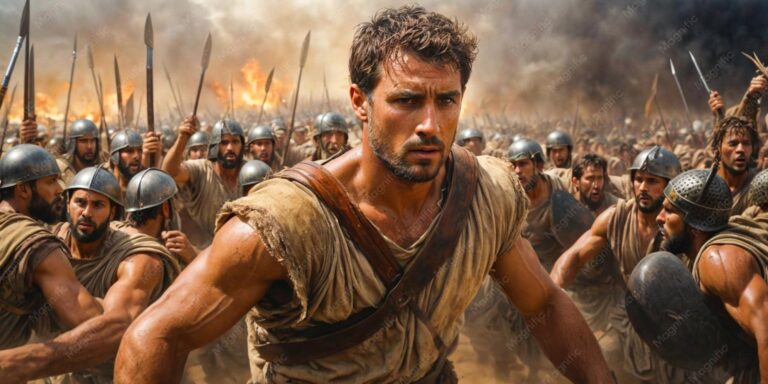
A Troublemaker Named Sheba: Cut Off The Head Of Sheba
WIth A Troublemaker Named Sheba, that divided Israel and challenged King David. Pride, deception, and discontent turned a troubled nation toward conflict. Yet God’s purposes continued despite human rebellion. This chapter reveals the consequences of following division instead of wisdom, while showing mercy toward a city that chose wisdom—and reminding us that God’s covenant and redemption plan continue through every battle.
Obedience, God’s Covenant, Judgment, Deceit, Pride, Redemption Plan, Faith, Jesus Christ
God’s Story Unfolds
📖 2 Samuel 20:1-2 (NIV)
“20 Now a troublemaker named Sheba son of Bikri, a Benjamite, happened to be there. He sounded the trumpet and shouted,
“We have no share in David,
no part in Jesse’s son!
Every man to his tent, Israel!”
“2 So all the men of Israel deserted David to follow Sheba son of Bikri. But the men of Judah stayed by their king all the way from the Jordan to Jerusalem.”
The story of Sheba begins with a single voice of division. After David had returned to Jerusalem, Israel was not completely united. Sheba, a Benjamite, used that division to challenge David and pull the people away from their king. His words were simple, but their consequences were serious: “We have no share in David.”
Sheba’s rebellion reminds us that division can begin with words, pride can turn into rebellion, and rebellion can quickly become destructive. Yet throughout this chapter, God continues to preserve His people and establish order.
This is another part of David’s story, but it also points toward a greater truth. Human kingdoms can experience rebellion, conflict, and division. God’s kingdom cannot ultimately be defeated. His redemption plan continues forward until the rightful King, Jesus Christ, reigns.
A Troublemaker Can Turn Division Into Rebellion
📖 2 Samuel 20:3 (NIV)
“3 When David returned to his palace in Jerusalem, he took the ten concubines he had left to take care of the palace and put them in a house under guard. He provided for them but had no sexual relations with them. They were kept in confinement till the day of their death, living as widows.”
Sheba did not need a large army to begin his rebellion. He needed a message that appealed to existing division.
He sounded the trumpet and declared:
We have no share in David, no part in Jesse’s son!
The people of Israel responded by following him, while the men of Judah remained with David.
This shows how quickly division can become rebellion. A person may begin by questioning leadership, but if pride takes control, questioning can become rejection, and rejection can become rebellion.
Sheba understood the weakness of a divided people and used it for his own purposes.
The lesson is important: we should be careful about voices that divide rather than heal.
God desires His people to walk in truth, faith, and unity. Division can make people vulnerable to deception.
Pride Can Make A Person Fight Against What God Has Established
📖 2 Samuel 20:4 (NIV)
“4Then the king said to Amasa, “Summon the men of Judah to come to me within three days, and be here yourself.”
Sheba lifted his hand against David, the king whom God had established over Israel.
The problem was not simply that Sheba disagreed with David. He attempted to separate Israel from its king.
Pride often begins with the belief that our judgment is better than everyone else’s. Eventually, pride can convince a person that God’s order should be replaced with their own.
The Bible repeatedly warns us about pride because pride changes the direction of the heart.
Sheba’s rebellion ultimately accomplished nothing lasting. His attempt to establish himself ended with his death.
Human pride may appear powerful for a season, but it cannot overcome God’s purposes.
Judgment Follows Rebellion And Deceit – A Troublemaker Named Sheba
📖 2 Samuel 20:5-8 (NIV)
“5 But when Amasa went to summon Judah, he took longer than the time the king had set for him.”
“6 David said to Abishai, “Now Sheba son of Bikri will do us more harm than Absalom did. Take your master’s men and pursue him, or he will find fortified cities and escape from us.”[a] 7 So Joab’s men and the Kerethites and Pelethites and all the mighty warriors went out under the command of Abishai. They marched out from Jerusalem to pursue Sheba son of Bikri.”
“8 While they were at the great rock in Gibeon, Amasa came to meet them. Joab was wearing his military tunic, and strapped over it at his waist was a belt with a dagger in its sheath. As he stepped forward, it dropped out of its sheath.”
David recognized the danger Sheba represented and sent his men to pursue him.
David understood that allowing the rebellion to continue would create even greater harm.
Eventually, Sheba reached Abel Beth Maakah and took refuge within the city. Joab and his army surrounded the city and began preparing to destroy its defenses.
But a wise woman intervened.
She understood something important: the city did not need to die for the rebellion of one man.
She asked Joab why he would destroy a city that was considered peaceful and faithful in Israel.
Joab explained that they were not seeking the destruction of the city. They wanted Sheba.
The woman then went to the people with her wisdom, and they acted.
Sheba’s head was thrown over the wall.
The rebellion ended.
There is a sobering lesson here. Sin may begin with one decision, but its consequences can spread far beyond the person who commits it.
God’s judgment is not arbitrary. He sees the rebellion, the deception, the motives, and the consequences.
Wisdom Can Stop Destruction – A Troublemaker Named Sheba
📖 2 Samuel 20:9-14 (NIV)
One of the most remarkable parts of this chapter is that the city was saved through the wisdom of one woman.
The army was prepared for battle. The city was under siege. Destruction appeared close.
But she spoke.
She did not meet violence with greater violence. She appealed to reason and wisdom.
She recognized that one man’s rebellion should not result in the destruction of an entire community.
Her actions remind us that God can use unexpected people to accomplish His purposes.
We should never underestimate the value of wisdom, courage, and peaceful words.
“A gentle answer turns away wrath.”
Sometimes the greatest victory is not won by the strongest person in the room, but by the person willing to speak wisdom when everyone else is preparing for destruction.
God Preserves His People Through Conflict – A Troublemaker Named Sheba
📖 2 Samuel 20:18-20 (NIV)
“18 She continued, “Long ago they used to say, ‘Get your answer at Abel,’ and that settled it. 19 We are the peaceful and faithful in Israel. You are trying to destroy a city that is a mother in Israel. Why do you want to swallow up the Lord’s inheritance?”
“20 “Far be it from me!” Joab replied, “Far be it from me to swallow up or destroy!”
David’s kingdom had experienced enormous conflict.
Absalom had rebelled.
Israel had divided.
Sheba had rebelled.
Joab had killed Amasa.
Yet David’s kingdom continued.
This does not mean every action of David or his commanders was righteous. The chapter contains violence, deception, political conflict, and death.
But through all of it, God continued to preserve Israel.
This is important when we look at God’s larger story.
God’s people often passed through difficult circumstances, but His covenant purposes continued.
Human beings could make terrible choices. Leaders could fail. Families could be divided. Enemies could rise.
Still, God’s plan did not stop.
The same principle continues throughout Scripture: circumstances change, people fail, kingdoms rise and fall, but God’s purposes remain.
The True King Must Bring Lasting Unity
📖 2 Samuel 20:21-26 (NIV)
” 21 That is not the case. A man named Sheba son of Bikri, from the hill country of Ephraim, has lifted up his hand against the king, against David. Hand over this one man, and I’ll withdraw from the city.”
The woman said to Joab, “His head will be thrown to you from the wall.”
“22 Then the woman went to all the people with her wise advice, and they cut off the head of Sheba son of Bikri and threw it to Joab. So he sounded the trumpet, and his men dispersed from the city, each returning to his home. And Joab went back to the king in Jerusalem.”
“23 Joab was over Israel’s entire army; Benaiah son of Jehoiada was over the Kerethites and Pelethites; 24 Adoniram[c] was in charge of forced labor; Jehoshaphat son of Ahilud was recorder; 25 Sheva was secretary; Zadok and Abiathar were priests; 26 and Ira the Jairite[d] was David’s priest.”
Sheba’s cry was essentially a rejection of David’s kingship:
We have no share in David.
The rebellion reveals something about humanity. People have repeatedly struggled with God’s authority and with the authority of the kings and rulers God allowed to govern.
But the Bible points toward a King whose kingdom will not be destroyed.
Jesus Christ is that King.
David’s kingdom was temporary. Israel experienced rebellion and division even under David.
Jesus brings the promise of a kingdom that cannot ultimately be overthrown.
The story of Sheba therefore becomes more than an ancient political rebellion. It becomes another reminder that humanity needs a righteous King.
Our ultimate hope is not found in earthly leadership, political power, armies, wealth, or human strength.
Its hope is found in Jesus Christ.
God’s Covenant Stands
Sheba’s rebellion could not cancel God’s covenant.
Israel experienced division, betrayal, war, and internal conflict, yet God’s promises continued.
God had made His covenant with David, and the rebellion of one man could not erase what God had established.
This is one of the strongest lessons throughout David’s story:
God’s promises do not depend upon human circumstances being perfect.
Plans may fail.
There people may rebel.
They may be deceived.
Reople may turn against one another.
But God remains faithful.
His covenant continues moving through history toward the fulfillment of His greater redemption plan.
The story of David ultimately points beyond David himself.
God’s covenant was leading toward the promised Messiah.
What This Teaches Us
Sheba’s story teaches us to be careful about the voices we follow.
Not every voice that sounds confident is speaking truth.
Deceit, not every person who promises change has a righteous purpose.
Don’t let every disagreement become division.
And not every opportunity to gain power should be pursued.
We should examine our hearts for pride, deception, bitterness, and rebellion.
At the same time, this chapter teaches us the importance of wisdom.
One wise woman helped prevent an entire city from being destroyed.
Her courage reminds us that we should not remain silent when truth, peace, and innocent people are at risk.
We also learn that God can bring order out of situations that appear completely broken.
Its people create division, God can still preserve His purposes.
Where kingdoms are shaken, God remains King.
When humanity fails, God’s redemption plan continues.
Every Story Leads to Jesus Christ
The Bible is filled with stories of kings, battles, rebellion, judgment, mercy, failure, and redemption.
Sheba’s rebellion shows humanity’s continuing struggle with authority and kingship.
David’s kingdom could be challenged.
Its kingdom could be divided.
His kingdom could be threatened.
But the story points us toward a greater King.
Jesus Christ came not merely to establish an earthly kingdom, but to bring people back to God.
Where rebellion separates, Jesus brings reconciliation.
Where sin brings judgment, Jesus offers redemption.
Then pride says, “We have no share in the king,” Jesus invites us into His kingdom.
Then humanity continues to fail, Christ remains faithful.
The story of Sheba ends with the rebellion silenced.
The greater story of Scripture points toward the day when every rebellion against God’s kingdom will finally end and Jesus Christ will reign as King.
Where the earthly kingdom of David could be challenged, but the kingdom of Jesus Christ cannot ultimately be defeated.