Pride and obedience stand in direct conflict as Pharaoh continues resisting God’s command to let Israel go, Snare to Us. Despite devastating plagues of locusts and darkness, his hardened heart refuses to surrender. Egypt suffers under judgment while God’s covenant people remain protected, living in light while darkness covers the land. Pharaoh’s own officials recognize the destruction and plead for change, yet his ego blinds him to the truth. Through it all, God’s redemption plan moves forward exactly as He promised.
God’s Covenant, Obedience, Redemption Plan, Pharaoh’s Pride, Ego, Locusts, Darkness, Worship, Judgment, Protection
📖 Exodus 10:1 (NIV)
“10 Then the Lord said to Moses, “Go to Pharaoh, for I have hardened his heart and the hearts of his officials so that I may perform these signs of mine among them “
The struggle between Pharaoh and the Lord had reached a critical point.
Again God commanded:
“Let my people go, so that they may worship me.”
Yet Pharaoh continued resisting.
Exodus 10 reveals two devastating plagues—the plague of locusts and the plague of darkness. Both exposed Pharaoh’s pride, his ego, and his unwillingness to humble himself before God.
While Egypt suffered increasing judgment, Israel remained protected. God’s covenant promises continued moving forward exactly as He had planned. Pharaoh’s resistance could delay obedience, but it could never stop God’s redemption plan.
📖 Exodus 10:2-3 (NIV)
“2 that you may tell your children and grandchildren how I dealt harshly with the Egyptians and how I performed my signs among them, and that you may know that I am the Lord.”
“3 So Moses and Aaron went to Pharaoh and said to him, “This is what the Lord, the God of the Hebrews, says: ‘How long will you refuse to humble yourself before me? Let my people go, so that they may worship me.”
The Lord told Moses that these events would serve a greater purpose than simply confronting Pharaoh.
Future generations would hear the story.
Children and grandchildren would learn how God displayed His power over Egypt and revealed Himself as the true Lord.
These signs were not random acts of judgment.
They were divine demonstrations of God’s authority and faithfulness.
The Lord was building a testimony that would be remembered for generations.
📖 Exodus 10:4–6 (NIV)
“4 If you refuse to let them go, I will bring locusts into your country tomorrow. 5 They will cover the face of the ground so that it cannot be seen. They will devour what little you have left after the hail, including every tree that is growing in your fields. 6 They will fill your houses and those of all your officials and all the Egyptians—something neither your parents nor your ancestors have ever seen from the day they settled in this land till now.’” Then Moses turned and left Pharaoh.”
Moses and Aaron returned to Pharaoh with a direct question from God:
“How long will you refuse to humble yourself before me?”
The issue was no longer lack of evidence.
Pharaoh had witnessed miracle after miracle.
The issue was pride.
God warned that if Pharaoh continued refusing to obey, locusts would cover Egypt and destroy everything the hailstorm had left behind.
The warning was clear.
The choice was simple.
Obey God or face the consequences.
Yet Pharaoh continued to resist.
📖 Exodus 10:7–11 (NIV)
“7 Pharaoh’s officials said to him, “How long will this man be a snare to us? Let the people go, so that they may worship the Lord their God. Do you not yet realize that Egypt is ruined?”
“8 Then Moses and Aaron were brought back to Pharaoh. “Go, worship the Lord your God,” he said. “But tell me who will be going.”
“9 Moses answered, “We will go with our young and our old, with our sons and our daughters, and with our flocks and herds, because we are to celebrate a festival to the Lord.”
“10 Pharaoh said, “The Lord be with you—if I let you go, along with your women and children! Clearly you are bent on evil.[a] 11 No! Have only the men go and worship the Lord, since that’s what you have been asking for.” Then Moses and Aaron were driven out of Pharaoh’s presence.”
Even Pharaoh’s own officials recognized the danger.
They pleaded with him:
“How long will this man be a snare to us?”
Egypt was being ruined.
The nation was suffering because of one man’s stubbornness.
Pharaoh attempted a compromise.
He offered to let only the men go worship.
But Moses refused.
God’s command included everyone.
Young and old.
Sons and daughters.
Flocks and herds.
Partial obedience was not obedience.
Pharaoh rejected God’s terms and drove Moses and Aaron from his presence.
📖 Exodus 10:12–15 (NIV)
“12 And the Lord said to Moses, “Stretch out your hand over Egypt so that locusts swarm over the land and devour everything growing in the fields, everything left by the hail.”
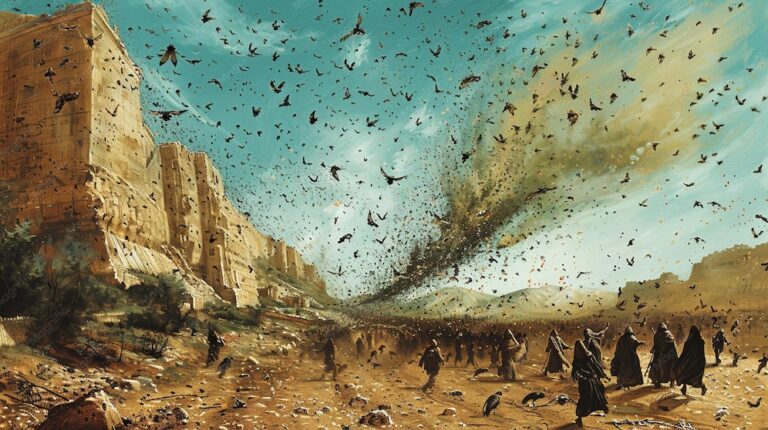
“13 So Moses stretched out his staff over Egypt, and the Lord made an east wind blow across the land all that day and all that night. By morning the wind had brought the locusts; 14 they invaded all Egypt and settled down in every area of the country in great numbers. Never before had there been such a plague of locusts, nor will there ever be again. 15 They covered all the ground until it was black. They devoured all that was left after the hail—everything growing in the fields and the fruit on the trees. Nothing green remained on tree or plant in all the land of Egypt.”
At God’s command, Moses stretched out his staff.
An east wind blew across Egypt.
By morning, locusts covered the land.
They consumed every remaining plant, tree, and crop.
Nothing green survived.
The destruction was unlike anything Egypt had ever experienced.
What the hail had spared, the locusts consumed.
God’s judgment was complete.
Yet Pharaoh still refused to surrender fully to the Lord.
📖 Exodus 10:16–20 (NIV)
“16 Pharaoh quickly summoned Moses and Aaron and said, “I have sinned against the Lord your God and against you. 17 Now forgive my sin once more and pray to the Lord your God to take this deadly plague away from me.”
“18 Moses then left Pharaoh and prayed to the Lord. 19 And the Lord changed the wind to a very strong west wind, which caught up the locusts and carried them into the Red Sea.[b] Not a locust was left anywhere in Egypt. 20 But the Lord hardened Pharaoh’s heart, and he would not let the Israelites go.”
Under pressure, Pharaoh again admitted wrongdoing.
He said:
“I have sinned against the Lord your God and against you.”
He begged Moses to pray for relief.
Moses prayed.
The Lord sent a strong west wind that carried every locust away.
Not one remained in Egypt.
Yet as soon as the crisis ended, Pharaoh’s heart hardened once more.
His words changed temporarily.
His heart did not.
📖 Exodus 10:21–23 (NIV)
“21 Then the Lord said to Moses, “Stretch out your hand toward the sky so that darkness spreads over Egypt—darkness that can be felt.” 22 So Moses stretched out his hand toward the sky, and total darkness covered all Egypt for three days. 23 No one could see anyone else or move about for three days. Yet all the Israelites had light in the places where they lived.”
The Lord then commanded Moses to stretch out his hand toward heaven.
A terrifying darkness covered Egypt.
Scripture describes it as:
“Darkness that can be felt.”
For three days the Egyptians could not see one another.
Normal life stopped.
Fear filled the land.
Yet there was one remarkable exception:
“All the Israelites had light in the places where they lived.”
God once again distinguished His covenant people from Egypt.
Judgment covered Egypt.
Light remained with Israel.
📖 Exodus 10:24–26 (NIV)
“24 Then Pharaoh summoned Moses and said, “Go, worship the Lord. Even your women and children may go with you; only leave your flocks and herds behind.”
“25 But Moses said, “You must allow us to have sacrifices and burnt offerings to present to the Lord our God. 26 Our livestock too must go with us; not a hoof is to be left behind. We have to use some of them in worshiping the Lord our God, and until we get there we will not know what we are to use to worship the Lord.”
Pharaoh attempted another compromise.
This time he offered to let the people go but demanded that their livestock remain behind.
Moses refused.
The Lord deserved complete obedience.
Israel would need their animals for sacrifice and worship.
Moses declared:
“Not a hoof is to be left behind.”
God’s people would leave exactly as God commanded.
Nothing less.
Nothing more.
📖 Exodus 10:27–29 (NIV)
“27 But the Lord hardened Pharaoh’s heart, and he was not willing to let them go. 28 Pharaoh said to Moses, “Get out of my sight! Make sure you do not appear before me again! The day you see my face you will die.”
“29 “Just as you say,” Moses replied. “I will never appear before you again.”
Pharaoh’s heart hardened again.
His pride reached its breaking point.
In anger he told Moses:
“Make sure you do not appear before me again!”
He threatened Moses with death.
Moses calmly replied:
“I will never appear before you again.”
The confrontation was ending.
The final judgment was approaching.
God’s redemption plan was moving toward its climactic moment.
Throughout every plague, God’s covenant remained secure.
The Lord remembered His promises to Abraham, Isaac, and Jacob.
Israel remained protected while Egypt experienced judgment.
God was proving that no king, no nation, and no hardened heart could stop His plans.
Pride prevents people from surrendering to God.
Partial obedience is still disobedience.
God’s covenant promises never fail.
God protects His people even during judgment.
Temporary remorse is not true repentance.
God’s power is greater than any earthly ruler.
Worship requires complete obedience.
No human resistance can stop God’s redemption plan.
Exodus 10 reveals the danger of a heart that refuses to humble itself before God. Pharaoh witnessed the devastation of locusts and the terrifying darkness that covered Egypt. His own officials pleaded with him to surrender, yet his pride remained stronger than his willingness to obey.
Meanwhile, Israel continued to experience God’s protection and favor. While darkness covered Egypt, God’s people walked in the light. The Lord’s covenant promises remained secure, and His redemption plan continued moving forward.
The lesson is timeless: God opposes pride but remains faithful to His promises. Those who humble themselves before Him find light, protection, and deliverance. Those who persist in hardening their hearts eventually discover that God’s purposes cannot be resisted forever.