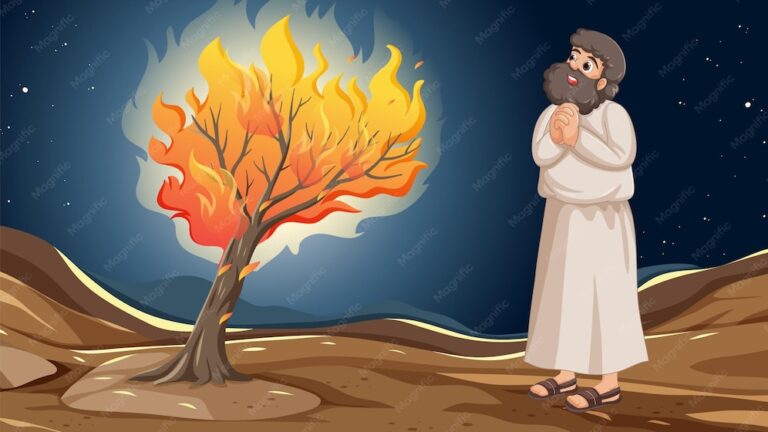
For forty years Moses lived as a shepherd in Midian, far from the palace of Egypt and far from the people he once tried to help. Yet God had not forgotten him, At the burning bush, the Lord revealed His redemption plan, reminding Moses of His covenant with Abraham, Isaac, and Jacob. Though Moses felt inadequate, God promised, “I will be with you.” The God who turns weakness into strength was preparing to lead His people toward a land flowing with milk and honey.
God’s Redemption Plan, Imperfect Leader, Burning Bush, Covenant Promise, God’s Presence, Deliverance, Strength Through Weakness
📖 Exodus 3:1 (NIV)
“3 Now Moses was tending the flock of Jethro his father-in-law, the priest of Midian, and he led the flock to the far side of the wilderness and came to Horeb, the mountain of God. “
📖 Exodus 3:2-4 (NIV)
“2 There the angel of the Lord appeared to him in flames of fire from within a bush. Moses saw that though the bush was on fire it did not burn up. 3 So Moses thought, “I will go over and see this strange sight—why the bush does not burn up.”
“4 When the Lord saw that he had gone over to look, God called to him from within the bush, “Moses! Moses!”
“And Moses said, “Here I am.”
God’s redemption plan often unfolds through people who feel unqualified for the task before them. Moses was no longer living in Pharaoh’s palace. He was a shepherd in Midian, tending flocks far from Egypt and far from the people he once tried to help. Yet God had not forgotten His covenant or His promises. The Lord used every season of Moses’ life to prepare him for this moment. What Moses viewed as failure, God used as preparation. What Moses saw as weakness, God would transform into strength.
📖 Exodus 3: 5-7 (NIV)
“5 “Do not come any closer,” God said. “Take off your sandals, for the place where you are standing is holy ground.” 6 Then he said, “I am the God of your father,[a] the God of Abraham, the God of Isaac and the God of Jacob.” At this, Moses hid his face, because he was afraid to look at God.”
“7 The Lord said, “I have indeed seen the misery of my people in Egypt. I have heard them crying out because of their slave drivers, and I am concerned about their suffering.”
While tending Jethro’s flock near Horeb, Moses noticed an extraordinary sight.
A bush was burning, yet it was not consumed.
As Moses approached, God called to him:
“Moses! Moses!”
The Lord instructed him to remove his sandals because he was standing on holy ground.
God then identified Himself as:
“God of Abraham, the God of Isaac and the God of Jacob.”
The covenant God of Genesis was still present and still working.
The promises made to Abraham had not been forgotten.
📖 Exodus 3:8–11 (NIV)
“8 So I have come down to rescue them from the hand of the Egyptians and to bring them up out of that land into a good and spacious land, a land flowing with milk and honey—the home of the Canaanites, Hittites, Amorites, Perizzites, Hivites and Jebusites. 9 And now the cry of the Israelites has reached me, and I have seen the way the Egyptians are oppressing them. 10 So now, go. I am sending you to Pharaoh to bring my people the Israelites out of Egypt.”
“11 But Moses said to God, “Who am I that I should go to Pharaoh and bring the Israelites out of Egypt?”
The Lord declared that He had seen the suffering of His people in Egypt.
“I have indeed seen the misery of my people.”
The oppression of Egypt had not escaped His notice.
The time for redemption had come.
God revealed His plan to rescue Israel and bring them into:
“A good and spacious land, a land flowing with milk and honey.”
The covenant promises were moving toward fulfillment.
📖 Exodus 3:12-13 (NIV)
“12 And God said, “I will be with you. And this will be the sign to you that it is I who have sent you: When you have brought the people out of Egypt, you[b] will worship God on this mountain.”
“13 Moses said to God, “Suppose I go to the Israelites and say to them, ‘The God of your fathers has sent me to you,’ and they ask me, ‘What is his name?’ Then what shall I tell them?”
Moses immediately focused on his own limitations.
“Who am I that I should go to Pharaoh?”
This question reveals the humility and insecurity that had developed during his years in Midian.
But God did not answer by praising Moses’ abilities.
Instead, God answered with His presence:
“I will be with you.”
The success of God’s mission never depended on Moses’ strength.
It depended on God’s presence.
The Lord often calls imperfect people because His power is displayed through their weakness.
📖 Exodus 3:14-16 (NIV)
14 God said to Moses, “I am who I am.[c] This is what you are to say to the Israelites: ‘I am has sent me to you.’”
15 God also said to Moses, “Say to the Israelites, ‘The Lord,[d] the God of your fathers—the God of Abraham, the God of Isaac and the God of Jacob—has sent me to you.’
“This is my name forever,
the name you shall call me
from generation to generation.”
“’16 “Go, assemble the elders of Israel and say to them, ‘The Lord, the God of your fathers—the God of Abraham, Isaac and Jacob—appeared to me and said: I have watched over you and have seen what has been done to you in Egypt. “
Moses asked what he should tell Israel when they questioned who had sent him.
God answered:
“I AM WHO I AM.”
The eternal God needed no introduction.
He is self-existent, unchanging, and sovereign over all things.
The same God who walked with Abraham, Isaac, and Jacob would now deliver Israel.
His name would be remembered throughout every generation.
This was not a new god appearing on the scene.
This was the covenant God fulfilling His promises.
📖 Exodus 3:17–22 (NIV)
“17 And I have promised to bring you up out of your misery in Egypt into the land of the Canaanites, Hittites, Amorites, Perizzites, Hivites and Jebusites—a land flowing with milk and honey.’”
“18 “The elders of Israel will listen to you. Then you and the elders are to go to the king of Egypt and say to him, ‘The Lord, the God of the Hebrews, has met with us. Let us take a three-day journey into the wilderness to offer sacrifices to the Lord our God.’ 19 But I know that the king of Egypt will not let you go unless a mighty hand compels him. 20 So I will stretch out my hand and strike the Egyptians with all the wonders that I will perform among them. After that, he will let you go.”
“21 “And I will make the Egyptians favorably disposed toward this people, so that when you leave you will not go empty-handed. 22 Every woman is to ask her neighbor and any woman living in her house for articles of silver and gold and for clothing, which you will put on your sons and daughters. And so you will plunder the Egyptians.”
God instructed Moses to gather the elders of Israel and announce the coming deliverance.
The Lord promised:
The elders would listen.
Egypt’s king would resist.
God’s mighty hand would intervene.
Israel would leave Egypt free.
The people would not leave empty-handed.
God even revealed that the Egyptians would provide silver, gold, and clothing for Israel.
Before the first plague occurred, God already knew the outcome.
The redemption plan was completely under His control.
Moses likely believed his life had taken a wrong turn.
He had fled Egypt as a fugitive.
He spent decades caring for sheep in the wilderness.
Yet every experience prepared him for leadership.
The palace taught him about Egypt.
The wilderness taught him humility.
Family life taught him responsibility.
The shepherd’s staff would soon become an instrument in God’s hand.
God often prepares His servants long before they understand their calling.
God’s covenant promises never fail.
God sees the suffering of His people.
God’s timing is always perfect.
The Lord often calls imperfect people to accomplish great purposes.
God’s presence is more important than personal ability.
Weakness becomes strength when surrendered to God.
Every season of life can be preparation for future service.
God’s redemption plan cannot be stopped by earthly rulers.
God always finishes what He begins.
Moses stood before a burning bush feeling unqualified, uncertain, and inadequate. Yet God was not looking for a perfect leader. He was looking for a willing servant. The Lord had been preparing Moses through every success, failure, challenge, and disappointment.
The promise that changed everything was simple:
“I will be with you.”
That promise carried Moses through Pharaoh’s resistance, the plagues, the Red Sea, and the wilderness journey. It remains one of the greatest promises in Scripture. God’s redemption plan moves forward not because of human strength, but because the Lord Himself goes before His people. The God who remembered His covenant in Egypt is still the God who fulfills His promises today.