God’s work is often accomplished through willing hearts, obedient hands 603000 Men Remember Sabbath and people using the talents He provides. As Israel followed God’s guidance, every offering, skill, and act of service helped fulfill His covenant purposes and advance His redemption plan for generations to come.
📖 Exodus 38:1-3 (NIV)
“38 They[a] built the altar of burnt offering of acacia wood, three cubits[b] high; it was square, five cubits long and five cubits wide.[c] 2 They made a horn at each of the four corners, so that the horns and the altar were of one piece, and they overlaid the altar with bronze. 3 They made all its utensils of bronze—its pots, shovels, sprinkling bowls, meat forks and firepans. “
The construction of the Tabernacle was not simply a building project. It was part of God’s covenant relationship with Israel and a visible reminder that His presence would dwell among His people.
Through obedience, the people demonstrated their trust in God’s leadership and His plan for redemption.
📖 Exodus 38:4-8 (NIV)
“4 They made a grating for the altar, a bronze network, to be under its ledge, halfway up the altar. 5 They cast bronze rings to hold the poles for the four corners of the bronze grating. 6 They made the poles of acacia wood and overlaid them with bronze. 7 They inserted the poles into the rings so they would be on the sides of the altar for carrying it. They made it hollow, out of boards.8 They made the bronze basin and its bronze stand from the mirrors of the women who served at the entrance to the tent of meeting.”
The altar of burnt offering was built from acacia wood and overlaid with bronze. It became the place where sacrifices would be offered before the Lord. This altar reminded Israel that approaching a holy God required atonement, sacrifice, and obedience.
The Tabernacle required more than materials. It required wisdom, craftsmanship, and skilled workers.
God had already chosen Bezalel and Oholiab, along with many others, to use their abilities for His purposes. Their talents were not accidents; they were gifts from God designed to accomplish His work.
📖 Exodus 38:9-15 (NIV)
“9 Next they made the courtyard. The south side was a hundred cubits[d] long and had curtains of finely twisted linen, 10 with twenty posts and twenty bronze bases, and with silver hooks and bands on the posts. 11 The north side was also a hundred cubits long and had twenty posts and twenty bronze bases, with silver hooks and bands on the posts.
12 The west end was fifty cubits[e] wide and had curtains, with ten posts and ten bases, with silver hooks and bands on the posts. 13 The east end, toward the sunrise, was also fifty cubits wide. 14 Curtains fifteen cubits[f] long were on one side of the entrance, with three posts and three bases, 15 and curtains fifteen cubits long were on the other side of the entrance to the courtyard, with three posts and three bases. “
These craftsmen served as builders, designers, engravers, and teachers. Their work demonstrates that God often accomplishes extraordinary tasks through ordinary people who faithfully use the abilities He provides.
The lesson remains true today: God equips His people with unique talents so they can serve His kingdom and help others grow.
The people willingly brought gold, silver, bronze, wood, fabric, and other materials for the Tabernacle.
These offerings represented gratitude for God’s protection, provision, and deliverance from Egypt. What once may have been viewed as personal possessions became tools for God’s purposes.
📖 Exodus 38:16-22 (NIV)
“16 All the curtains around the courtyard were of finely twisted linen. 17 The bases for the posts were bronze. The hooks and bands on the posts were silver, and their tops were overlaid with silver; so all the posts of the courtyard had silver bands.”
“18 The curtain for the entrance to the courtyard was made of blue, purple and scarlet yarn and finely twisted linen—the work of an embroiderer. It was twenty cubits[g] long and, like the curtains of the courtyard, five cubits[h] high, 19 with four posts and four bronze bases. Their hooks and bands were silver, and their tops were overlaid with silver. 20 All the tent pegs of the tabernacle and of the surrounding courtyard were bronze.”
21 These are the amounts of the materials used for the tabernacle, the tabernacle of the covenant law, which were recorded at Moses’ command by the Levites under the direction of Ithamar son of Aaron, the priest. 22 (Bezalel son of Uri, the son of Hur, of the tribe of Judah, made everything the Lord commanded Moses;
The detailed accounting of the materials reveals God’s order and accountability. Nothing was wasted. Everything had a purpose.
The contributions of thousands of individuals combined into something far greater than any one person could accomplish alone.
One unique item in the Tabernacle was the bronze basin.
📖 Exodus 38:23-25 (NIV)
“23 with him was Oholiab son of Ahisamak, of the tribe of Dan—an engraver and designer, and an embroiderer in blue, purple and scarlet yarn and fine linen.) 24 The total amount of the gold from the wave offering used for all the work on the sanctuary was 29 talents and 730 shekels,[i] according to the sanctuary shekel.”
“25 The silver obtained from those of the community who were counted in the census was 100 talents[j] and 1,775 shekels,[k] according to the sanctuary shekel”
The basin was made from the mirrors of the women who served at the entrance to the Tent of Meeting. What once reflected physical appearance became part of a sacred instrument used for cleansing.
This transformation reminds us that God can take what we possess and use it for something far greater when it is surrendered to Him.
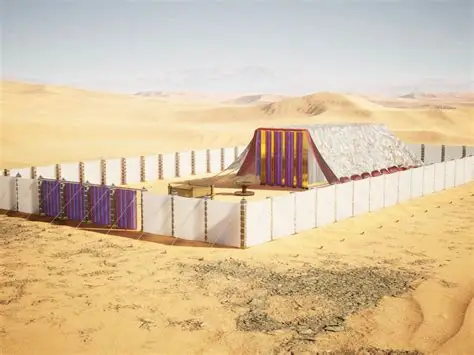
The courtyard surrounding the Tabernacle created a defined and holy space where worship would occur.
📖 Exodus 38:26- 28 (NIV)
’26 one beka per person, that is, half a shekel,[l] according to the sanctuary shekel, from everyone who had crossed over to those counted, twenty years old or more, a total of 603,550 men. 27 The 100 talents of silver were used to cast the bases for the sanctuary and for the curtain—100 bases from the 100 talents, one talent for each base. 28 They used the 1,775 shekels to make the hooks for the posts, to overlay the tops of the posts, and to make their bands.”
Every curtain, post, base, hook, and peg was carefully crafted according to God’s instructions. The beauty and order of the Tabernacle reflected the holiness of the God who would dwell among His people.
Nothing about the structure was random. Every detail pointed toward God’s covenant, His presence, and His ongoing redemption plan.
One remarkable detail recorded in Exodus is the census of the people.
📖 Exodus 38:29-31 (NIV)
“29 The bronze from the wave offering was 70 talents and 2,400 shekels.[m] 30 They used it to make the bases for the entrance to the tent of meeting, the bronze altar with its bronze grating and all its utensils, 31 the bases for the surrounding courtyard and those for its entrance and all the tent pegs for the tabernacle and those for the surrounding courtyard.”
A total of 603,550 men contributed through the census offering. This represented a nation working together under God’s direction.
The Tabernacle was not built by one leader alone. Moses provided leadership. Skilled workers applied their talents. The people brought offerings. Together they completed the task God had assigned.
This demonstrates the power of unity when people follow God’s guidance.
God gives different talents to different people for His purposes.
Obedience is often demonstrated through faithful service.
Every contribution matters, regardless of size.
God values accountability and stewardship.
Leadership and teamwork are essential for accomplishing God’s work.
Worship involves both sacrifice and service.
God’s redemption plan often advances through ordinary people doing extraordinary things together.
The completion of the Tabernacle was more than a construction project—it was a testimony to what happens when people follow God’s instructions, use their gifts, and work together in unity. Through offerings, craftsmanship, leadership, and obedience, Israel created a place where God’s presence would dwell among them.
The same principle remains true today. God still uses willing hearts, special talents, faithful leaders, and obedient communities to accomplish His purposes. When His people trust Him and contribute what He has given them, seemingly impossible tasks become powerful testimonies of God’s faithfulness and provision.